


Business Sectors
Events
Offshore Support Journal Conference, Middle East 2025
 09 Dec 2025
 DUBAI
DUBAIContents
Register to read more articles.
EPS tanker adds first safety-approved onboard carbon capture, aims to slash CO2
Pacific Cobalt has become the first ship to receive an LR class notation for an onboard carbon capture system that will enable the 2020-built chemical tanker to reduce its CO2 emissions by up to 40%


Eastern Pacific Shipping’s 50,000-dwt MR chemical tanker Pacific Cobalt has become the first ship to receive a special notation from Lloyd’s Register (LR) for its onboard carbon capture and storage (OCCS) system, ensuring it mitigates any safety risks associated with its installation and use.
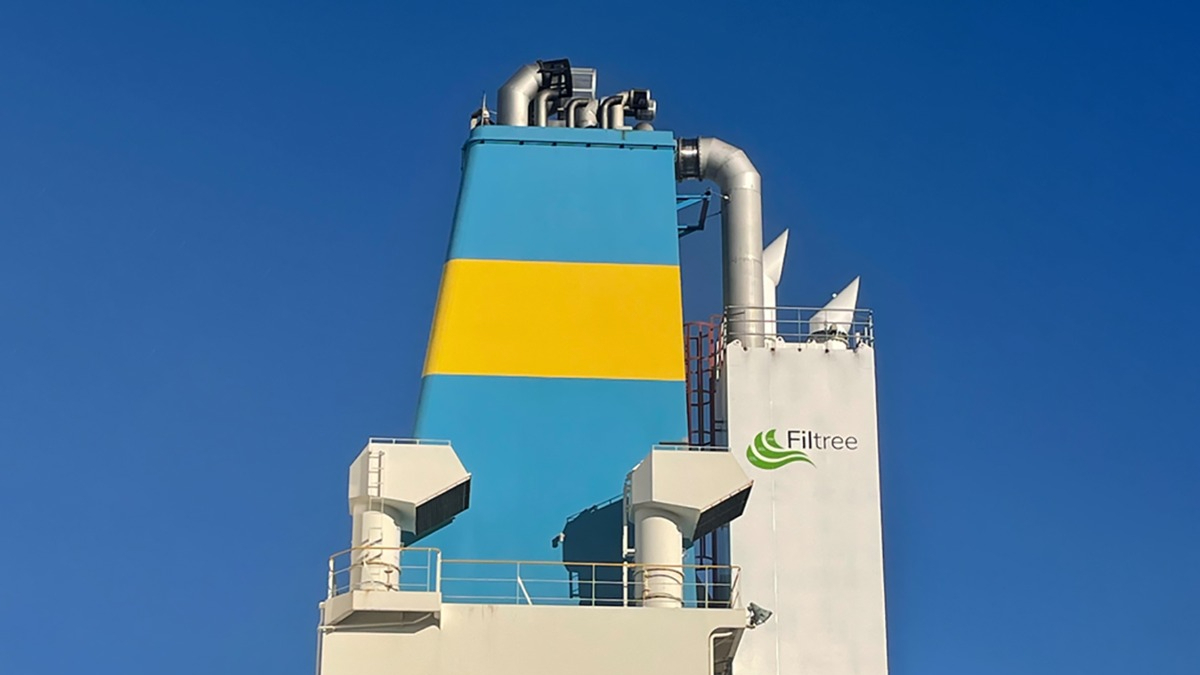
Pacific Cobalt was retrofit with a prefabricated Filtree OCCS system supplied by Value Maritime, which is anticipated to capture up to 40% of CO2 emissions from the ship’s exhaust. Stored in tanks on board, the captured CO2 is offloaded when the ship docks in port.
Rule requirements for the design, construction and installation survey of OCCS are included in the LR class notation Emission Abatement Carbon Capture & Storage (EACCS) (Amine, HFO). Requirements associated with the new class notation address the safety risks that may present to the vessel, covering aspects such as materials, structure, containment, piping, refrigeration plant, electrical, control, safety systems, vessel integration and manufacturing. Requirements associated with the READY descriptive note cover the preparation of a vessel for the future installation and integration of an EACCS, such as structures, layout, interfacing, materials, electrical and safety systems.
LR chief executive Nick Brown called Eastern Shipping “a pioneer in onboard CCS,” noting the “class notation will further support OCCS installations on ships giving industry confidence in the technology’s ability to support shipping’s decarbonisation goals.”
2020-built Pacific Cobalt is one of three EPS MR tankers that have been refitted with OCCS systems, with equipment surveys currently underway on the other two vessels.
EPS chief executive Cyril Ducau said the retrofit of Pacific Cobalt with an exhaust cleaning and carbon capture system was “an important milestone in EPS’s sustainable shipping journey.”
Combining an exhaust gas cleaning system with carbon capture, Value Maritime’s Filtree System flushes 99.9% of SOx emissions and 99.0% of particulate matter from the exhaust gas using seawater. From there the remaining gas, mainly CO2, enters the OCCS system where, as it rises, contacts the chemical compound, amine. The low temperature of the exhaust gas allows part of the CO2 to bind to the amine particles. Although still a gas, the compound behaves like a liquid and is pumped into a storage tank.
This approach reduces the energy requirements for OCC as the CO2 is not liquefied or stored under pressure. When the ship arrives at port, the CO2-saturated amine is pumped out and replaced.
Want to know more about the future of carbon capture and storage? Come meet the experts at CO2 Shipping, Terminals & CCS Conference, Houston, Texas, 16 September 2024.
Related to this Story

Events
Offshore Support Journal Conference, Middle East 2025
09 Dec 2025DUBAI
Maritime Regulations Webinar Week
16 Dec 2025GMT - ONLINE
Maritime Decarbonization Conference, Americas 2026
22 Jan 2026HOUSTON
Offshore Wind Journal Conference 2026
02 Feb 2026London
© 2024 Riviera Maritime Media Ltd.


