


Business Sectors
Events
Offshore Support Journal Conference, Middle East 2025
 09 Dec 2025
 DUBAI
DUBAIContents
Register to read more articles.
Study shows ports are not prepared for captured CO2 offloads
A new study commissioned by the Global Centre for Maritime Decarbonisation (GCMD), in collaboration with Lloyd’s Register and ARUP, has identified low port readiness as a major hurdle bottlenecking the adoption of onboard carbon capture and storage systems as a practical method


The report, Concept study to offload onboard captured CO2 studied 10 planned liquefied CO2 (LCO2) related infrastructure projects worldwide. These projects are likely to handle much larger volumes of captured CO2 than that from onboard carbon capture storage (OCCS) systems; port infrastructure needed for offloading, storing and transporting onboard captured carbon dioxide will likely need to be integrated with these projects for economies of scale.
The carbon chain is still in its infancy, with many of these planned projects yet to reach the final investment decision phase and ports have not proceeded with offloading infrastructure investments.
GCMD said that while the technologies required for offloading onboard captured CO2 exist at high levels of maturity, no safe transfer of captured CO2 by trained personnel has been demonstrated.
While a limited number of ports do possess the infrastructure to offload LCO2, they are primarily designed to handle food-grade CO2 and the higher purity standards that accompany this use limits the interoperability of facilities to handle CO2 captured on board.
Results conclude that introducing LCO2 offloading into already complex port operations will likely impact port efficiency, and the need for additional buffer zones for safety reasons will add to existing space constraints at ports and terminals.
The GCMD study determines that captured CO2 in its liquefied form is likely the most efficient and cost-effective option for onboard storage and transport. But safe offloading requires the appropriate infrastructure, since liquefied CO2 poses unique safety considerations: chiefly asphyxiation and toxicity, if a leak or a loss of containment takes place.
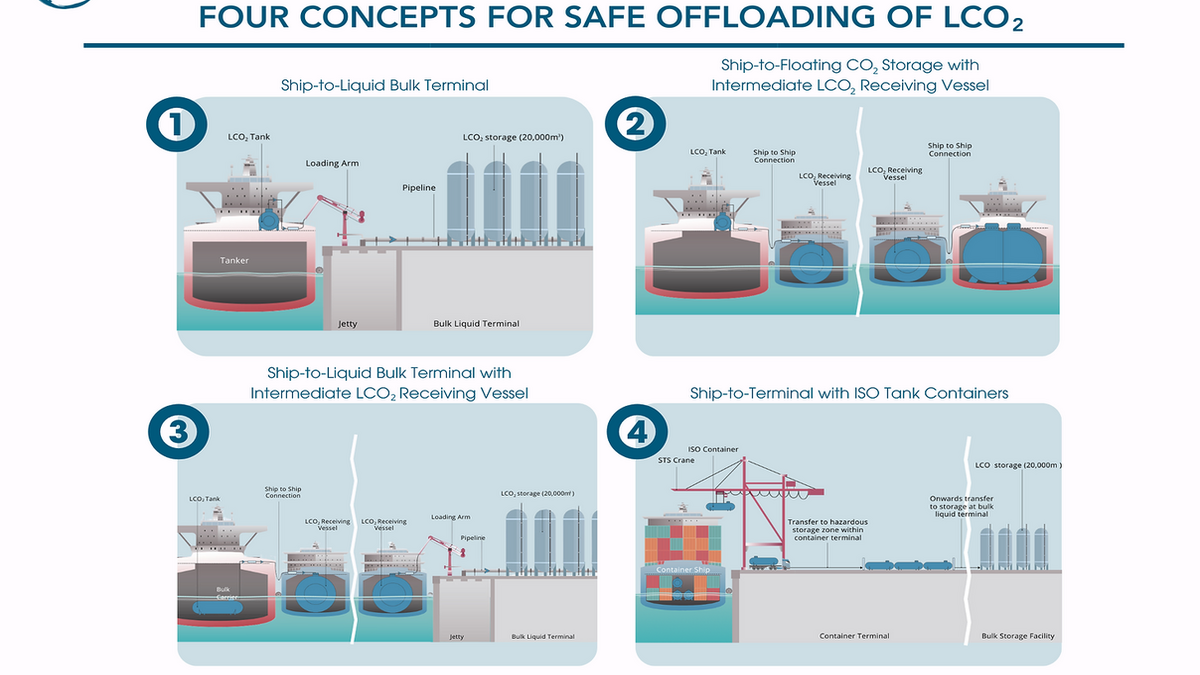
The study shortlists and ranks different offloading methods. Ship-to-ship and ship-to-shore transfers using an intermediate LCO2 receiving vessel was deemed the most promising method for offloading at scale, with captured CO2 eventually sequestered or used as feedstock for manufacturing synthetic fuels.
Ship-to-terminal transfer of captured CO2 stored in ISO tank containers was identified as more compatible at smaller scales and for end uses that require higher grades of CO2. GCMD’s study also believes this method of transfer is also most compatible with existing port infrastructure and therefore easier to pilot today.
Unique to CO2 is evaluation of its storage at conditions near its triple point, where the gaseous, liquid and solid phases of CO2 co-exist. Storage at or near the triple point is sensitive to impurities, and minor changes in temperature and pressure can lead to a phase change from liquid to solid CO2, leading to hazardous situations, such as pipe blockages and pressure build-up. A series of safety studies, including a hazard identification of offloading, simultaneous operations and a coarse quantitative risk analysis were conducted, and mitigation measures and emergency response procedures articulated for handling LCO2.
GCMD chief executive Professor Lynn Loo said, “While pilots have successfully demonstrated numerous capture technologies on board ships, it is still uncertain how captured carbon on merchant ships can be safely offloaded, and what the rest of the value chain looks like. This study sheds light on these challenges, and highlights recommendations to holistically address these concerns for parties interested in advancing OCCS/LCO2 offloading concepts.”
The full study can be accessed here.
Riviera Maritime Media’s CO2 Shipping & Terminals Conference will be held in London, 18 June 2024, click here for more information on this industry-leading event
Related to this Story

Events
Offshore Support Journal Conference, Middle East 2025
09 Dec 2025DUBAI
Maritime Regulations Webinar Week
16 Dec 2025GMT - ONLINE
Maritime Decarbonization Conference, Americas 2026
22 Jan 2026HOUSTON
Offshore Wind Journal Conference 2026
02 Feb 2026London
© 2024 Riviera Maritime Media Ltd.


