


Business Sectors
Events
Offshore Support Journal Conference, Middle East 2025
 09 Dec 2025
 DUBAI
DUBAIContents
Register to read more articles.
Vessel prepared for pioneering methanol conversion
An offshore research vessel’s conversion reaches a critical stage in Q4 2024, when two of its four engines will be swapped out for methanol ones


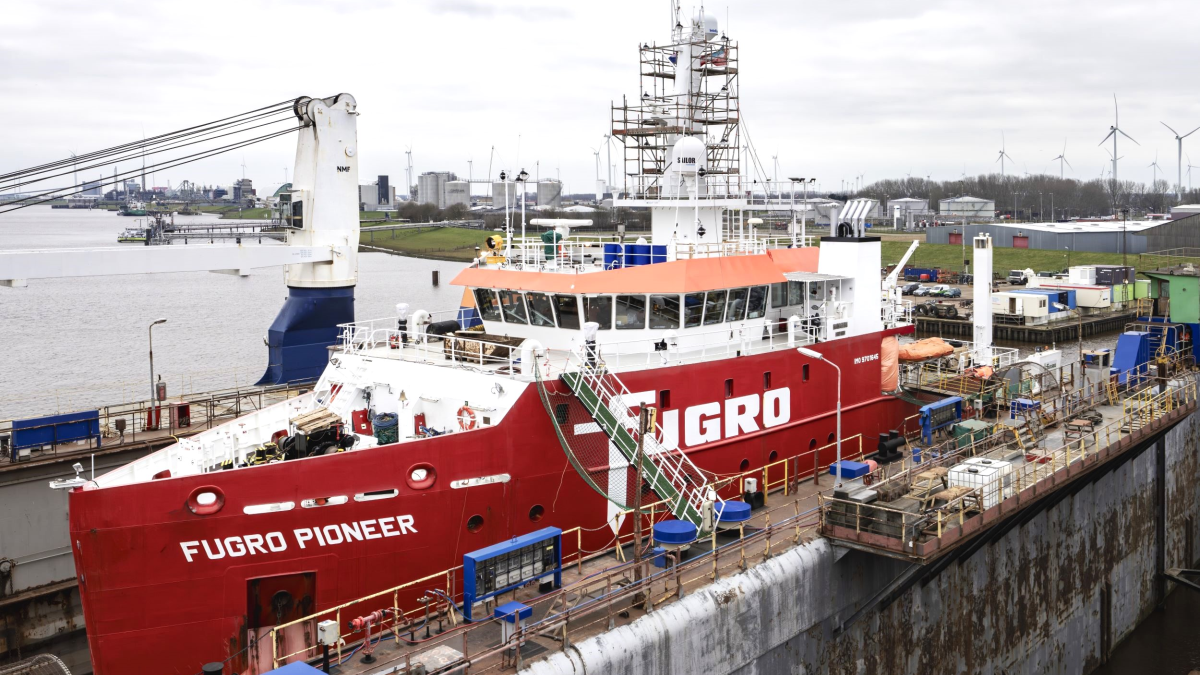
Fugro intends to install methanol engines on its pioneering vessel conversion and replace the alarm and monitoring system this year, ready to demonstrate improved sustainability in offshore surveys.
The Dutch shipowner is converting 2014-built, 1,327-gt research ship Fugro Pioneer to methanol fuel as part of its ambition to become climate neutral by 2035.
This 54-m vessel is being converted in the Netherlands as part of the Fugro-led Methanol as Energy Step Towards Emission-free Dutch Shipping consortium with a grant received at the end of 2021 from the Netherlands Enterprise Agency.
The first phase of this conversion was completed at the Niestern Sander shipyard in Delfzijl, where Fugro Pioneer was prepared for two of the four original marine gas oil (MGO) engines to be swapped with methanol equivalents.
Two of its Caterpillar diesel-burning engines will be replaced with methanol-only Scania engines with ignition enhancements in Q4 2024, while the remaining two engines will continue to run on diesel for the time being, allowing Fugro to offer service in regions where green methanol is not yet available.
“This is an important concrete step by Fugro towards our ambition of climate neutrality by 2035,” said Fugro global director of fleet services Remko Kloos.
“Fugro Pioneer will operate using sustainable methanol fuel and will be equipped with innovative vessel automation to carry out our geotechnical work safely and efficiently worldwide.”
Fugro Pioneer is a survey and research vessel built for collecting geotechnical data about the seabed to prepare for offshore windfarm construction. After the new methanol engines are installed, the ship will be deployed on projects in Europe.
Dutch systems integrator Alewijnse played a key role in the preparation work, covering the electrical engineering and automation necessary for the conversion.
“We are supplying and installing a new alarm monitoring and control system [AMCS] and making adjustments to the power management, fire protection, and closed-circuit TV surveillance systems,” said Alewijnse account manager Jim Stolk.
“An essential part of the work also includes the electrical installation for the new methanol bunkering station, including the placement of fixtures and switches.”
Green methanol significantly reduces CO2 emissions and NOx can be reduced by up to 90% compared with conventional fuels.
Methanol burns more completely than marine gasoil, but both the liquid and vapour forms are highly flammable, meaning extra safety precautions and monitoring are required.
“For this reason, we use special programmable logic controllers (PLCs) to monitor safety and potential fire risks during the combustion process,” explained Mr Stolk.
“We drew on our extensive experience with safety PLCs, which we also regularly apply to industrial projects.”
Alewijnse refit manager Ben Bonte said the five-year maintenance inspection was carried out on Fugro Pioneer and more work is coming.
“Preparations for installing the AMCS are already in full swing,” he said. “Once our engineering team completes the design, we will be able to install the system in the coming months while the ship is at sea.
“Everything on the ship has been prepared for installing the new methanol engines. The actual switch to the new AMCS and the installation of the new methanol engines are scheduled for Q4 of this year.”
Alewijnse has previous experience in converting ships to use alternative fuels.
“Such as Samuel de Champlain. Europe’s first dredging vessel to be converted to a dual-fuel application, the ship’s engines run on both MGO and LNG,” said Alewijnse project manager Bertran Smit. “Other examples are crew transfer vessels Hydrocat 48 and Hydrocat 55, These vessels in the Windcat series run on both diesel and hydrogen.”
Offshore Support Journal Conference, AsiaUse this link for more information
Maritime Decarbonisation, Europe: Conference, Awards & Exhibition 2024address critical environmental issues head-on. Focused on the industry’s energy transition, the conference offers a comprehensive forum for stakeholders across the maritime sector to explore solutions and strategies for achieving low-carbon shipping and zero-emissions shipping.
Related to this Story

Events
Offshore Support Journal Conference, Middle East 2025
09 Dec 2025DUBAI
Maritime Regulations Webinar Week
16 Dec 2025GMT - ONLINE
Maritime Decarbonization Conference, Americas 2026
22 Jan 2026HOUSTON
Offshore Wind Journal Conference 2026
02 Feb 2026London
© 2024 Riviera Maritime Media Ltd.


