


Business Sectors
Business Sectors
Events
Contents

Register to read more articles.
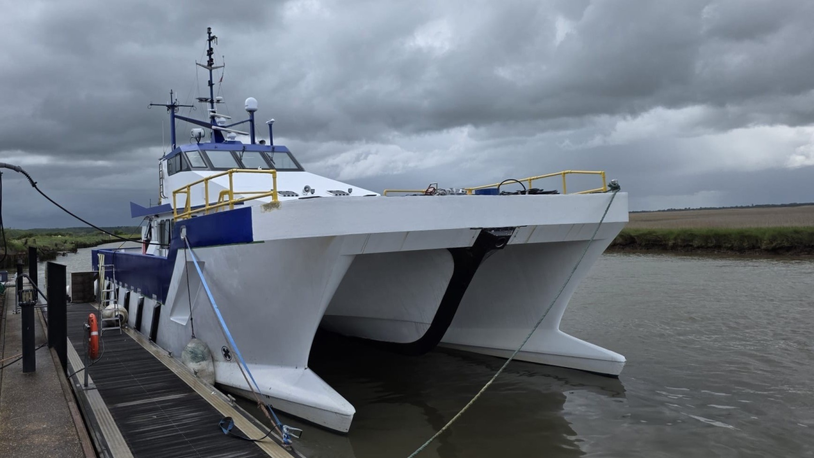
Electric CTV conversion edges towards commissioning
In June 2026, Tidal Transit’s crew transfer vessel (CTV) e-Ginny completed a major refit, ready for commissioning, having been ‘powered up’ for the first time in June 2026


Having completed the refit, e-Ginny has become the world’s first 100% electric, zero-emissions crew transfer vessel and, after months of design, strip-out, rebuild and installation, all of the electrically-powered vessel’s new systems – batteries, propulsion, controls and onboard systems – had been brought together to perform as one.
As one might expect of a first-of-its-kind project using first-of-its-kind technology, including new-generation batteries and electric propulsion, the refit did not go exactly as planned timewise, which meant that the vessel – which was due to make an appearance at Seawork in June – wasn’t able to do so.
As the company also explained, the complexity of the project was such that it led to a much more extensive overhaul than anticipated, and a decision also had to be taken to remove some of the batteries, around 500 kW in total, to reduce weight, which brought e-Ginny to just under 3 MW of onboard energy storage. “The overall reduction in weight actually offsets the lower available energy capacity, meaning range and performance will hardly be affected,” said the company, noting that essential systems such as cabinets, wiring and all the supporting infrastructure needed to make a fully electric CTV operational were heavier than expected.
As regular readers of OWJ will know, the vessel’s old propulsion system has been completely replaced with a quad installation of Volvo Penta IPS 30s paired with fully electric motors and over 3.4 MWh of on-board battery capacity, with the batteries supplied by Corvus.
As well as being emissions-free, e-Ginny will also benefit from seamless movement and control, thanks to the use of forward-facing, individually-steerable drives with twin counter-rotating propellers, delivering better manoeuvrability and a smoother ride. Being electrically, rather than diesel, propelled the level of vibration and noise on the vessel will also be very much lower. Shore-based and offshore charging will provide another benefit too, significantly increasing the range of the vessel and the time it can spend at work, although as Tidal Transit chief executive Leo Hambro told OWJ, although e-Ginny is ready for commissioning, there have been issues getting charging capacity due to the very poor grid connections in Great Yarmouth and Burgh Castle.
“We are due to get the commissioning done starting late-August,” said Mr Hambro. “We hope to start extensive sea trials soon and have had several interesting conversations with charters. We have an MJR offshore charger sitting in a warehouse in Teeside ready to go, along with an Artemis shoreside charger, ready for when we know which port is going to be used, when the grid is available. The refit of e-Ginny has led us to order four newbuild electric architecture CTVs with range extending generators. They will be delivered from late 2027 through 2028.”



Related to this Story

Events

© 2026 Riviera Maritime Media Ltd.


