


Business Sectors
Business Sectors
Events
Contents

Register to read more articles.
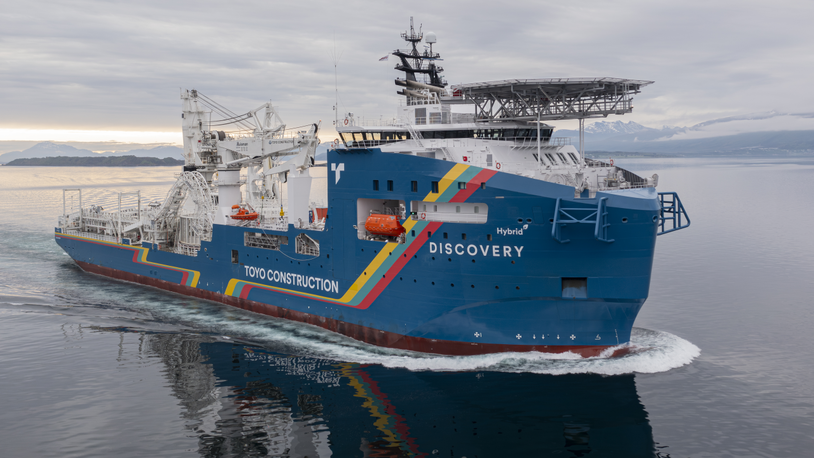
Japanese newbuild is ready for the next wave of offshore wind projects
Vard recently delivered a hybrid cable-laying vessel to Toyo Construction in Japan, a vessel that could have roles other than cable-laying as the offshore wind industry in the country evolves


Delivery took place at Vard Langsten in Norway on 26 July 2026, after which the flexible, environmentally friendly ship set sail for Japan. This was the first vessel the Japanese construction company had ordered from Vard, and the first Vard has delivered to the Japanese windfarm market. In keeping with Vard’s usual approach to construction of offshore vessels, the hull was built at Vard in Tulcea, Romania and it was outfitted and delivered by Vard Langsten in Norway.
Toyo Construction already owns a number of smaller offshore vessels, and wants to position itself for growth in the offshore wind sector in Japan. The company described the new cable-lay vessel, Discovery, as ‘a core asset in its fleet.’
The newbuild is Japan’s largest purpose-built cable-lay vessel and is of Vard 9 15 design, a design developed especially for the client to cater for the requirements of the growing Japanese offshore wind market. It will also be able to operate worldwide. When the vessel was ordered in late 2023, Vard said the vessel would have an optimised hull design to suit conditions offshore Japan, allowing it to be used in shallow water and deep water for floating offshore wind and power transmission projects.
The vessel is prepared for inter-array, HVAC export and interconnector cable installation and for cable burial and construction work. With a length of 150 m and a beam of 28 m it will have a cable carrying capacity of 9,000 tonnes. Classed by Japanese classification society Class NK, Discovery has total installed power of 12,880 kW and will be cable of a speed of knots. It will transport cables in an above-deck carousel with a capacity of 4,000 tonnes and a below-deck carousel of 5,000 tonnes. The vessel has accommodation for 90 people, all in single cabins, a helideck and a four-point mooring system.
In addition to being used as a cable-laying vessel, the newbuild is fitted with a 400-tonne capacity active heave-compensated crane supplied by Huisman, and has a large deck, making it suitable for applications such as work on foundations, moorings for floating wind and other marine-related projects. It will have a four-point mooring system and helideck.
In a statement issued at the time that the vessel was delivered, Toyo Construction said it is equipped with a DP Class 2 dynamic positioning system, ensuring accurate cable installation in challenging conditions. It also highlighted the vessel’s ability to transition between cable-laying mode and construction mode… “allowing it to support the next wave of market needs, such as mooring installation for floating windfarms and HVDC transmission network construction.”
To minimise the new vessel’s environmental footprint it has a 2,000 kWh battery pack, a connection for shore power and an advanced energy management system that will help to reduce CO2, NOx, and SOx emissions.



Related to this Story

Events

© 2026 Riviera Maritime Media Ltd.


