


Business Sectors
Business Sectors
Events
Contents

Register to read more articles.
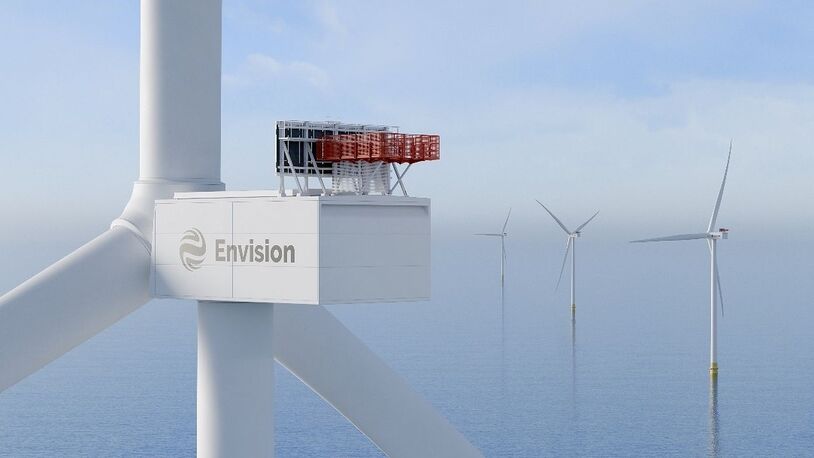
Another Chinese manufacturer targets Europe’s offshore wind industry
China-based Envision Energy has unveiled a large offshore wind turbine, the EN-252/16.7, which it plans to use to target the fast-growing European offshore wind market


The Chinese multinational describes the EN-252/16.7, the latest in a growing number of Chinese wind turbines targeting the European market, as a ‘next-generation offshore wind turbine for high-wind environments and tailored to the requirements of international offshore markets.’
“With 16.7 MW rated power, a high-performance rotor and an integrated powertrain, the new turbine is designed to deliver higher energy production, greater reliability and increased project ROI,” the company said. For suitable site-specific conditions, the turbine can also be uprated, creating further potential to reduce turbine numbers and capital expenditure for the project (CAPEX).
The EN-252/16.7 builds on Envision’s proven Model Z platform and more than a decade of offshore wind development and operational experience.
“The Model Z platform has been in operation since 2023, providing a foundation of operating data and engineering experience for the next generation of offshore turbines,” said Envision. “The EN-252/16.7 is tailored with a Europe-specific high-performance rotor and is being developed through extensive component- and system-level validation. The turbine combines high-capacity generation with vertically integrated key component technologies, advanced safety and grid capabilities, and AI-powered lifecycle monitoring through Envision’s Galileo system.”
Envision executive vice president of offshore wind Christian Schrimpf said, “The next phase of offshore wind is not simply about increasing turbine scale. The real value of scale lies in how effectively it translates into higher energy production, greater reliability and stronger economics across the project lifecycle. With the EN-252/16.7, we are bringing these capabilities together to help customers capture more value from offshore wind over the long term.”
The company said that, with swept-area-to-power ratio of approximately 2.99 square meters per kilowatt, the EN-252/16.7 is designed to increase energy production from high-wind offshore resources. “For a GW-scale offshore windfarm, the turbine can deliver approximately 1-2% higher annual energy production while reducing turbine quantity by around 10% compared with currently available turbines,” the company claimed. It said this will provide an estimated 2-4% reduction in levelized cost of energy (LCOE), depending on site conditions and project configuration.
The EN-252/16.7 is supported by extensive component- and system-level validation through Envision’s in-house testing facilities. Testing includes drivetrain system loading tests and more than 600 hours of highly accelerated life testing for drivetrain, helping capture component boundaries and system interactions under demanding operating conditions.
Reliability is further supported by Envision’s vertically integrated approach to the development and manufacturing of key components. The company has accumulated experience across approximately 12,000 gearboxes, 12,000 main-bearing sets, 25,000 blade sets, 23,000 generators and 28,000 converters.
The EN-252/16.7 is designed to support safe and resilient operation under extreme conditions, including extreme wind events, withstanding a 10-minute average extreme wind speed of up to 58.5 m/s and a three-second gust once in 50-year of up to 82 m/s. Safety is further supported by the turbines integration capability with energy storage.
Combined with Envision BESS, the system can provide long-duration backup power for critical turbine devices and safety-related functions when external grid power is unavailable, including during pre-commissioning and severe storm or typhoon conditions.
The turbine also incorporates grid-forming control, black-start capability and stable operation under weak-grid and grid-fault conditions. Autonomous operating capabilities further support continuous power supply to critical turbine systems when conventional grid support is disrupted, extending resilience from extreme-weather protection to electrical and operational continuity.
The AI-driven Galileo system supports early fault detection and proactive maintenance throughout the turbine lifecycle. Commercially applied across more than 20,000 turbines since 2020, Galileo uses more than 30 functional models to monitor major components and critical failure modes, providing early-warning reports approximately one to six months in advance per different conditions.
“Earlier fault detection supports more timely maintenance planning, helping reduce unplanned interventions and lifecycle operating expenditure,” the company concluded, noting that the turbine also includes an AI-turbine interface to support future upgrades and the continued evolution of intelligent turbine operations.




Related to this Story


Events

Maritime Regulations Webinar Week
 16 Dec 2025
 GMT - ONLINE

Floating energy: successfully unlocking stranded gas using FLNGs and FSRUs
24 Feb 2026GMT - ONLINE
© 2026 Riviera Maritime Media Ltd.


