


Business Sectors
Business Sectors
Events
Contents

Register to read more articles.
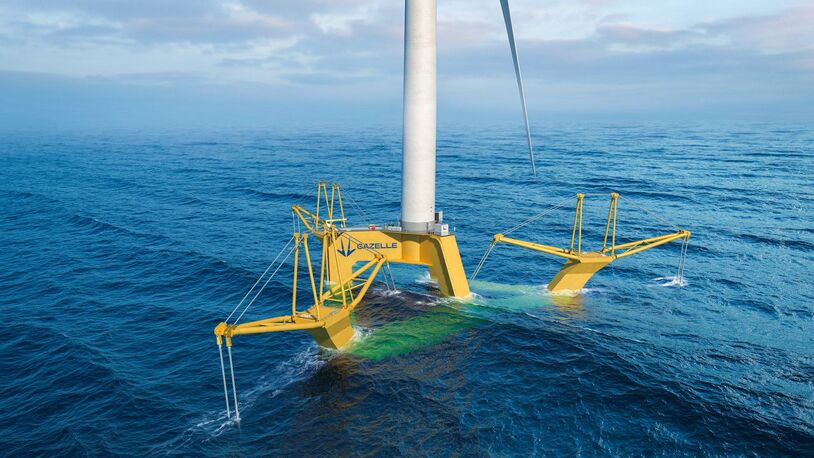
Gazelle Wind Power develops ‘breakthrough’ floating platform for 18 MW+ wind turbines
Gazelle Wind Power has developed and tested what it describes as a ‘breakthrough’ floating platform for wind turbines for extreme offshore conditions


The design is being developed as part of Gazelle’s work with a major Asian utility on a large-scale floating offshore wind development at a typhoon-prone site.
Global performance simulations indicate that Gazelle’s new platform design can support 18 MW+ turbines under severe wind, wave and current conditions.
The company claims that costing exercises also indicate that the new design could deliver 44% lower capex and 52% lower levelised cost of energy than the benchmark semi-submersible designs. These cost reductions are driven by the platform’s lower structural and mooring requirements, compact footprint, modular steel construction and ability to use existing port infrastructure. The design also allows simpler installation and tow-to-port maintenance, reducing reliance on specialist offshore vessels and helping limit downtime, which can increase energy production and lower lifetime operating costs.
The design retains the core principles of Gazelle’s technology, combining a central counterweight with three articulated mooring frames (AMFs) with near-vertical mooring lines to provide passive restoring force as wind, waves and currents act on the platform. This helps control platform motion and mooring loads without an active ballast system.
In the new configuration, Gazelle has refined the platform around a tripod support structure, upgraded AMFs and revised hull geometry. The changes improve hydrodynamic performance, mooring flexibility and load distribution, while reducing structural weight and increasing damage tolerance. Together, they are designed to support larger turbines and commercial-scale deployment.
The study assessed the new design under both normal and extreme environmental conditions, including survival and power-production cases. The platform was assessed for a typhoon-prone site with a 50-year extreme wind speed of 59.8 m/s at a hub height of 155 m and a 50-year significant wave height of 14.2 m.
The simulations showed controlled platform behaviour under these conditions. Roll and pitch angles remained below 5 degrees, while accelerations at the top of the tower and tower-base loads remained within the project’s design criteria.
“These results indicate that Gazelle’s constant-load mooring system can maintain low platform motions while providing lower mooring loads than a tension leg platform and a smaller floater footprint than conventional semi-submersible, barge or spar designs,” the company said.
Gazelle and its client recently completed a basin-test campaign to compare physical test data with the numerical model and support further model calibration. The results will feed into subsequent engineering stages.
Gazelle Wind Power chief technology officer Jason Wormald said, “These results show that Gazelle can scale to the next generation of 18 MW+ turbines without simply making the platform bigger and heavier. Even in extreme offshore conditions, the design maintains strong control of motion and structural loads, reinforcing its potential for commercial-scale deployment.”
Gazelle Wind power chief executive Jon Salazar said, “Gazelle’s technology has always been designed to reduce the material, infrastructure and cost required to deploy floating wind. With this innovative new 18 MW+ design, we are showing that those advantages can be carried into larger turbines and more demanding offshore conditions. With the cost reductions demonstrated by this new design, our technology could help make floating wind viable in places that have previously been too challenging or expensive to develop.”




Related to this Story


Events

Maritime Regulations Webinar Week
 16 Dec 2025
 GMT - ONLINE

Floating energy: successfully unlocking stranded gas using FLNGs and FSRUs
24 Feb 2026GMT - ONLINE
© 2026 Riviera Maritime Media Ltd.


