


Business Sectors
Business Sectors
Events
Contents
Register to read more articles.
Drone inspections cut costs at LNG terminal
Grain LNG set out a drone-and-data approach to civil-asset inspection that improves access, trending and baselining across a large, complex site


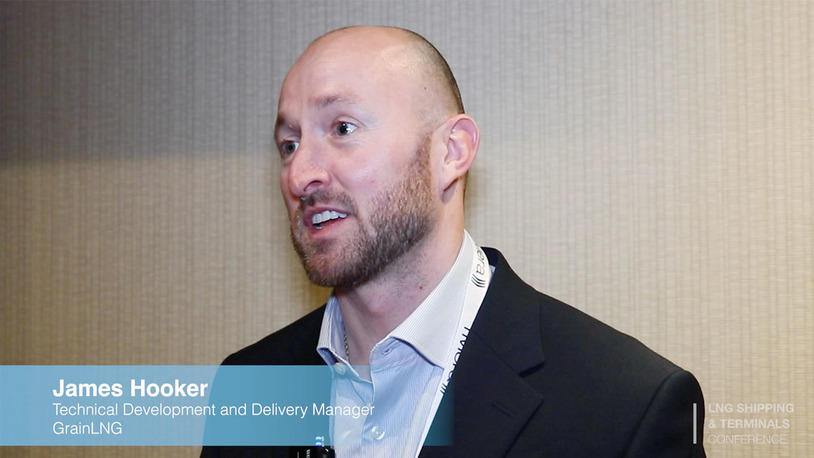
Grain LNG technical development and delivery manager James Hooker describes how drone inspections changed the way its civil-asset base was managed, replacing predominantly manual access with a data-led programme for condition baselining and trend analysis.
Speaking immediately after his session at the LNG Shipping & Terminals conference in London in October 2025, he outlined the approach and its benefits.
Mr Hooker set the scale: the terminal covers about 600 acres and contains roughly 70,000 assets, ranging from buildings and structures to tanks, many of which are difficult or costly to reach.
Drone imagery allows the team to establish an initial baseline and then track change over time, replacing ad-hoc, manual surveys with a structured cycle.
“Drones, in particular, changed how we manage civil asset base,” he said.
Operations use third-party pilots because of the specific safety and airspace requirements on an LNG site.
Imagery and video captured by the flights is ingested into a common platform that stores the datasets and trends them through time. The platform produces visual records that support decision-making and allow the organisation to identify deterioration, prioritise interventions and, where appropriate, defer intrusive work until evidence supports it.
To mitigate the inherent ’what you can see’ limitation of aerial surveys, the terminal complemented top-down drone imagery with a bottom-up layer of fixed ground cameras at selected data points. That pairing creates a more granular model of assets and their behaviour between flight cycles.
Mr Hooker described this as a “top down, bottom up approach,” noting it provides a richer, time-series view that would have been impractical to assemble with scaffolds or rope access alone. The programme is part of a broader technology journey over recent years, embedding new tools and workflows to improve inspection repeatability, reduce costs and improve safety around access, he said.
While specific savings figures were not disclosed in the interview, Mr Hooker stated that the drone-enabled regime produced “significant cost savings,” particularly where traditional access would have been extensive.
Sign up for Riviera’s series of technical and operational webinars and conferences:
- Register to attend by visiting our events page.
- Watch recordings from all of our webinars in the webinar library.
- To take part in the webinars, contact brand manager Ian Pow (Ian.Pow@rivieramm.com)
Events
© 2026 Riviera Maritime Media Ltd.


