


Business Sectors
Business Sectors
Events
Contents
Wind-assisted propulsion on LNG carriers faces challenges
Bureau Veritas global market leader gas carriers Carlos Guerrero outlines wind-assisted options and highlights routeing, visibility, stability and deck-reinforcement constraints


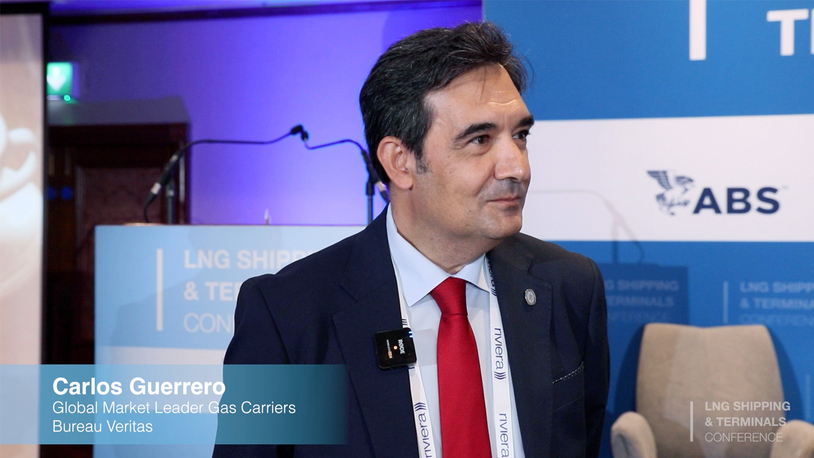
Wind-assisted propulsion on LNG carriers is technically feasible but constrained by operational and safety considerations, according to Bureau Veritas global market leader gas carriers, Carlos Guerrero, in an interview recorded during day two of LNG Shipping & Terminals 2025 Conference in October 2025.
He addressed technology selection, routeing and installation issues, and stated the performance of such systems depends on meteorological conditions and navigational planning rather than the devices alone.
Mr Guerrero said wind propulsion solutions are available for different ship types but still await deployment on LNG carriers.
He added navigational aids are important for LNG trades with long ocean passages.
On device choices, he referred to comparative work looking at sails and rotating rotors to examine safety cases including bridge visibility, navigation risks and installation impact.
He said it is not yet a realistic solution for any type of ship, emphasising practical deployment would still require case-by-case assessment.
He also noted the potential for stability and visibility implications with equipment mounted on the trunk deck and the need to consider hazardous-area interfaces for devices driven by electric motors.
He said reinforcement requirements for deck foundations could make retrofits challenging and costly if not foreseen at the newbuilding stage, arguing that designing LNG carriers to be “ready for future installation” would reduce downtime and engineering complexity when owners elected to add wind devices later.
Mr Guerrero discussed trades that could benefit from wind assistance, citing routes across the North Atlantic and other basins where prevailing winds are favourable.
He said estimates indicate multiple devices installed on a standard LNG carrier could achieve fuel savings of around 10%, but classification activities focus on safety rather than quantified performance.
Sign up for Riviera’s November 2026 LNG Shipping & Terminals Conference:
- Register to attend here: The LNG Shipping & Terminals Conference.
- To take part in the Conference or webinars, please contact Ian Pow: ian.pow@rivieramm.com
- View the latest issue of Tanker Shipping & Trade here: LNG Shipping & Terminals.
Events
© 2026 Riviera Maritime Media Ltd.


