


Business Sectors
Business Sectors
Events
Contents

Register to read more articles.
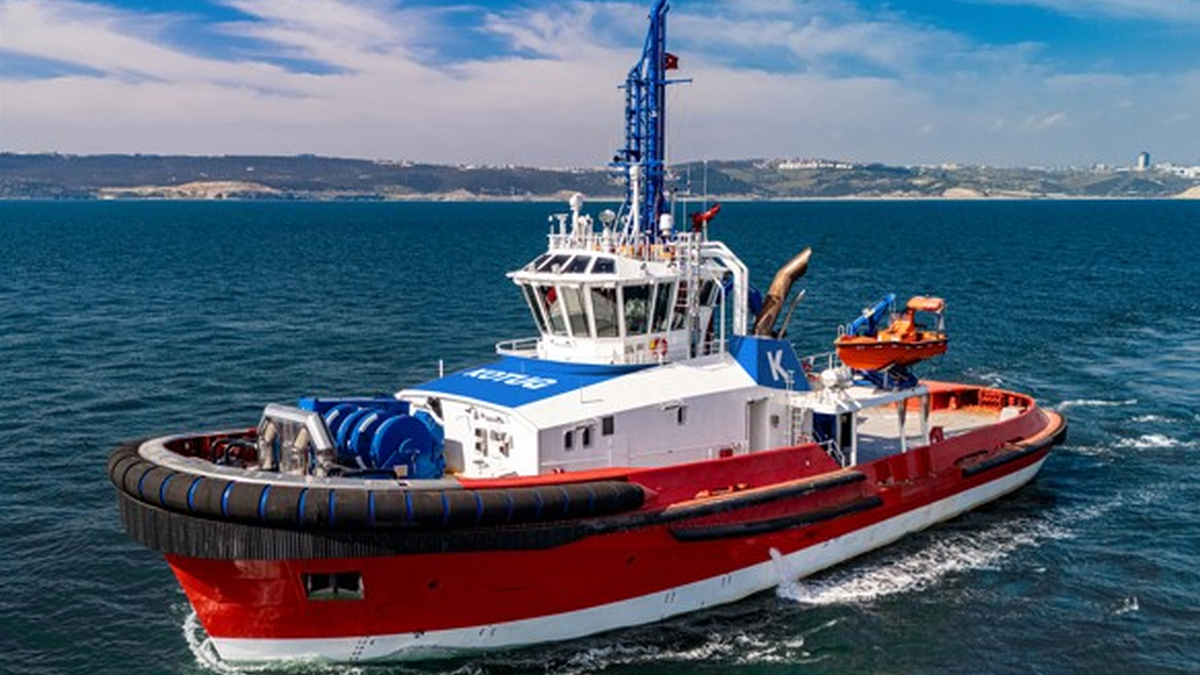
Update: world’s first dual-fuel methanol escort tug arrives in Canada
A newbuild first dual-fuel methanol escort and emergency response tug has arrived in British Columbia after its construction in Turkey to tow tankers to an expanded crude oil export terminal


Kotug Canada has welcomed the arrival of its first dual-fuel methanol escort and emergency response tug in British Columbia after it completed a transatlantic voyage that took it up the western coast of North America.
This joint venture between Kotug International and Horizon Maritime had two of these 44-m vessels built by Sanmar Shipyards in Turkey to a Robert Allan Ltd’s RAsalvor 4400-DFM design and with ABS class.
SD Aisemaht, the first of these 996-gt tugs was sailing near Victoria on 7 October and Nanaimo, both on Vancouver Island, on 9 October, according to automatic identification system (AIS) data.
A second of these vessels, SD Qwiy Aanitsa Sarah, was still in Yalova, Turkey, undergoing final commissioning, classification and sea trials, according to AIS data.
Both will be employed to escort Aframax tankers between the expanded crude Trans Mountain Pipeline export terminal near Vancouver to the Pacific Ocean along a route of around 150 nautical miles that includes the Juan de Fuca Strait and the Salish Sea.
“With 115-120 tonnes of bollard pull, they will become among the most powerful escort tugs operating in Canada,” said Kotug in a statement.
“But their impact goes far beyond power. At the heart of the project is a clear ambition to significantly reduce emissions in one of the world’s most demanding marine environments.”
Both vessels have twin ABC 16V DZM methanol-diesel dual-fuel engines from Anglo Belgian Corp (ABC) and two Schottel SRP 710 rudderpropellers, providing a top speed of 15 knots.
Schottel also supplied each tug’s STT 170 side thruster for additional manoeuvrability during tanker escort and emergency towage.
They have exhaust aftertreatment systems to minimise NOx emissions and to comply with IMO Tier III regulations, and hybrid propulsion enabling one engine to drive two thrusters up to a speed of 9.5 knots.
These tugs also have response equipment for emergency towage, a FiFi1 firefighting system, skimmers and tank capacity to store 405 m3 of oil recovered from marine spillages.
Western Canada Marine Response will use these escort tugs for emergency towage and oil spill response and recovery when required.
Schottel’s mechanical cross-link system, Sy-Drive M, and variable speed shaft alternators enable dual-fuel engines to run at their optimal running time, while electric winches and hotel and auxiliary loads can be run on one engine.
ABS has granted Enviro and Sustain-2 (2020) notations for their environmentally responsible design and sustainability-focused operational standards, LFFS for a low-flashpoint-fuelled ship, DFD for its methanol dual-fuel engines, and OSR-C2 for their oil spill response capabilities.
SD Aisemaht and soon SD Qwiy Aanitsa Sarah have class notations for ship towing and escort, bollard pull of over 115 tonnes, FFV 1 firefighting, quick response operations, unmanned machinery spaces, UWILD for underwater inspection instead of drydocking, HAB(WB) for accommodation with low vibrations, and an inventory of hazardous materials.
Riviera will host TUGTECHNOLOGY ‘27 in Rotterdam, the Netherlands, 19-20 May 2027. Use this link for more information and to register.


Related to this Story


Events

© 2026 Riviera Maritime Media Ltd.


