


Business Sectors
Business Sectors
Events
Contents

Tackling the tough decisions around Jones Act OSV fleet renewal
With OSV newbuild prices prohibitive at current day rates, Jackson Offshore Operators executive vice president and chief operating officer Matt Rigdon says discussions with charterers have focused on extending the life of its existing fleet to cut fuel consumption and lower emissions


There have been no formal requests for proposals to construct a ‘traditional oil and gas’ offshore supply vessel (OSV) for Jones Act service in about a decade. Deepwater activity in the US Gulf is robust and day rates for high-spec US-flag OSVs have climbed to the mid-US$30,000 range, but they are still less than half the levels needed to seriously consider ordering a newbuild. Without higher day rates and long-term contracts, financing costly newbuilds for the sector remains remote, creating a fleet renewal dilemma.
But that does not mean discussions around renewing the fleet are not taking place between owners and charterers, particularly considering the current age of the Jones Act fleet.
“With our customers, we are evaluating what the next solution is going to be to replace or extend the life of the existing fleet of Jones Act deepwater supply boats,” Jackson Offshore Operators executive vice president and chief operating officer Matthew Rigdon tells OSJ.
Mr Rigdon sat down with OSJ at the International Workboat Show in New Orleans in November to discuss his outlook on the deepwater US Gulf of Mexico oil and gas market and the tough decisions facing Jones Act OSV owners regarding fleet renewal.
He points out there are a finite number of qualified deepwater boats available for the US Gulf of Mexico – about 107 – and more than half of those vessels are 10 years old or more.
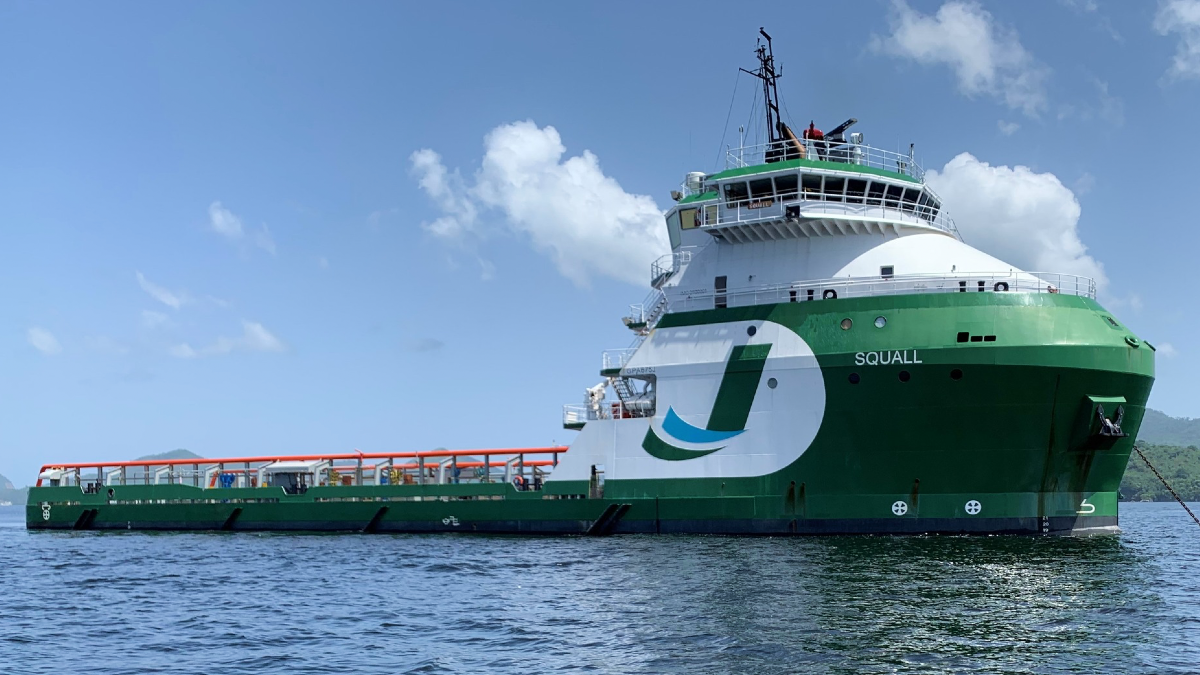
Jackson Offshore’s own fleet of six DP-2-class platform supply vessels (PSVs), and two DP-1-class fast/crew supply boats, were all built either in 2014 or 2015 and operate under the US flag. All the PSVs are large, ranging from 4,200-dwt, 80-m Storm to 5,150-dwt, 91-m Blizzard. Among Jackson Offshore’s PSVs are a quartet of GPA 675-J DP-2 vessels designed by Guido Perla Associates (GPA). These diesel-electric, DP-2 boats – Breeze, Squall, Thunder and Lightning – have an overall length of 77 m and deadweight of 4,426 tonnes.
OSV owners that have not ordered a newbuild at a US shipyard in a decade might be in store for some sticker price shock.
“Your basic, true oil and gas, deepwater OSV would be about US$90M,” estimates Mr Rigdon, who has undertaken some preliminary design assessments on new construction. “This means you need a charter rate in excess of US$75,000 a day on a very long term, compared with current average charter rates of US$35,000.” Besides higher rates, banks would probably want to see charters of 10 years or more before even considering financing a newbuild for the offshore oil and gas sector.
While some owners have secured day rates close to US$40,000 on short-term charters, Mr Rigdon believes a more realistic approach now is to examine how to extend the life of existing assets, as well as target investments towards improving fuel consumption and energy efficiency.
Jackson Offshore has long-term charters for its fleet with oil majors BP, Chevron and Shell, and he says discussions have begun with charterers around what can be done now and in the future, to prolong the life of these vessels, potentially for as much as 15 years.
“Historically, they have not set hard useful lives of vessels. But traditionally, they have said they don’t want to set a long-term charter on a vessel that’s more than 12 years old. That is all being re-evaluated.”
Retrofitting or upgrading an existing OSV will still require a significant capital investment by an owner.
Referring to the firm’s four GPA-designed PSVs, Mr Rigdon says, “We just performed the first 10-year special drydocking survey on the first vessel of that series. In the next five years, we have got to put together a plan to evaluate the long-term solution to extend the life of that vessel beyond, not just 15 years, but likely into the 25-year range, and make investments to improve efficiency,” he says.
Would Jackson Offshore consider upgrading its PSVs with energy storage systems? “Absolutely, we would have to look at that,” says Mr Rigdon. However, as of today he struggles to see the benefit of the hybrid solution to its relative cost; retrofitting an existing PSV with batteries and energy management systems can run into the millions of dollars.
But he foresees the technology improving over the next five years, when decisions must be made about capital spending on Jackson’s existing fleet.
Capital investment considerations
One of the challenges for owners such as Jackson Offshore when considering investments in batteries are the terms put in place by charterers. Mr Rigdon says, “The hybrid system is much more efficient in terms of delivering fuel savings if you can drop down to a single engine, operate in a closed bus and use the batteries as your spinning reserve. As of today, there’s not a single client in the deepwater Gulf of Mexico that will allow us to operate in a closed bus tie; instead, you have got to operate with bus bar untied and two engines running at all times. And so even in DP with the battery system, you’re not gaining that much efficiency.”
Power demand can widely fluctuate during dynamic positioning operations. Batteries can play a pivotal role in balancing the energy supply, allowing diesel generators to operate in their most efficient power range, lowering fuel consumption and by extension, CO2 and greenhouse gas (GHG) emissions.
Ironically, charterers are putting more pressure on OSV owners to reduce fuel consumption and GHG emissions. “There are a lot of the key performance indicators (KPIs) in our contracts that have grown and evolved, focusing on emissions and fuel savings,” says Mr Rigdon.
Jackson Offshore uses FuelTrax electronic fuel monitoring systems (EFMSs) on its vessels. “We have KPIs that our clients want us to manage such as operating in the best economy in transit mode, as dictated by FuelTrax.”
Jackson Offshore crews use the FuelTrax EFMS to gain real-time feedback on fuel consumption, enabling it to operate the vessel in the most fuel-efficient manner.
Longer term, Mr Rigdon sees potentially upgrading his PSVs with more efficient propulsion systems. One technology that caught his attention at the International Workboat Show was the Rim Drive azimuthing thruster from Kongsberg. The direct-electric drive system uses permanent magnet technology to improve efficiency, with the motor directly coupled to the propeller to minimise power losses.
Mr Rigdon says the company will consider technologies like the Rim Drive to improve the efficiency of its vessels that can “deliver tremendous savings” to charterers. “Our clients are focusing on emissions right now in the 500-m zone around their assets offshore. But as the scope of their reporting requirements on their emissions generated in producing oil and gas grows, improving the efficiency of transit will become even more important,” he concludes.
Riviera’s Offshore Support Journal Conference, Middle East will be held in Dubai, UAE, 11 December 2024. Click here for more information on this industry-leading event.



Related to this Story

Events

© 2026 Riviera Maritime Media Ltd.


