


Business Sectors
Business Sectors
Events
Contents
Register to read more articles.
How much committed Qatar LNG is now trapped behind the Strait of Hormuz?
QatarEnergy annual reports and recent notices indicate that a wide book of LNG sale and purchase agreements is now constrained by halted production, suspended loadings and force majeure


A review of QatarEnergy annual reports and recent company notices suggests that a large and still-growing book of LNG sale and purchase agreements is now being held up by the closure of the Strait of Hormuz. Many of those contracts are due to start this decade and many are tied directly to Qatar-origin supply.
The immediate operational position set out by QatarEnergy is clear. In recent notices, the company said it had ceased LNG production, then moved to stop loadings, and later declared force majeure to affected buyers. The clearest wording in the supplied notices states: “QatarEnergy has declared Force Majeure to its affected buyers.”
Against that backdrop, the question for the market is not simply whether Qatar can produce LNG in the long term, but which contractual volumes are now constrained by geography if cargoes cannot pass through Hormuz. The SPA data in this review has been compiled from QatarEnergy sources, including annual reports, annual reviews and the supplied recent press release links.
"More than 840 LNG carrier loadings could be disrupted, leaving many vessels idle"
On a conservative reading of clearly identified, quantified LNG SPAs in the 2021–2024 QatarEnergy annual reviews alone, the commitment base reaches about 50.05M tonnes per annum (mtpa).
That figure is built from the following deals:
China (18.5 mtpa), India (7.5 mtpa), Bangladesh (4.05 mtpa), France (3.5 mtpa), The Netherlands (3.5 mtpa), Pakistan (3 mtpa), Germany (2 mtpa), Taiwan (4 mtpa), South Korea (2 mtpa), Italy (1 mtpa), plus a global SPA with Shell (1 mtpa).
This is the conservative floor, not the ceiling. The same source set also contains older Qatargas-era and Qatar Petroleum-era agreements that appear capable of extending into 2026 or beyond, although some are not fully quantified in the supplied material. These include a 15-year SPA with Kansai Electric starting in 2013 for 0.5 mtpa, a 15-year SPA with Chubu Electric starting in 2013 for up to 1 mtpa, a 20-year SPA with PTT starting in 2015 for 2 mtpa, and a 15-year SPA with Tohoku Electric starting in 2016, although the annual report does not state the volume for the Tohoku contract.
A 2016 Qatargas agreement with Pakistan’s Global Energy Infrastructure Limited is also identified as a 20-year SPA, but the volume is not disclosed. That means the presently constrained book is best described as at least 50.5 mtpa, and above 52 mtpa if older quantified contracts still remain live in 2026. The full total could be higher, but the available sources do not support a firmer figure.
Drewry LNG lead analyst Pratiksha Negi noted that the exposure extends beyond Qatar alone. Ms Negi said Qatar and the UAE account for 20% of global LNG supply, or 80M–85M tonnes annually, and said complete substitution is unlikely. She said the global LNG trade would suffer because supply shortages would lead to demand destruction, cutting trade, especially in price-sensitive countries in Asia and South America.
"Asia sources 25% of its total LNG imports from Qatar and the UAE"
Ms Negi said losses could be managed in the near term, but only up to a point. “While supply shortages can be managed in the near term, the blockade, if it extends for more than a month, will make readjustments increasingly difficult,” she said. She added that alternative supplies could support the market only to a limited extent, and that as supply losses accumulate they would lead to demand destruction and drag overall trade growth in 2026.
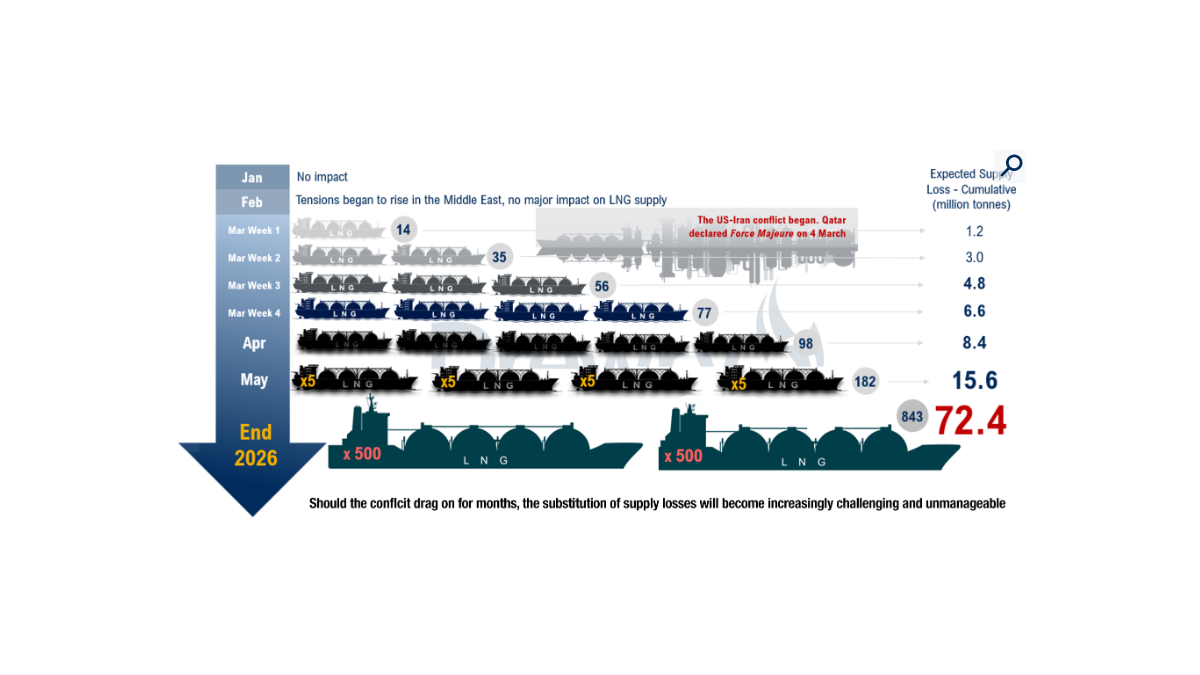
Drewry said weekly losses would amount to 12Bn tonne miles, rising to 45Bn tonne miles if the supply cut lasted for a month. It also said losses could exceed 490Bn tonne miles if the disruption were prolonged for a year. Drewry further warned that more than 840 LNG carrier loadings could be disrupted, leaving many vessels idle.
On replacement supply, Ms Negi said US cargoes to Asia would increase, backed by volumes added in 2025 and expected in 2026, while diversions from Europe to Asia would depend on price differentials and competition between the two regions. She said the US could send more cargoes to both Europe and Asia to compensate for lost Middle East supply, but warned that even this would fall short of covering Qatar and the UAE’s share. Drewry estimates that about 1M–1.5M tonnes of LNG supply could be choked in a week, translating into 7M tonnes of lost supply in a month.
Ms Negi said additional supply to Asia could also come from Australia, Papua New Guinea, Russia, Canada and African exporters including Nigeria, Mozambique and Algeria. But she said that, even combined, those additional exports would not match Middle East LNG supply. “While weeks and a month can be managed, the situation will become challenging if the blockade continues for months,” she said, adding that cumulative supply loss could reach 72M tonnes by the end of 2026 and could not be made up under any scenario.
Drewry also pointed to the demand side of the equation. Ms Negi said higher prices caused by supply shortages would result in demand destruction, especially in countries highly exposed to Middle Eastern supply, and noted that Asia sources 25% of its total LNG imports from Qatar and the UAE.
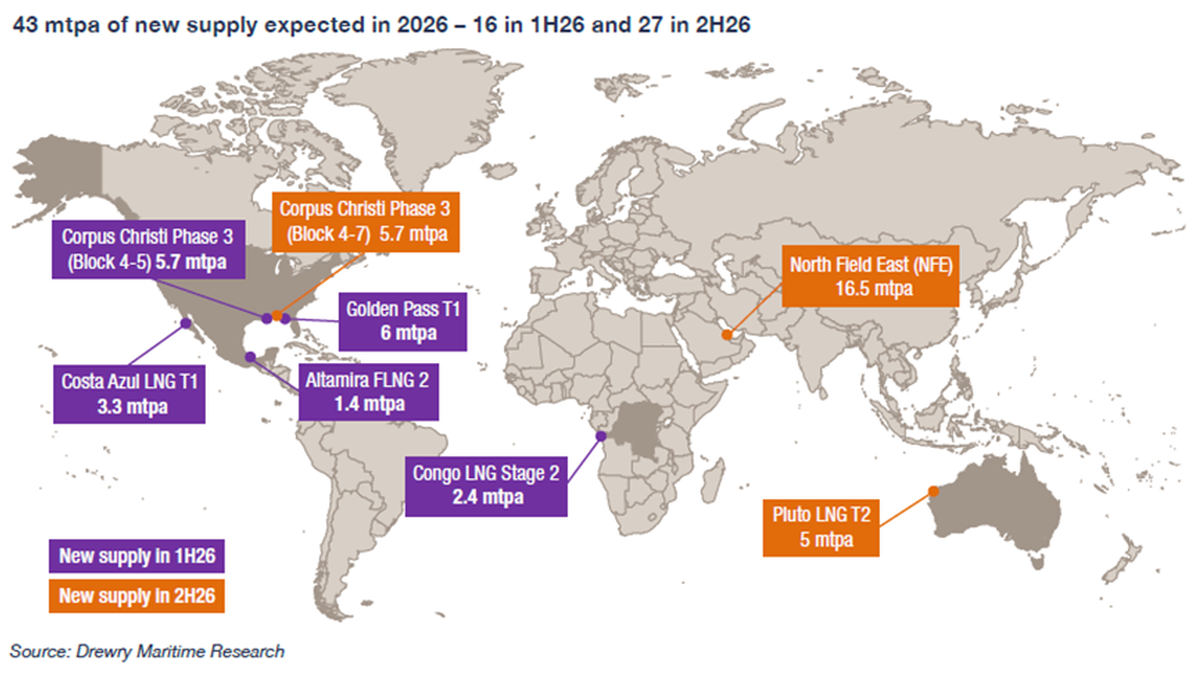
Near-term new LNG supply offers little immediate relief. Ms Negi said new capacities are limited and that Qatar had been expected to add 16.5 mtpa of new liquefaction capacity in 2026, but the start-up of any new terminal would now be stalled by the conflict. She added that several projects scheduled to start this year – Altamira FLNG 2, Congo LNG Stage 2, Corpus Christi Phase 3, Costa Azul LNG T1 and Golden Pass T1 – are now expected to become operational only by the end of H1 2026, meaning that even where new exports do arrive, their timing does not match the present disruption.
That leaves the market facing a progressively harder test the longer Hormuz remains closed. A short disruption could be partly absorbed through diversions and incremental supply from other exporters, but Drewry’s assessment is that the strain becomes much harder to manage if the blockade continues beyond a month, with cumulative losses mounting, replacement capacity falling short and demand destruction beginning to cut into the trade itself.
Sign up for Riviera’s November 2026 LNG Shipping & Terminals Conference:
- Register to attend here: The LNG Shipping & Terminals Conference.
- To take part in the Conference or webinars, please contact Ian Pow: ian.pow@rivieramm.com
- View the latest issue of LNG Shipping & Terminals here: LNG Shipping & Terminals.

Related to this Story

Events

Maritime Regulations Webinar Week
 16 Dec 2025
 GMT - ONLINE
Floating energy: successfully unlocking stranded gas using FLNGs and FSRUs
24 Feb 2026GMT - ONLINE
© 2026 Riviera Maritime Media Ltd.


