


Business Sectors
Business Sectors
Events
Contents

Register to read more articles.

As bunker fuel costs rise, so does the commercial value of wind
From purpose-built cargo ships to existing tankers, PCTCs and LNG carriers, wind-assisted propulsion continues to make a compelling business case


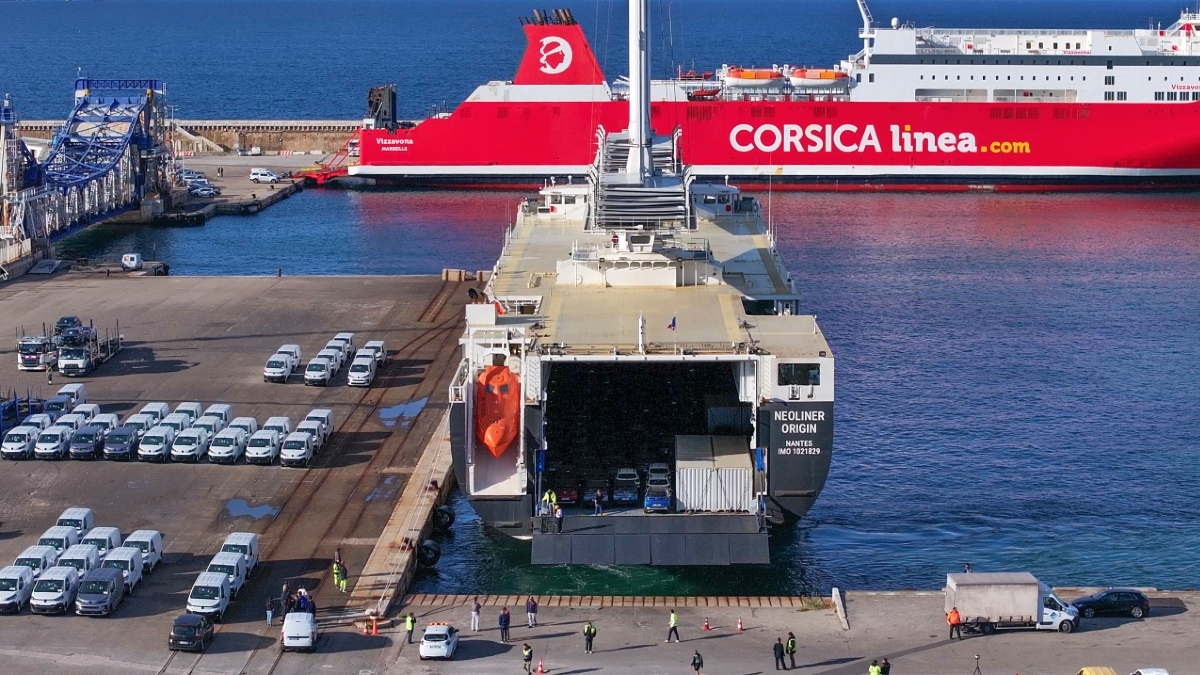
A year into operations, the world’s first purpose-designed, sail-powered roro, Neoliner Origin, is extending its route within Europe and North America. The move by French owner Neoline is a highly visible symbol of the historic embrace of wind-assisted propulsion amid uncertainty about alternative fuels.
Driven by 3,000 m2 of SolidSail semi-rigid carbon and fibreglass sails hanging off two 76 m-high folding masts, the 136 m, 265-TEU ship has just added Zeebrugge and Halifax to its ports of call, according to the enterprise’s chief executive Jean Zanuttini. “Wind is certainly intermittent, but it is more predictable than the prices and availability of many other energies”, he says.
The €60M (US$67.5M) ship’s only concession to the combustion engine is a medium-speed diesel unit complemented by a 900-kW electric motor, two auxiliary generators and three thrusters each delivering 450 kW. The engine is deployed for manoeuvring in port and sometimes to reach the destination on time.
Partly backed by container giant MSC’s €1.5Bn (US$1.7Bn) Fund for Energies in an all-French operation, Neoliner Origin could be the first of a fleet of roro ships for which “the wind is the main propeller”, says Mr Zanuttini
So far it’s been relatively smooth sailing. The only serious mishap occurred in June when the forward mainsail let go and crashed to the deck during a voyage along the French coast. Chantiers d’Atlantique, designer of the SolidSail technology, has since fixed the problem.
Although Neoliner Origin is primarily wind-driven, the advance of wind-assisted propulsion continues at a pace that wasn’t foreseen even a decade ago, largely because its benefits are being more accurately quantified.
Singapore’s Global Centre for Maritime Decarbonisation (GCMD) has run the hard numbers on fuel savings. “Scaling energy efficiency technologies (EETs) depends not on just proving that they work but on establishing how much fuel they save under real-world operating conditions”, explains GCMD’s chief executive, Professor Lynn Loo. Following on from a six-month, real-world trial with Eastern Pacific Shipping’s 50,000-dwt oil and chemical tanker, Pacific Sentinel, that was retrofitted with bound4blue’s eSails and established fuel savings as high as 20%, Eastern Pacific has taken the next step.
In a project called FEET (Fund for Energy Efficient Technology), wind-assisted propulsion (WAPS) is now financed against robustly quantified savings in a pay-as-you-save system. As Ms Loo explained in October, under FEET, payments are linked to verified fuel savings: “This is how we aim to turn operational evidence into investor confidence and unlock wider adoption of EETs across fleets.”
In other words, investors can see exactly where their money’s going because the guesswork is removed from the financing. Lenders are prepared to offer up to 100%. The hard numbers have given Eastern Pacific the confidence to install three of bound4blue’s 22m-high suction sails on each of two tankers, Pacific Sentinel and Pacific Sunstone. “We look forward to seeing more energy-efficient technologies make their way onto ships,” says chief executive Cyril Ducau.
European WAP project
Europe is throwing its weight behind WAPS under a similar project. Dubbed AWESOME (Advanced Wind Energy System Optimisation & Monitoring for Efficiency), it was launched in mid-2026 with the declared aim of “providing shipowners with verified performance data, practical tools and standardised methods for assessing wind-assisted propulsion.”
The overall goal is to reduce the investment risk, also by quantifying payback time and operational impact in much the same way as FEET is doing. AWESOME is led by Kongsberg Marine with 14 other partners, including Barcelona-based bound4blue and Sintef, the Norwegian research institute. The project will be trialled on Neoliner Origin and one of Odfjell’s chemical tankers.
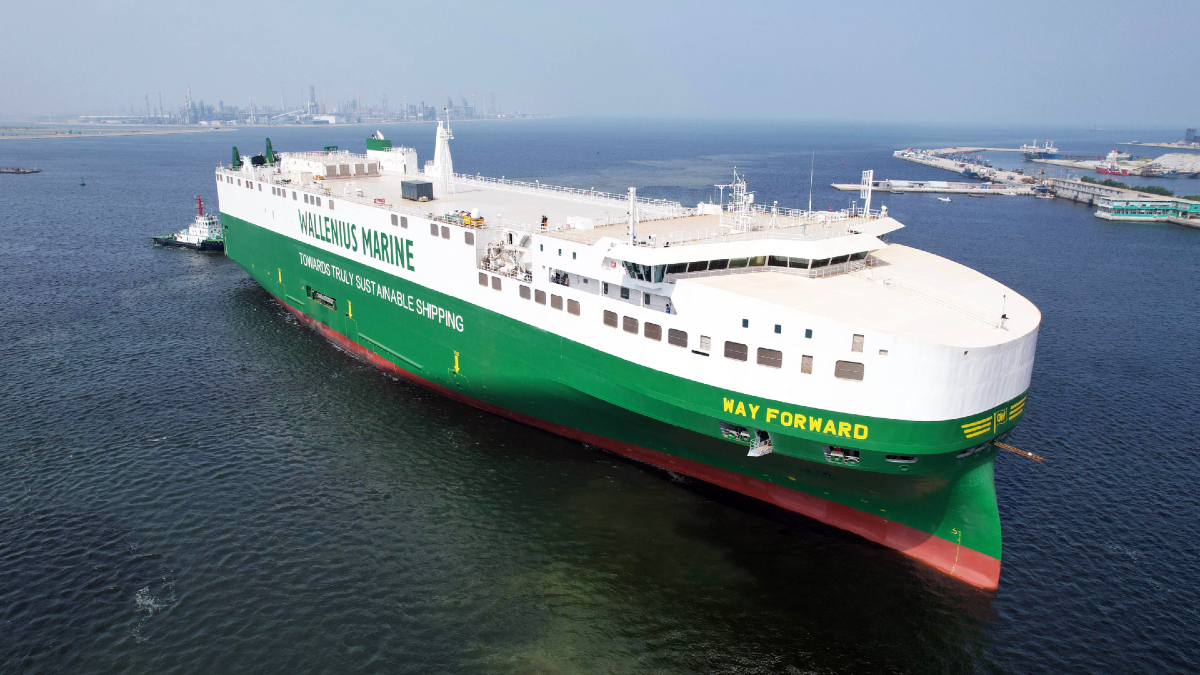
Adoption is spreading right across the entire shipping spectrum. Next year Oceanbird, the joint venture between Alfa Laval and Wallenius Marine, will install two of its towering, 40 m-tall Wing 560s on the Volkswagen-chartered car carrier Way Forward following on from the successful installation of a single sail in mid-June on Tirranna, another car carrier. These sails are purpose-designed for these vessels, and the trial on Tirranna showed fuel consumption could be cut by half on a windy route, according to Oceanbird chief executive Amrit Kaur Bhullar.
There appears to be room for a variety of designs. As we reported in August, German shipowner Leonhardt & Blumberg is retrofitting four general cargo newbuilds with Dutch group Econowind’s VentoFoils, whose propulsive capacity is based on “boundary-layer suction”. Integrated fans and vents create a vacuum at the rear of the wings that is claimed to generate up to five times the force of a conventional wing of the same size. Because of the suction effect, the wing can work at 25-degree wind angles when conventional sails lose effectiveness.
In further developments, Mitsui OSK (MOL) is committed to its own 49 m-high Wind Challenger rigid sails developed in collaboration with Oshima Shipbuilding. In September, MOL took delivery of the wind-assisted LNG carrier Fujin Sailor in another world first. The technology is intended for large ships, and MOL is developing a new LNG carrier with four sails that the company estimates could slash fuel use by between 15-30%. Nothing less than ambitious, Mitsui OSK aims to install Wind Challengers on 80 ships by 2035.
In another heavyweight project, in August South Korea’s Polaris Shipping commissioned four 210,000-dwt Newcastlemax bulk carriers with rotor sails under a 25-year contract with Brazilian mining giant Vale. Installations are also finding their way onto much smaller vessels. In August, a multi-purpose newbuild plying French Polynesia was fitted with a 22m-high bound4blue suction sail, reportedly a world-first for such a vessel.
More than fuel
So far, most of the installations are designed to save fuel, but there are other compelling reasons, argues UK’s BAR Technologies. “An operator can take [wind propulsion] as fuel saving, emissions reduction, speed or operational flexibility, depending on what is most valuable at that moment,” the group explains. “The commercial value of that energy is not fixed.”
Going beyond fuel savings, BAR Technologies believes “the propulsion margin created by wind assistance can instead be used to maintain a higher speed without a proportionate increase in fuel consumption.” In short, a reduced passage time, assuming the economics of the charter and voyage allow it, offers another tool for the operator. To prove the point, BAR Technologies is working with Hyundai Heavy Industries on a 174,000 m3 LNG carrier that will incorporate its WindWings into the vessel’s design and operating profile from the outset.
Although speed is not the main issue for Neoliner Origin, the crew are extracting more. Recently the vessel hit a top speed of 16.6 knots, more than a knot faster than the previous record. Average speed is, of course, much slower, just over 9 knots on a recent voyage. But fuel savings were 78%, equivalent to 17 tonnes compared with an equivalent conventional vessel sailing the same route at the same speed.
And that’s with the wind as the main propeller.



Related to this Story

Events

© 2026 Riviera Maritime Media Ltd.


