


Business Sectors
Business Sectors
Events
Contents

Register to read more articles.
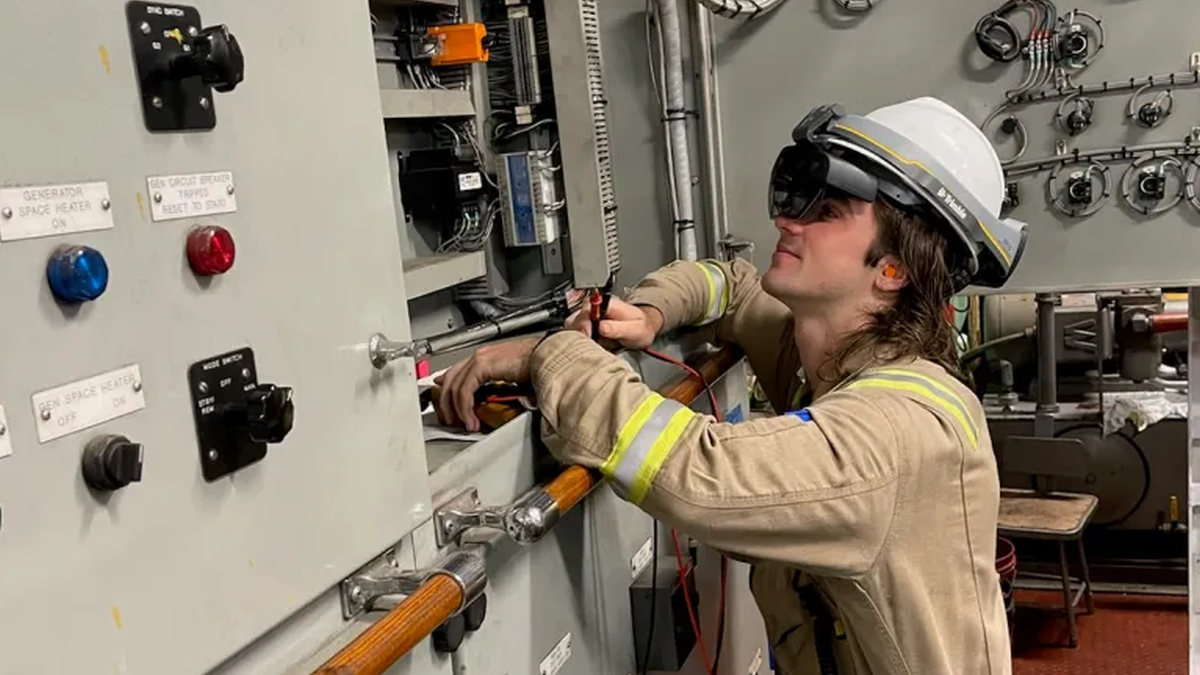
ABS: augmented reality raises crew performance, operational efficiencies
Widespread deployment of augmented reality will depend on the industry demonstrating that productivity gains can be achieved without compromising safety


Augmented reality (AR) technologies could enhance how crews operate on vessels, harbour teams dock and unload ships and how engineers construct vessels in shipyards.
AR also has applications in ship inspections, design and seafarer training by providing additional information just when it is required.
But, its adaption by the maritime industry has been slow and there is need to move pilot schemes into larger deployments for the benefits to be enabled.
ABS thinks widespread deployment of AR will depend on demonstrating how productivity gains can be achieved without compromising safety and how the technology is adapted to support crews.
The US class society said some of the applications were in inspection, maintenance, navigation, training and remote assistance and diagnostics, reducing workload and improving insights available to seafarers and superintendents.
“Augmented reality could change how industrial work is performed, bringing expert guidance, operational data and digital workflows directly into the user’s field of view,” said ABS senior vice president and chief technology officer, Patrick Ryan.
“To unlock that potential responsibly, industry needs a clear understanding of the safety and performance implications,” he said.
AR’s key advantage is its ability to display relevant information directly in the user’s line of sight, said ABS.
The technology can display step-by-step procedures in front of a technician, mark inspection points and tolerances on equipment, and flag hazard zones and exclusion areas as crews move through a space.
Real-world benefits, however, depend on the task, the user, the operating environment and the information.
ABS developed its Advisory on Assessing Augmented Reality for Industrial Operations to provide industry insight into how to evaluate AR’s effects on safety and performance, and how those effects compare with current work practices.
It was developed with support from the ABS Laboratory for Ocean Innovation at Texas A&M University.
The advisory outlines a structured methodology for comparing AR-enabled tasks with baseline practices across safety and performance dimensions.
“This advisory provides the tools to evaluate the implications rigorously and consistently,” said Mr Ryan.
It highlights how different types of tasks, such as those relying on navigation, hand-eye co-ordination, memory or information processing, place different demands on users, making it important to evaluate AR for the specific task it would support.
The advisory also reviews the trade-offs AR applications can introduce, including distraction, visual occlusion and over-reliance on system outputs.





Related to this Story



Events

Maritime Regulations Webinar Week
 16 Dec 2025
 GMT - ONLINE

Floating energy: successfully unlocking stranded gas using FLNGs and FSRUs
24 Feb 2026GMT - ONLINE
© 2026 Riviera Maritime Media Ltd.


