


Business Sectors
Business Sectors
Events
Contents
Belgium seeks alternative concepts for energy island as HVDC costs soar
The Belgian government has agreed to continue construction of the Princess Elisabeth energy island in the North Sea, but wants transmission system operator Elia to develop a ‘new concept’ for its completion


Elia said it welcomed the government’s commitment to continued development of the energy island, and said it sees a second interconnector with the UK as a possible solution to cost growth.
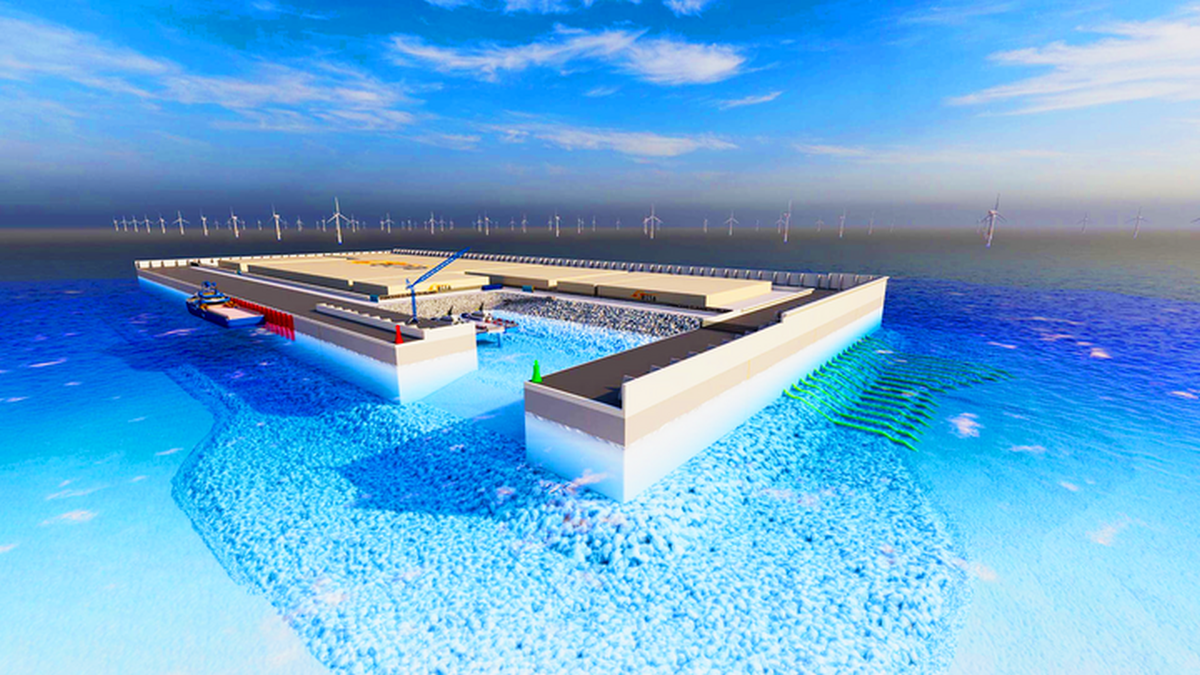
The energy island was due to be completed by 2027. It is being built approximately 45 km off the Belgian coast, within the Princess Elisabeth wind zone. It is the world’s first artificial energy island and is designed to integrate 3.5 GW of additional offshore wind capacity into Belgium’s electricity grid, reducing the country’s dependence on fossil fuels while providing more affordable green electricity. In addition to unlocking Belgium’s second offshore wind zone, the energy island will also serve as a landing point for additional interconnectors that will link Belgium to its neighbours.
The TSO welcomed the government’s decision to ‘further optimise’ the next phase of the project – including a potential second interconnector with the UK – which it said is “in the interest of industry and consumers.” Working closely with Elia and Belgium’s electricity and gas regulator CREG, the government is developing an alternative concept for the next phase of the energy hub that "remains aligned with the original objectives of the project, but at a lower cost."
The revised concept is required because of what Elia described as “unprecedented global increases in the cost of high-voltage direct current (HVDC) technology and related services required for offshore development.”
As a result of the proposed changes, and in line with the government’s decision, Elia will not sign a contract relating to the acquisition of HVDC infrastructure for the project. Signing the contract was temporarily suspended earlier in 2025, a decision that covers, among other things, the HVDC converter stations for the project and subsea cables.
Elia said that due to the sharp increase in the cost of HVDC infrastructure and its installation, in January 2025 it decided to postpone signing the contract. The delay was intended to provide enough time for a new, future-proof solution to be reached with all of the project’s stakeholders. Following the government’s decision, the HVDC contract will not be signed in its current form.
Elia Transmission Belgium chief executive Frédéric Dunon said, “Elia is delivering this project within a legal framework. Thanks to the government’s decision, its implementation can now continue. We support the government’s ambition to realise the project’s core objectives through an optimised configuration which is adapted to current market conditions.
“We are pleased the strategic importance of further offshore development and a second interconnector with the UK has been reaffirmed. These are key elements in Belgium’s long-term energy policy. Along with the authorities, the regulator and our UK partners, we will assess how this ambition can be achieved in the most efficient way.” In May 2024, Belgium, Ireland and the UK signed a joint statement on electricity interconnection that will enable them to trade electricity from offshore windfarms.
Construction of the energy island is ongoing. Once completed, it will enable windfarms in the Princess Elisabeth Zone to be efficiently connected to Belgium’s grid.
“The project is of major strategic importance for Belgium, and will be critical for the country’s electricity supply over the next few decades,” Elia concluded.
Sign up for Riviera’s series of technical and operational webinars and conferences:
- Register to attend by visiting our events page.
- Watch recordings from all of our webinars in the webinar library.

Related to this Story


Events

Maritime Regulations Webinar Week
 16 Dec 2025
 GMT - ONLINE
Floating energy: successfully unlocking stranded gas using FLNGs and FSRUs
24 Feb 2026GMT - ONLINE
© 2026 Riviera Maritime Media Ltd.


