


Business Sectors
Business Sectors
Events
Contents

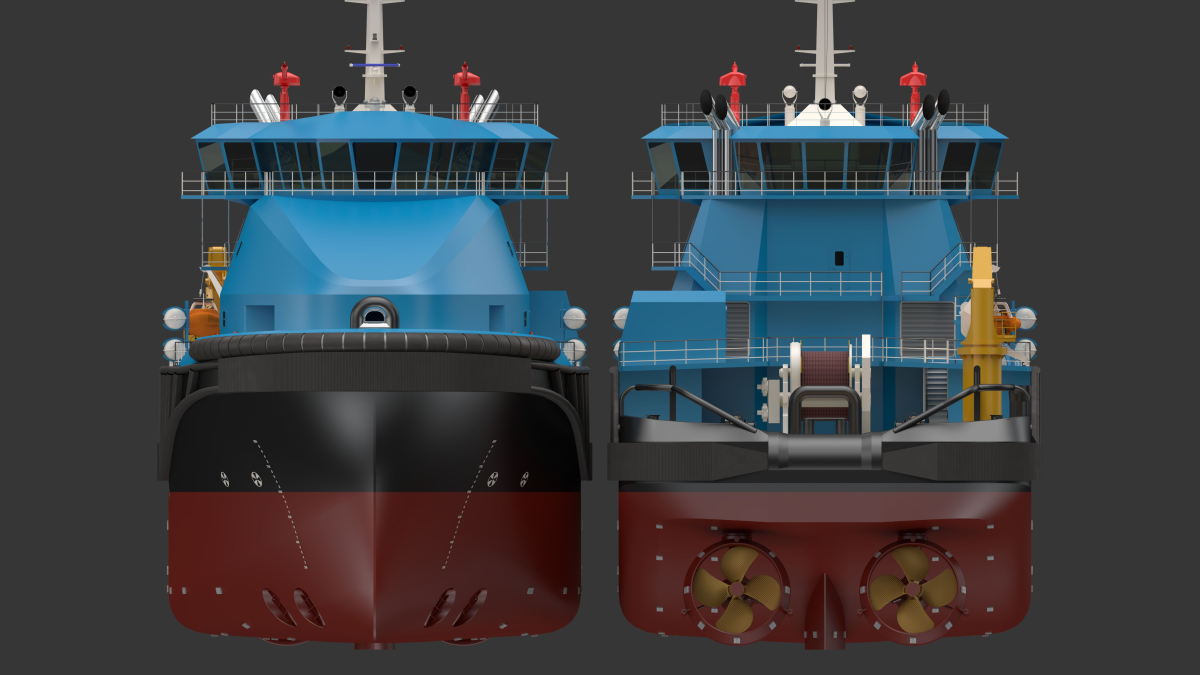
Smit Lamnalco expands support tug fleet in South America
A Boskalis subsidiary has orders four new high-power firefighting offshore support tugs from a Turkish shipbuilder


Smit Lamnalco has ordered four diesel-electric, firefighting offshore support tugs from Uzmar Shipyard to operate in French Guyana.
These Bureau Veritas-classed vessels will have a bollard pull of more than 130 tonnes and built to Robert Allan Ltd’s RAmpage 6000-DE design.
They will be equipped with a 100% electric powertrain and a propulsive package from Sweden’s Berg Propulsion.
This package will include two MTA836 Z drive fixed-pitch azimuth thrusters and two MTT216 controllable-pitch bow thrusters, alongside an MPC800 control system.
The equipment manufacturer worked with Smit Lamnalco Uzmar and the naval architect to optimise propulsion, increase operational responsiveness and manoeuvrability of these 60-m vessels.
“Diesel engines are optimised for efficiency at specific ratings and there are limits on flexibility,” Berg Propulsion Eurasia managing director Mustafa Muslum said.
“The all-electric setup provides full torque at any speed. For this reason, many tug owners have come to prefer propulsion systems that are hybrid- or fully-electric.”
Berg is due to deliver equipment for the first in the series in November 2026 and equipment for the last vessel in this series is scheduled for delivery by July 2027.
“At Uzmar, we continue to lead the way in innovative tugboat construction, delivering advanced dual-fuel, methanol, diesel-electric and battery-supported solutions tailored for the evolving needs of global ports and terminals,” said Uzmar group chief executive and president Ahmet Noyan Altug.
“This diesel-electric project demonstrates our capability to combine high bollard pull performance with efficiency, lower emissions, and operational flexibility.”
The latest order is part of a wider trend for shipyards to build tugs with electric powertrains and hybrid propulsion and higher power and bollard pull to service the growing demands for supporting ships at offshore loading terminals and floating production systems.
“Rather than producing multiple tugboats rated at 70-80 tonnes bollard pull, the sector is opting for fewer vessels with greater bollard-pull capacity per tug,” said Mr Muslum.
“There is rising demand for higher bollard pull and this trend will continue.”



Related to this Story

Events

Maritime Regulations Webinar Week
 16 Dec 2025
 GMT - ONLINE
Floating energy: successfully unlocking stranded gas using FLNGs and FSRUs
24 Feb 2026GMT - ONLINE
© 2026 Riviera Maritime Media Ltd.


