


Business Sectors
Business Sectors
Events
Contents

Register to read more articles.

Why passenger ships cannot afford to ignore this hidden power drain
HVAC systems on passenger ships consume up to a third of total energy demand – representing one of the cruise sector’s most overlooked decarbonisation opportunities


Every time a cruise ship sits in port on a warm summer day, its generator engines are running, burning fuel not to move passengers, but to keep them comfortable.
The air conditioning plant, the ventilation fans, the chiller compressors, the pumps circulating cold water through miles of pipework to cabin fan coil units and public room air-handling units, all of it consuming electrical power at a rate that can represent 30% of the ship’s total energy budget. For an industry facing the most demanding emissions regulatory regime in its history, that figure represents both a serious problem and a largely untapped opportunity.
IMO’s Carbon Intensity Indicator (CII) and Energy Efficiency Existing Ship Index (EEXI) regulations, mandatory since January 2023, have focused minds across the sector on propulsion efficiency, slow steaming, hull coatings and alternative fuels. These are legitimate responses to a genuine challenge. But there is a persistent blind spot in the decarbonisation conversation, sitting in the machinery flat behind the galley, humming quietly and drawing power that never appears in the propulsion data. Heating, ventilation, and air conditioning (HVAC) has been treated for decades as a fixed hotel overhead, rather than a variable that can be managed, measured, and materially reduced. That thinking is now a compliance liability.
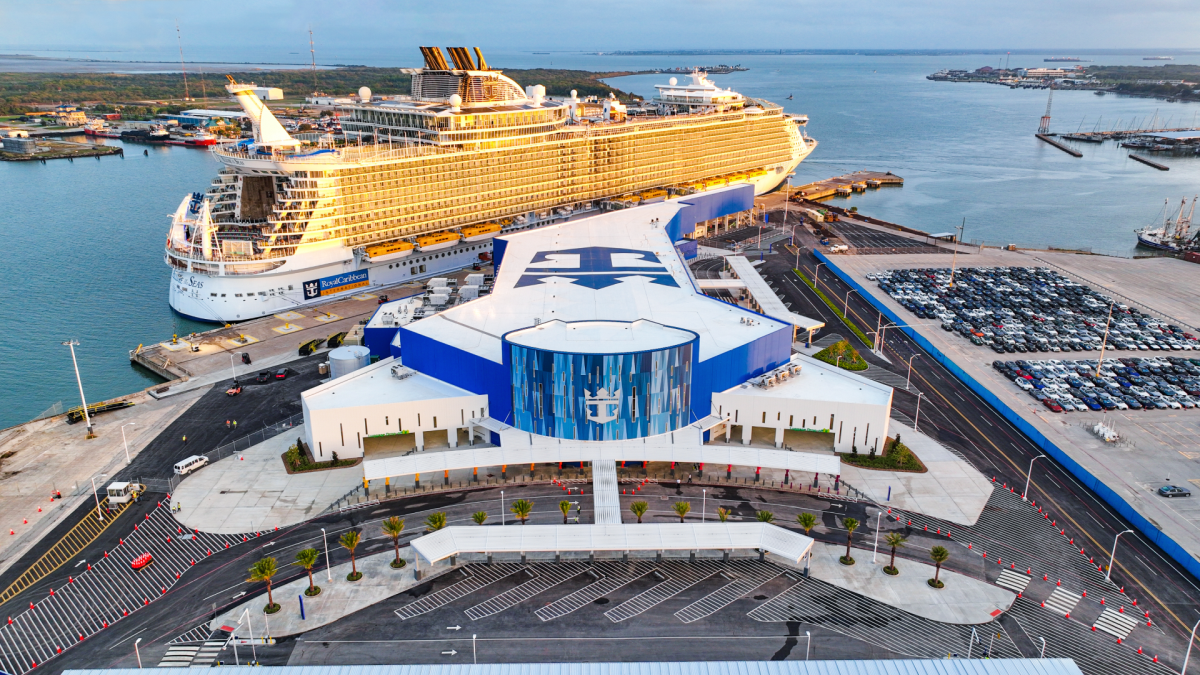
The good news is that the technology to address this is neither experimental nor unproven. It is already at sea and delivering results. The experience gained aboard Royal Caribbean’s Oasis of the Seas offers a useful reference point. When the 361-m vessel entered service in December 2009 as the world’s largest cruise ship, energy efficiency and a low carbon footprint per passenger were embedded design criteria from the outset.
“There is a persistent blind spot in the decarbonisation conversation”
Harri Kulovaara, then executive vice president at Royal Caribbean Cruises Ltd, framed the challenge in terms that resonate just as sharply today. “The benefits of scale are naturally one aspect, but the important thing is to realise how focused work in each area of energy consumption can lead to enormous savings,” he said. The vessel achieved an improvement in overall energy efficiency of between 15 and 25% against its predecessors, with Mr Kulovaara estimating energy efficiency per passenger some 50% better than the average 10-year-old cruise ship of the period.
A significant proportion of that gain came from HVAC. Finland-based Koja Marine, appointed main contractor for the air conditioning systems aboard Oasis of the Seas and its sister vessel Allure of the Seas, designed a system that maximised passenger comfort while minimising both its physical footprint and its energy appetite. Fan coil cooling elements were repositioned closer to the public areas they served, direct-driven frequency-controlled fans replaced fixed-speed arrangements in the air-handling units, and the shipowner subsequently reported HVAC energy savings of close to 30%. Central to this performance was the deployment of 350 VACON AC drives providing stepless speed control across the vessel’s public spaces, with carbon dioxide levels monitored continuously and fan coil operation adjusted in real time accordingly.

Koja Marine director, Esko Nousiainen, pointed to the visibility this delivered as much as the efficiency gain itself. “The Profibus fieldbus provides access to motor power values,” he said. “The shipowner is therefore able, in real time, to monitor the amount of energy used by the process. Changes made by a passenger to the values in the HVAC automation system and their effect on energy consumption can be perceived instantly.”
That level of sub-metering granularity, real-time visibility of HVAC energy consumption at zone level, is precisely what most passenger vessel operators still lack today, and precisely what suppliers with serious marine HVAC credentials have been developing in parallel. Johnson Controls (JCI) is among the most prominent of these.
As director, Aftermarket Technical, Marine Services for JCI, Anders Andersson’s perspective spans decades of HVAC evolution, from traditional refrigeration systems on cargo vessels to the complex cooling networks aboard today’s largest cruise ships. He described the modern shipboard HVAC plant in terms that underline just how far the discipline has travelled. “We are like a district cooling system,” he said, “a fairly large such system.” With vessels now routinely carrying more than 7,000 people, the parallel is apt, and it carries the same implication that land-based district energy managers have long understood: a system of that scale and complexity cannot be managed efficiently without comprehensive data and intelligent automation.
JCI’s Global Marine and Navy division claim an installed base covering more than 10,000 vessels, and its product portfolio for the cruise and ferry segment now includes magnetic bearing centrifugal chillers, variable speed drives, absorption chillers for waste heat recovery and radar-based remote monitoring systems. The company has recently introduced the YZ chiller, combining low global warming potential refrigerants with oil-free magnetic bearing compressor technology to deliver what Mr Andersson described as “fantastic efficiency, a very high power-to-cooling ratio.” These systems are already being deployed on newbuild cruise ships and are under active discussion for retrofit applications.
“It will eventually become beyond human capacity to manage and fine-tune a system of this complexity”
The case for magnetic bearing chillers in passenger ship applications is increasingly difficult to argue against on pure financial grounds. Where a conventional chiller compressor relies on oil-lubricated mechanical bearings, generating friction, contaminating heat exchanger surfaces and degrading efficiency progressively over its service life, a magnetic bearing machine runs the rotor on a cushion of electromagnetic force with no physical contact, no oil circuit and no lubrication system to maintain. Friction losses are a fraction of those in conventional centrifugal machines, and at partial load, where chiller plants spend most of their operating lives, the efficiency advantages are most pronounced.
Mr Andersson is emphatic on this point: “It is extremely important that you have a high part load efficiency, otherwise you will not materialise your heat load saving.” The absence of an oil circuit also eliminates the single most common cause of progressive chiller efficiency degradation in marine plants, oil contamination of evaporator and condenser surfaces, while compressor noise falls well below eighty decibels and the smaller physical footprint of modern machines eases the chronic space constraints of shipboard machinery arrangements.
Beyond hardware, he emphasised that the most significant efficiency gains come from optimising the entire system, from chillers and distribution pipework through to air handling and occupancy-driven demand management. Much of the low-hanging fruit, cooling unoccupied spaces, running fans at fixed speed regardless of actual ventilation demand, has already been addressed on newer tonnage. The next layer of improvement is more demanding. “Modern cruise ships are now designed to operate more like floating smart cities,” Mr Andersson observed, with integrated systems that respond dynamically to passenger activity. Achieving that in practice requires not just the right hardware but the right information architecture, and that is where digitalisation is emerging as the decisive variable.
Real-time data collection, remote monitoring and AI-driven optimisation are becoming integral tools for operators managing HVAC networks of a scale and complexity that was barely imaginable a generation ago. Mr Andersson is candid about the limits of human capacity to manage these systems without digital support. “Maintaining the required competence on board pushes on the limit of human capacity,” he said. “It will eventually become beyond human capacity to manage and fine-tune a system of this complexity.” The implication for operators is straightforward: investment in connected monitoring and automation is not a future option but an operational necessity, and one that pays back through measurable reductions in energy consumption and maintenance cost.
Shore-power challenge
Shore-power requirements add a further dimension that Mr Andersson flagged as a significant engineering challenge. As ports across Europe and North America push for reduced berthed emissions, cruise ships are increasingly required to shut down their onboard generators and connect to the local grid. The problem is thermal: when the generators go off, so does the waste heat they produce, and that heat has historically been a free resource for heating hotel spaces and domestic hot water. “When you switch off the generators, you have no waste heat to use,” he said. Heat pump technology is emerging as the preferred response, recovering heat generated by the cooling process itself and upgrading it for useful heating applications elsewhere in the ship.
Conversely, when vessels are underway, waste heat from the main engines and generators can be directly converted to useful HVAC cooling through absorption chillers, an arrangement that JCI has offered in its marine portfolio for some years.
The refrigerant question adds a parallel urgency that operators would be unwise to ignore. Johnson Controls explicitly acknowledges the transition already under way, with its marine services division listing R22 phase-out and refrigerant conversion among its core aftermarket offerings. Tightening F-gas regulations across Europe and IMO’s own environmental agenda are making high global warming potential refrigerants increasingly untenable, and many systems still operating aboard older passenger tonnage will face a reckoning at the next drydock. This is not a future compliance risk. It is arriving now, and it runs on a separate track from CII, compounding the pressure on operators that have deferred both conversations.
Under CII, every gram of CO2 emitted by a passenger vessel above 5,000 gt counts against its annual rating, whether it originated from the main engines or from an auxiliary diesel generating power for an ageing chiller running at full load on a half-empty ship in October. IMO’s reduction factors run through to 2030, requiring a 21.5% improvement, with a further regulatory review expected to tighten the framework again from 2026. Mr Andersson’s closing thought is at once realistic and optimistic: “There is an endless number of challenges, but also endless opportunities.”




Related to this Story

Events

Maritime Regulations Webinar Week
 16 Dec 2025
 GMT - ONLINE
Floating energy: successfully unlocking stranded gas using FLNGs and FSRUs
24 Feb 2026GMT - ONLINE
© 2026 Riviera Maritime Media Ltd.


