


Business Sectors
Business Sectors
Events
Contents

Register to read more articles.
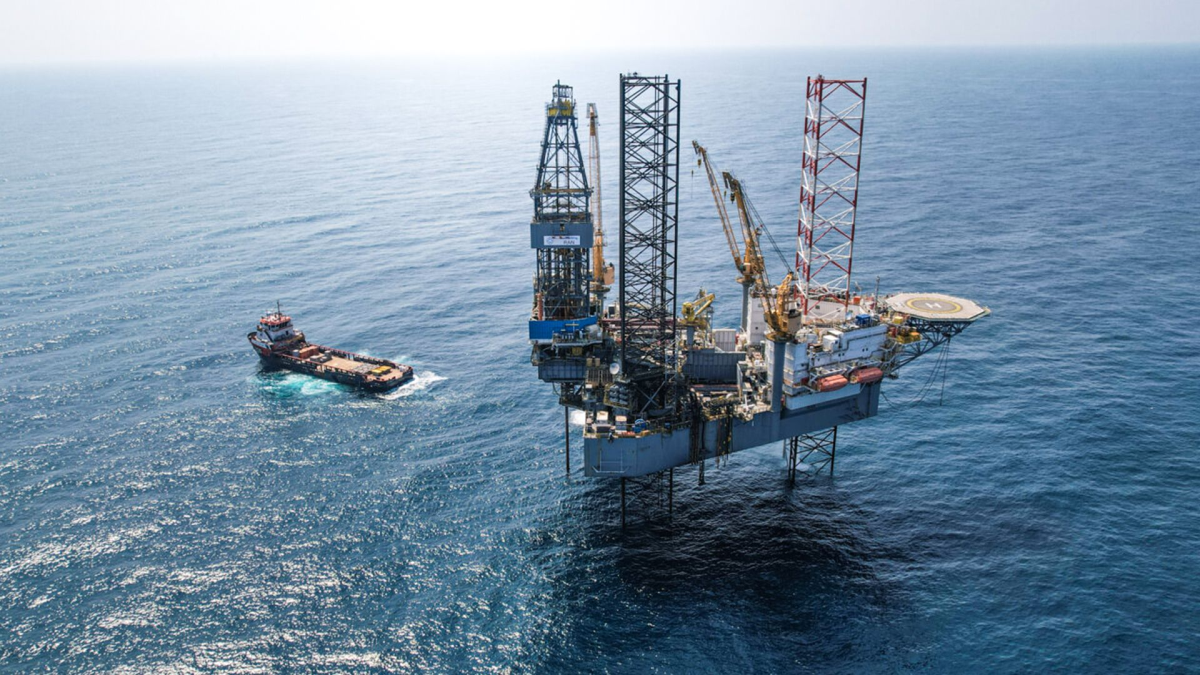
Rigs report: ExxonMobil hits oil again in Guyana; Wintershall Dea has 'major discovery' offshore Mexico
More oil was discovered in Guyana’s Stabroek offshore block, which has four sanctioned developments and a fifth on the way, while Wintershall Dea’s Kan prospect offshore Mexico could contain 200-300M barrels of oil equivalent


ExxonMobil operates the Stabroek Block and China’s CNOOC and US-headquartered Hess Corp each have a stake in the block. Hess revealed the news in its quarterly report. The discovery of 28-m of oil-bearing sandstone reservoir was made at the Lancetfish-1 well, approximately 6 km southeast of the earlier Fangtooth discovery, in just under 1,828 m of water by drilling rig Noble Don Taylor.
The devleopments in the Stabroek Block offshore Guyana have reportedly totalled some 11Bn barrels of oil, to date. Hess also reported its Prosperity FPSO arrived at the Stabroek block on 11 April and hook-up and commissioning has begun.
With four developments in the block currently sanctioned, Hess said, "Government and regulatory approvals are expected very soon for a fifth development, Uaru, with a production capacity of approximately 250,000 gross barrels of oil per day."
Operator Wintershall Dea and its partners Harbour Energy and Sapura OMV have made a significant oil discovery on the Kan exploration prospect in Block 30, located in shallow waters of the Cuenca Salina in the Sureste Basin, offshore Mexico. Based on preliminary estimates the discovery may contain 200 to 300M barrels oil equivalent in place.
“This important discovery at Wintershall Dea’s first owner-operated exploration well offshore Mexico is a great success”, said Wintershall Dea chief technology officer and executive board member responsible for global exploration, Hugo Dijkgraaf. “It was one of the most contested blocks of Mexico’s bid round 3.1 back in 2018. The successful Kan discovery confirms the attractiveness of Block 30, complementing Wintershall Dea’s outstanding Mexican licence portfolio. "It is a significant step to extending our footprint in Mexico contributing to the development of a potential new hub in the shallow waters of the Sureste Basin”, Dijkgraaf underlines.
In rig-building news, Chinese shipyard CIMC Raffles has delivered the jack-up rig Wan Zuan 3 to Chinese Oilfield Services Limited in China for use in the South China Sea where it will soon undertake workover operations. The jack-up drilling rig can operate in water depths up to 100 m and drill to a depth of 9,144 m.
In Namibia, oil and gas company Sintana Energy reported over 50% of 3D seismic survey data has been gathered from Petroleum Exploration License 87 (PEL 87) and the surrounding area in the Orange Basin.
Sintana president Robert Bose said, “Survey activities on PEL 87 are well advanced and we remain confident the results will confirm we are on trend with the recent massive discoveries in the basin, and will further demonstrate that Saturn Turbidite Complex is a significant offshore deepwater oil opportunity.”
PEL 87 has been mapped and the complex shares many geologic characteristics and is on-trend with the Venus oil discovery made by TotalEnergies in February 2022.
Last month, Australian firm Woodside Energy signed an option agreement to acquire a 56% participating interest in PEL 87 with the decision to exercise the option to follow after the evaluation of seismic data acquired as part of the agreement. Woodside has a period of at least 180 days after delivery of the survey to exercise its option.
OMV Norge – the Norwegian subsidiary of Austrian energy company OMV – has found oil near the Gudrun field offshore Norway. Odfjell Drilling’s Deepsea Yantai rig drilled the wildcat well 15/2-2 S in the OMV Norge operated production licence 817, encountering a “500 m thick oil column in the intra-Draupne Formation, consisting of multiple thin sandstone layers totalling 23 m with poor reservoir properties,” according to the Norwegian Petroleum Directorate.
An initial estimate suggests the discovery has about 0.95–5.55M m3 of recoverable oil equivalent due to the limited thickness of the sandstone layers and uncertainty in their dispersion. The well will now be permanently plugged and abandoned and the licensees will evaluate the well result to define the volume potential in different reservoir zones, and will assess the discovery alongside other prospects in the production licence.
Deepsea Yantai is moving on to production licence 1148 in the North Sea, where Wellesley Petroleum serves as operator.
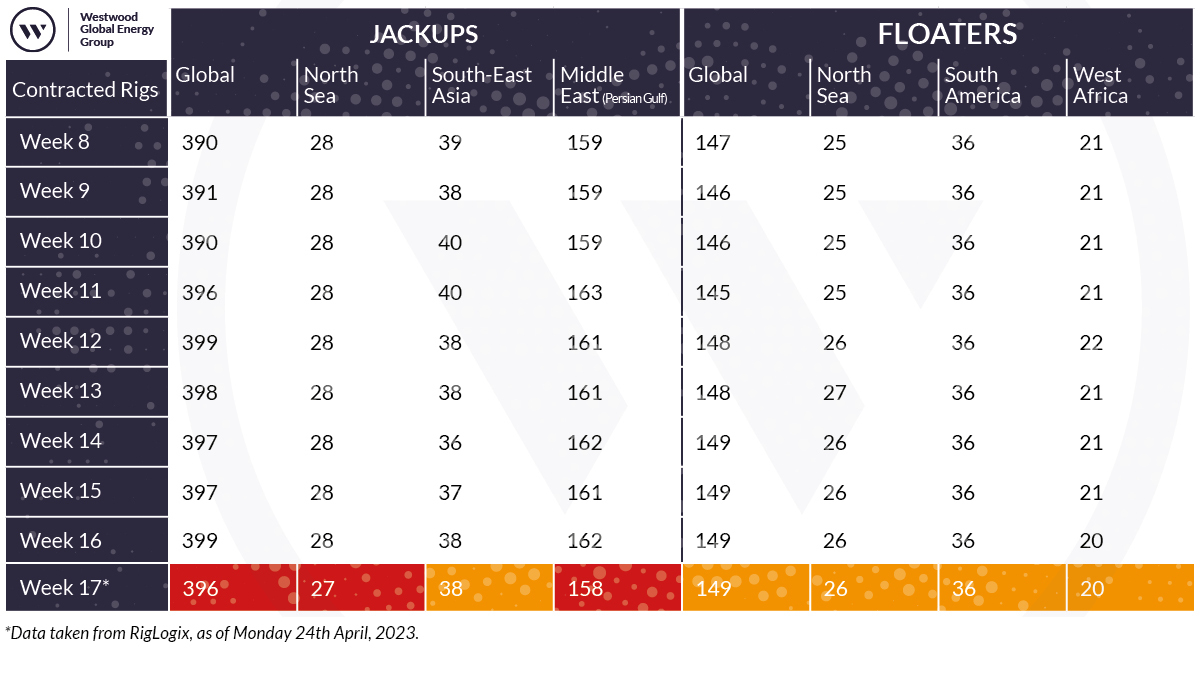
In contracts and rigs utilisation news, active jack-up units stood at 396 units in week 17, 2023 signalling a marginal reduction, according to figures from Westwood Global Energy Group’s RigLogix platform.
Shelf Drilling has secured a short-term contract for the jack-up Adriatic I for operations offshore Nigeria, with a firm term of 90 days and an estimated contract value of US$11M excluding revenues for mobilisation and demobilisation. The contract is scheduled to start in early May.
In regulatory, litigation and arbitration news, in the North Sea, the Petroleum Safety Authority Norway (PSA) has identified serious regulatory breaches at Saipem’s Scarabeo 8 semi-submersible drilling rig following an audit conducted from 19-26 January 2023 that focused on the management of the working environment and operations on the rig.
PSA has identified several serious regulatory breaches including some relating to the management of the working environment.
Saipem has been ordered to review its management system for the working environment, which is intended to safeguard competence, surveys, risk assessments, the rectification of faults and deficiencies and improvements. PSA has ordered the work to include “an analysis of the underlying causes of identified deficiencies related to the management of the working environment within Saipem.”
Saipem has been given until 31 August 2023 to comply with the order.
An arbitration tribunal has ruled in favour of Keppel FELS in its arbitration against Scottish firm Awilco Drilling. This is the first of two arbitration cases between the companies and involves the termination of two orders for the rigs Nordic Winter and Nordic Spring. Awilco had placed orders for both rigs in 2018 and 2019 respectively before cancelling both orders in 2020 citing an alleged breach of contract – a charge which Keppel has denied.
Keppel submitted claims amounting to US$424.9M for the first rig and US$268.9M for the second rig. A tribunal hearing for the first rig was scheduled to begin in October 2022. In light of the ruling pertaining to the first rig, Awilco said it was “disappointed with the Tribunal’s decision and is currently reviewing the award to establish if grounds exist for appeal and, if so, the merits of such an appeal. The hearing for the second rig is expected in May. Nordic Winter and Nordic Spring have since been taken up by Dolphin Drilling.
In North America, Chevron and ExxonMobil have relinquished 20 offshore oil and gas exploration permits off the coast of British Columbia, following a lawsuit challenge brought by Canadian environmental law group Ecojustice. Last July, lawyers from Ecojustice represented the conservation groups World Wildlife Fund Canada and the David Suzuki Foundation, challenging the validity of 20 offshore oil and gas exploration permits awarded decades ago.
These permits, first issued in the 1960s and 1970s, were extended indefinitely by Natural Resources Canada. The litigants referred to them as “sleeper” permits and believe they should have expired decades ago.
Chevron has now surrendered 19 of these permits with ExxonMobil relinquishing its sole permit earlier this year and several more offshore British Columbia (which were not challenged). The lawsuit has now been dropped.
Chevron’s permits lay in the Scott Islands marine National Wildlife Area and in rare protected glass sponge reefs in Hecate Strait and Queen Charlotte Sound. The rare, ancient reefs are the largest among several found along the coast of British Columbia and Alaska. The sponge reefs of Hecate Sound and Queen Charlotte Sound are formally protected within a designated 2,410 km2 marine protected area.
Glass sponge reefs – so named because of a skeleton made of silica – are believed to only exist in the waters off the northwest coast of North America. These particular reefs are estimated to be about 9,000 years old. Their skeletal structure faces threats from warming ocean waters and increased acidification. Sponge reefs date back to at least the late Jurassic period and were thought to have been extinct millions of years ago before a chance discovery in British Columbia’s waters in the 1980s.
Earthjustice is also party to another court challenge in the District of Columbia challenging the US Bureau of Ocean Energy Management’s decision to award exploration licenses for millions of acres in the Gulf of Mexico.
And the London High Court has ruled NGO Greenpeace can proceed in its legal challenge against the British government over its invitation to oil and gas explorers last year to apply for licences in the North Sea.
A judge has ruled the challenge can proceed to a full hearing. Last year, the UK held its first exploration licensing round since 2019, making over a 100 licences available. The first licences were expected to be awarded in Q2 this year.
Sign up for Riviera’s series of technical and operational webinars and conferences in 2023:
- You can register to attend by visiting our events page.
- Watch recordings from all of our webinars in the webinar library.


Related to this Story


Events

Maritime Regulations Webinar Week
 16 Dec 2025
 GMT - ONLINE
Floating energy: successfully unlocking stranded gas using FLNGs and FSRUs
24 Feb 2026GMT - ONLINE
© 2026 Riviera Maritime Media Ltd.


