


Business Sectors
Events

Floating energy: successfully unlocking stranded gas using FLNGs and FSRUs
 24 Feb 2026
 GMT - ONLINE
Contents
Register to read more articles.
The hidden geography of LNG shipping risk
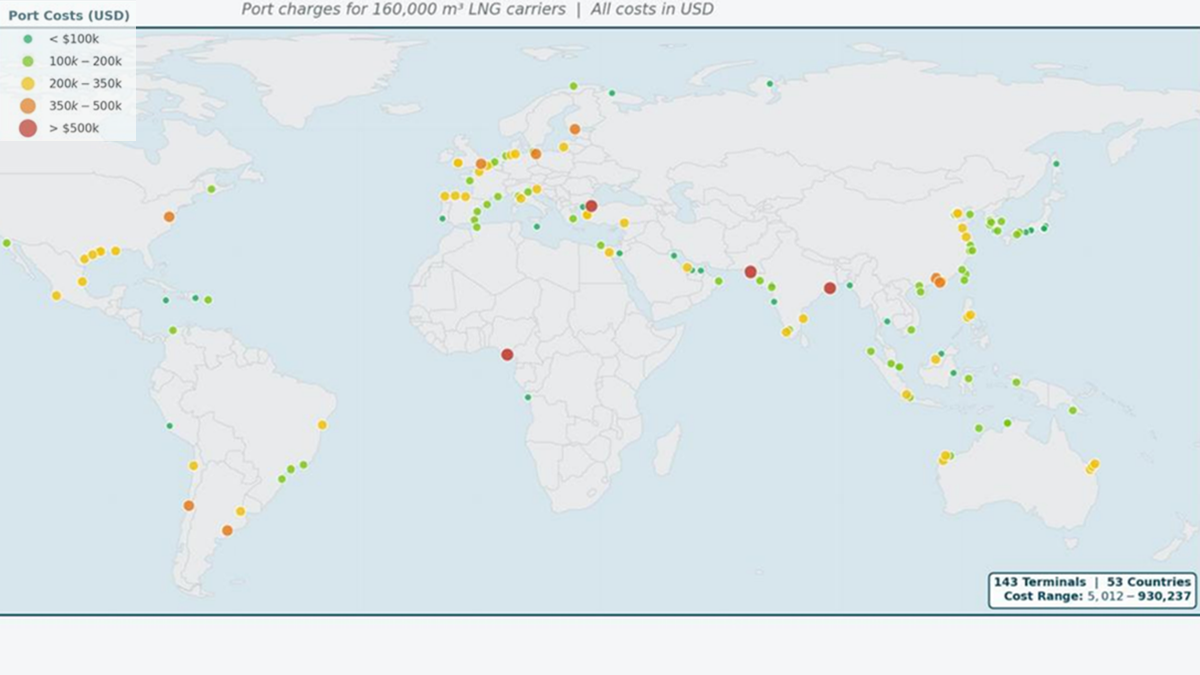
Port costs for LNG carriers differ depending on location and operational difficulties, notes Wood Mackenzie research director Ikram Elloumi


Port costs are often treated as a secondary line item in LNG economics. However, for vessels such as a modern 160,000-m³ LNG carrier (TFDE), they can materially alter voyage profitability, risk exposure, and trading optionality. A global comparison of loading and discharge costs shows that port economics are not evenly distributed; instead, they cluster sharply by geography and operational complexity.
A world divided by port cost
A regional heatmap of LNG port costs reveals three distinct tiers. Ocean-accessible hubs such as the US Gulf, Qatar, and much of West Africa remain structurally low-cost, typically below US$70,000 per port call. These regions benefit from deepwater access, short pilotage, high terminal automation, and predictable berth availability.
In contrast, North Africa, Australia, and Argentina stand out as persistent high-cost regions. Algeria and Australia routinely exceed US$120,000 to US$190,000 per port call, while Argentina sits in a league of its own, with costs reaching US$220,000 to US$360,000 per port call. This stark divergence explains why geographic cost maps show green clusters in the Atlantic and Middle East, and red concentrations in the Southern Cone and parts of Asia-Pacific.
The world’s most expensive LNG ports
The ranking of individual terminals reinforces this picture. Bahía Blanca and Escobar in Argentina account for two of the three most expensive LNG port calls globally, followed closely by Darwin LNG in Australia and Arzew/Skikda in Algeria. These are not premium terminals charging for superior service; rather, they are ports where navigation difficulty, congestion, and environmental constraints dominate the cost structure.

Cost is really risk in disguise
When port costs are compared against operational risk, the correlation is clear. Low-cost regions such as the US Gulf and Qatar also score highest on reliability, with minimal navigation risk and congestion. At the opposite end, Argentina combines extreme costs with extreme operational fragility, creating the weakest risk-adjusted proposition in global LNG shipping.
The key insight is that high port costs are not driven by tariffs alone. More than 70% of the cost at expensive terminals stems from operational friction.
The first element is pilotage: rivers, channels, long pilot boarding distances, narrow access channels, tidal windows, and the need for multiple tugs can add US$100,000 or more to a single port call.
The second element is waiting time and hidden demurrage. Congested terminals such as Escobar and Bahía Blanca frequently impose tidal or berth delays. A 48-hour wait on a TFDE vessel can erase around US$150,000 in voyage value.
The third element is insurance and contingency pricing. Ports exposed to grounding risk, severe weather, or chronic congestion are priced as ’accident-prone,’ embedding risk premiums into port charges and compulsory services.
Implications for LNG trading
For LNG traders and portfolio managers, the conclusion is unavoidable: port cost is a proxy for operational risk. High-cost ports only make commercial sense when upstream LNG is deeply discounted or when destination market spreads are exceptionally strong. In normal market conditions, these ports steadily erode margin through delays, demurrage, and unreliability.
Conversely, the cheapest LNG on a risk-adjusted basis continues to originate from the US Gulf, Qatar, and Nigeria, where predictable port operations preserve optionality and protect trading margins.
In LNG trading, the question is not just where LNG is cheapest, but where does each dollar of port cost buy the least risk. On that measure, geography matters more than ever.
Sign up for Riviera’s November 2026 LNG Shipping & Terminals Conference:
- Register to attend here: The LNG Shipping & Terminals Conference.
- To take part in the Conference or webinars, please contact Ian Pow: ian.pow@rivieramm.com
- View the latest issue of Tanker Shipping & Trade here: LNG Shipping & Terminals.


Related to this Story

Events

Maritime Regulations Webinar Week
16 Dec 2025GMT - ONLINEFloating energy: successfully unlocking stranded gas using FLNGs and FSRUs
24 Feb 2026GMT - ONLINE
© 2024 Riviera Maritime Media Ltd.


