


Business Sectors
Business Sectors
Events
Contents
Register to read more articles.
US targets another Chinese refinery and VLCCs amid resilient Iranian oil flows
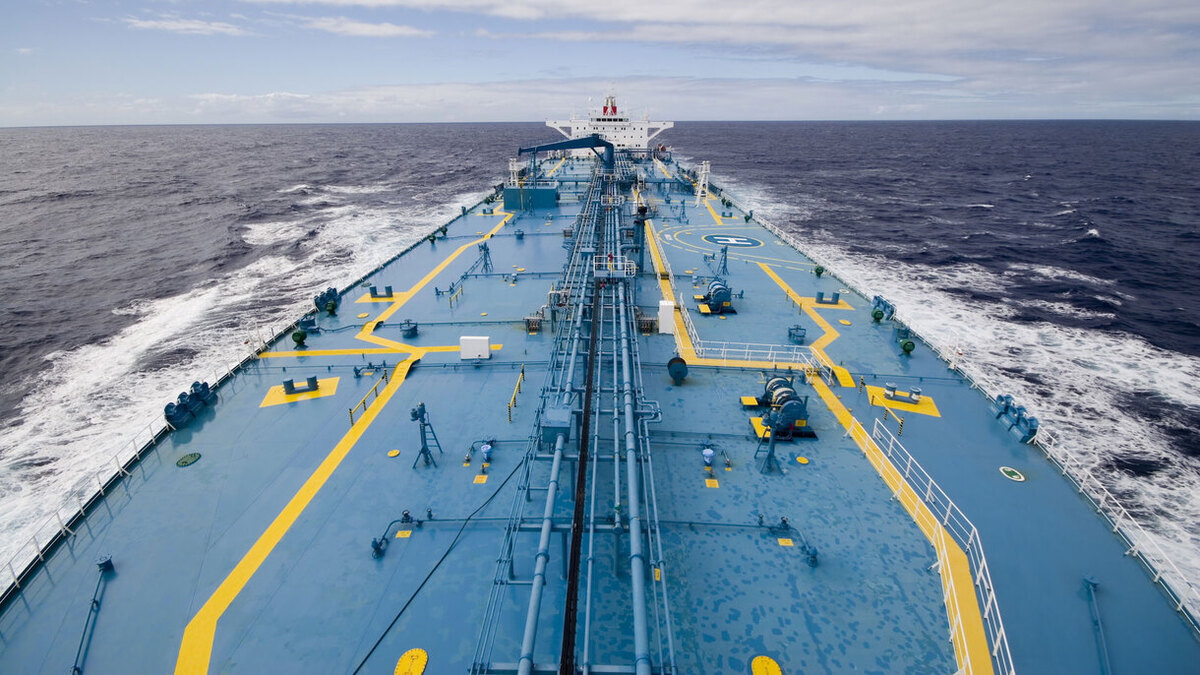
The United States has imposed a new round of sanctions targeting entities involved in transporting Iranian oil, with a specific focus on another Chinese ’teapot’ refinery and the VLCC tanker segment


While international media report renewed interest in nuclear talks between the US and Iran – potentially resuming this weekend in the capital of Oman – Washington continues to intensify its ’maximum pressure’ campaign.
In a statement issued on 8 May, the US Treasury designated Hebei Xinhai Chemical Group Co Ltd, an independent refinery in Hebei Province, along with three port terminal operators in Shandong Province, for “purchasing or facilitating the delivery of hundreds of millions of dollars’ worth of Iranian oil”.
According to the Treasury, Hebei Xinhai has received multiple shipments of Iranian oil from ’shadow fleet’ tankers, some of which have been sanctioned for their role transporting Iranian petroleum. This marks the third Chinese refinery sanctioned for such activity in recent months, following two others designated in March and April.
In addition, three companies operating a terminal at Dongying Port were blacklisted for “receiving Iranian oil shipments from shadow fleet vessels since 2024”.
Iranian crude flows remain resilient
Signal Ocean market analyst Maria Bertzeletou noted in a recent report that US measures targeting Chinese independent refiners "have disrupted operations and deterred other refiners from similar purchases”.
However, Iranian crude exports to China remain resilient. Data from Vortexa shows Chinese imports of Iranian oil averaged 1.5M b/d in April, down from March’s record high of 1.8M b/d, yet still above the 2024 average of 1.4M b/d. Notably, Shandong Province alone absorbed over 1.5M b/d in March, marking a nearly 50% increase from the 2024 average.
Kpler expects Iranian flows to remain resilient, hovering between 1.0–1.2M b/d, unless the US begins targeting large Chinese refining complexes or major port hubs.
Market sources told Riviera that while the US administration’s measures are significant, they have yet to deliver the intended impact. Notably, with Washington now moving to impose fees on Chinese-owned and -built tonnage, tanker operators backed by Chinese financing or operating Chinese-built vessels may increasingly avoid US-linked trades altogether. Instead, they are exploring alternative routes and markets, such as Brazil, West Africa, Guyana, Venezuela and Iran.
With global trade becoming increasingly fragmented, shipping insiders noted China, Iran and Russia have continued to deepen their maritime and geopolitical alliances. This suggests current sanctions cannot easily disrupt these ties.
VLCCs and Aframaxes under increased scrutiny
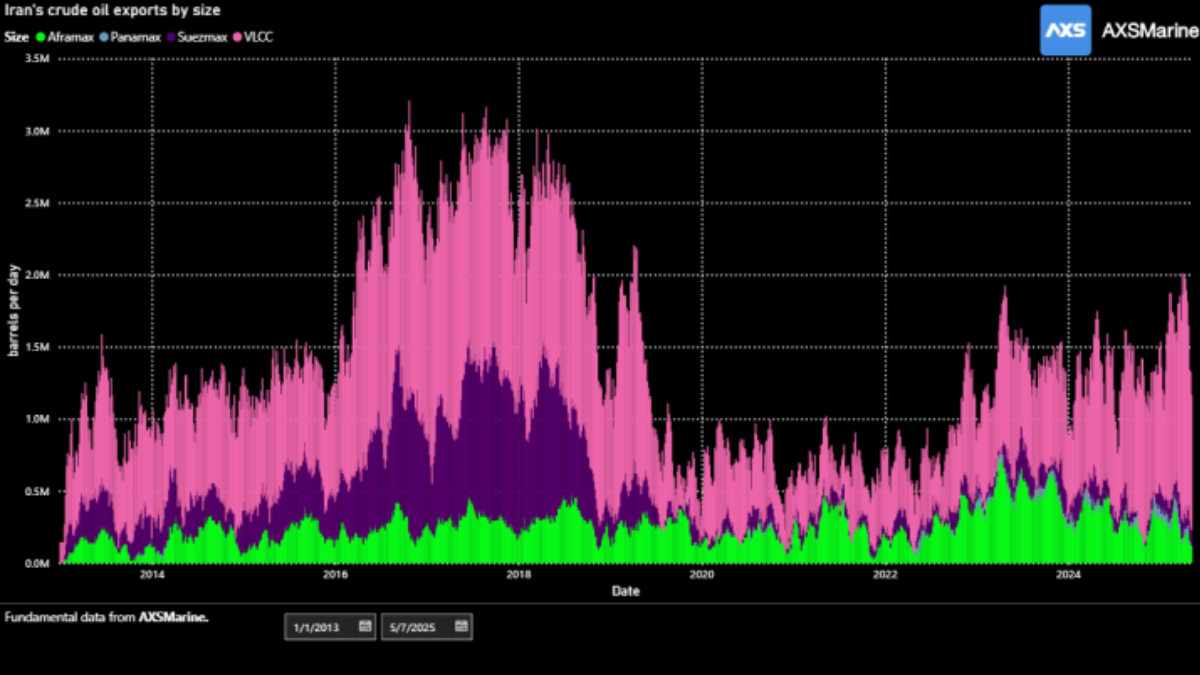
Data from AXSMarine shows Iran’s rising oil exports are primarily supported by VLCC and Aframax tankers. Reflecting this, the US Treasury’s latest sanctions list includes six additional tankers – four VLCCs and two Aframaxes – with an average age of 22.5 years.
“Iran’s shadow fleet relies on obscure shipmanagement companies to manage its fleet of tankers that Tehran needs to mask Iran’s petroleum shipments to China using ship-to-ship transfers with sanctioned vessels,” the Treasury stated.
Greek shipowner Navios Maritime Partners highlighted in its Q1 2025 investor presentation, released on 7 May, that sanctioned tankers now account for 10% of the global fleet by vessel count.
Citing data from the US Treasury and shipbroker Clarksons, Navios reported 13% of the VLCC segment is now under sanctions, up from 10% in February. The share of sanctioned Aframax tankers has also increased, rising to 24%, compared with 21% just three months earlier.
Riviera’s Tanker Shipping & Trade Webinar Week will be held from 30 June 2025. Click here to register for this free-to-attend event.



Related to this Story

Events

Maritime Regulations Webinar Week
 16 Dec 2025
 GMT - ONLINE
Floating energy: successfully unlocking stranded gas using FLNGs and FSRUs
24 Feb 2026GMT - ONLINE
© 2026 Riviera Maritime Media Ltd.


