


Business Sectors
Business Sectors
Events
Contents
Register to read more articles.
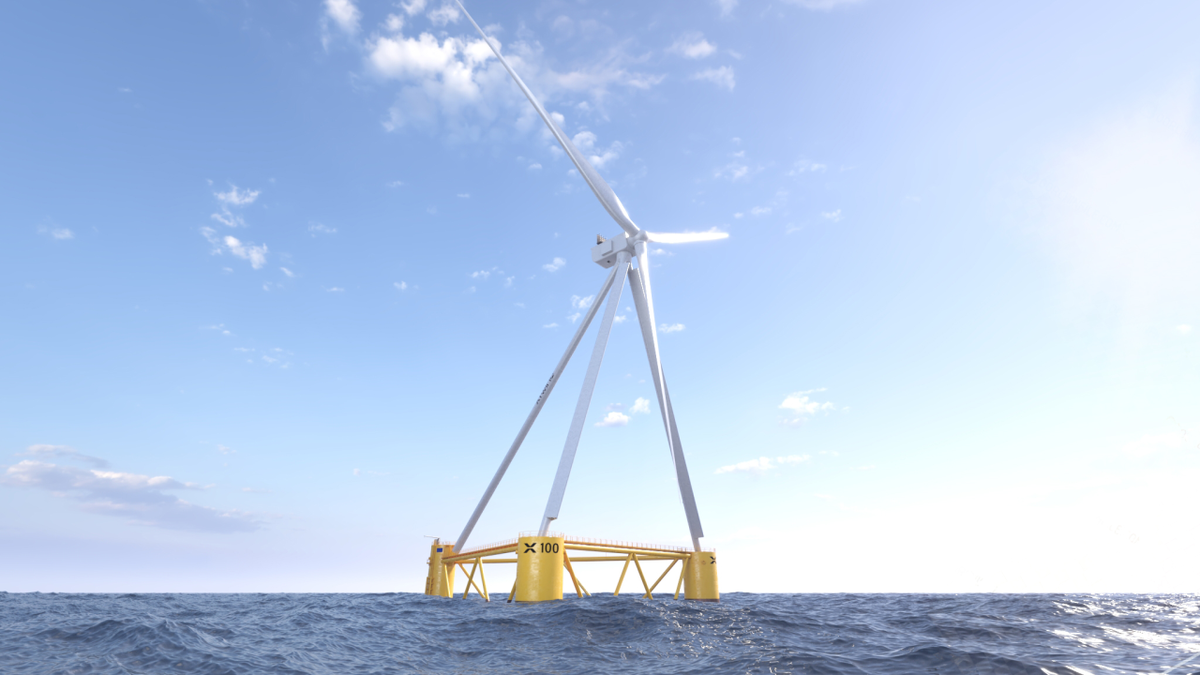
X1 Wind’s X100 floating offshore wind platform secures DNV certification
X1 Wind has reached an important milestone with its X100 pre-commercial platform, receiving a statement of compliance (SoC) for basic design from DNV


Certification of the X100 was carried out according to DNV-SE-0442 ‘Certification of floating wind turbines.’ This independent endorsement confirms that the X100 design meets rigorous international safety, engineering, and technical requirements, and validates the platform’s integrity and constructability.
“Achieving basic design certification is a pivotal step in X1 Wind’s roadmap,” said the company. “It confirms that the platform’s structural design, stability, and hydrodynamic behaviour – including its response to 500-years extreme waves, wind, and currents – are within safe and predictable limits.
“Under the scope of basic design approval, DNV has verified the calculation methodologies used by X1 Wind, and the design of the platform, including the station-keeping system, weathervaning structure, and integration of the turbine, for a 25-year service life.
Approval significantly accelerates the certification process for commercial-scale units, and the company already has contracts in place for the scaled-up X150 version, suitable for 15-20MW turbines for projects in Europe and Asia, using the same approved calculation methodologies established within the X100 certification.
X1 Wind chief technology officer and co-founder Carlos Casanovas said, “Completing basic design certification is a major milestone for X1 Wind. It demonstrates that our innovative design meets the highest international standards whilst greatly reducing the costs of floating offshore wind.
“This independent validation is crucial for technical assurance and to build trust with our partners and future clients, and it serves as a very strong basis for the certification of our commercial-size units.”
The X100 platform will be deployed at the PLEMCAT test site in the Mediterranean as part of the NextFloat Project. Led by Technip Energies and X1 Wind, this EU-funded initiative aims to accelerate the industrialization of floating wind and substantially reduce its levelized cost of energy. It is supported by private capital, the EU-funded projects NextFloat and NextFloat+, the PAREF project funded by the French state as part of France 2030 operated by ADEME, and the Spanish Government programme RenMarinas.
The X100 platform is designed for turbines with power ratings ranging from 6 MW to up to 10 MW, depending on site conditions. The pilot will operate in offshore conditions for several years, providing essential data to support final prototype certification and enable commercial-scale deployment and full-scale commercialization.
X1 Wind’s technology combines the stability and low environmental impact of a tension-leg platform with the cost-efficiency of semi-submersible structures. This allows for a primary steel platform of approximately 1,500 tonnes, which X1 Wind says is an estimated weight saving of 30% to 50% compared to traditional steel floaters installed in European pre-commercial projects of a similar scale.
Related to this Story


Events

Maritime Regulations Webinar Week
 16 Dec 2025
 GMT - ONLINE
Floating energy: successfully unlocking stranded gas using FLNGs and FSRUs
24 Feb 2026GMT - ONLINE
© 2026 Riviera Maritime Media Ltd.


