


Business Sectors
Business Sectors
Events
Contents
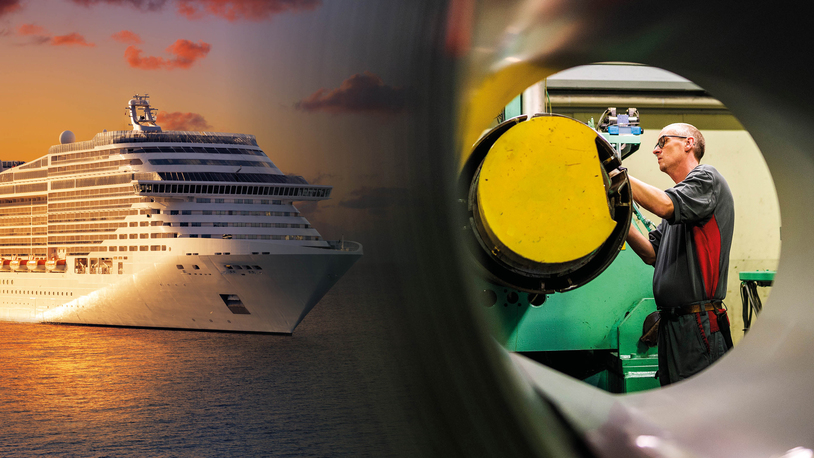
An alternative to phenolic epoxy tank coatings


The carriage of chemicals in bulk at sea needs to follow the regulations in Solas chapter VII (on the carriage of dangerous goods) and the International Convention for the Prevention of Pollution from Ships (Marpol), particularly Annex II Regulations for the Control of Pollution by Noxious Liquid Substances in Bulk.
Both conventions require chemical tankers built after 1 July 1986 to comply with the International Bulk Chemical Code (IBC Code), which sets out the international standards for the safe carriage, in bulk by sea, of dangerous chemicals and noxious liquid substances. The IBC Code sets out a list of chemicals and their hazards, and identifies both the ship type required to carry that product and the environmental hazard rating. There are approximately 1,800 cargoes in the IBC Code and Marpol convention that must be in a marine resistance list.
From a classification point of view, a chemical tanker means a ship constructed or adapted and used for the carriage in bulk of any liquid product listed in Marpol Annex II, Chapter 17. A product tanker means an oil tanker engaged in the trade of carrying oil other than crude oil, i.e. products like naphtha, gasoline, gas oil, jet fuel and other fuel oils. The IBC Code defines three types of chemical tankers intended to carry Chapter 17 products: ship type 1–3, with decreasing severity in environmental and safety hazards.
Crude oil accounts for three quarters of the volume of global seaborne trade of liquid cargoes, products accounts for 19 per cent, and chemicals for the remaining 6 per cent. From 1 January 2013, it became mandatory for crude oil tankers to coat the lower parts and top of the cargo oil tanks with an IMO PSPC type-approved coating, typically 2 x 160µm dry film thickness of a standard universal-primer epoxy. A product tanker carries refined crude oil products and white oils, including CPP, naphtha, jet fuel, gasoline, diesel and DPP. The cargo tanks of product tankers are coated with pure epoxy coatings for carriage of refined oil products. If the product carrier also loads vegetable oils, it is recommended that the cargo tank be coated with phenolic epoxy coating to resist the free fatty acid content of the cargo. Chemical tankers carry organic and inorganic chemicals, molasses, and vegetable, animal and lube oils, so the cargo tanks need to be coated with a phenolic epoxy coating with the best chemical resistance and longest dependable track record.
A cargo tank coating needs to be resistant to the cargoes the ship intends to carry. Consult the online resistance guides from major coating suppliers to assure that the cargo can be carried safely. If there are no organic or inorganic coatings that are resistant to strong acids, stainless steel tanks are the best option. No tank coating technologies 100 per cent fulfil all user needs, so the shipowner or operator needs to consult their cargo list and compare with the supplier resistance lists or seek the advice of their supplier.
For certain cargoes carried, there can be some absorption of the cargo by the coating. Desorption of the cargo depends on temperature, relative humidity, ventilation in the cargo tank, type of absorbed cargo and tank cleaning. Tank coatings require time to recover (conditioning time) after carriage of aggressive cargoes so that the small amounts of previous cargo carried cannot contaminate the next cargo to be carried. The conditioning time is used to restore the coating after carriage of aggressive cargoes, which tend to be adsorbed in the coating film. During conditioning the cargo is desorbed by a time-dependant diffusion. Conditioning of a phenolic epoxy tank coating is required after carriage of aggressive cargoes. The conditioning time for a phenolic epoxy is 5-10 days, depending on the cargo carried. An inorganic zinc silicate coating has a more open film, so slightly more cargo can be absorbed in the paint film, but 100 per cent of the cargo is desorbed from the paint film in four days. Certain cargoes are incompatible with the previous carried cargo. Methanol is one such special cargo to be aware of, and carrying edible cargoes in a tank after having carried a toxic cargo is another example. The paint supplier will be able to give advice on cargo sequencing.
Clean the tank upon discharge of a cargo to avoid contamination of the following cargo and prolong the life of the tank coating. Before cleaning, the tank needs to be vented to a gas-free state. Tank cleaning is first done with clean water, and then cleaning agents from the portable or fixed tank-cleaning machines. Using seawater for tank cleaning can ruin cargo tank pumps and contaminate cargoes. Before cleaning, it is always important to ask what to clean from and what to clean to. Always consult tank cleaning guides and cleaning agent suppliers for the best possible advice. This is particularly important if difficult residues need to be removed from the tank. To avoid damage to the tank coating, keep washing time as short as possible and the temperature of wash water as low as possible. When tank cleaning is finished, it is very important to vent the tank and bring it back to a dry and conditioned state before the next cargo is loaded. Be aware that water from tank cleaning or from condensing air in a tank that will carry methanol can be a problem. There are different max water content tolerances for different tank coatings when carrying methanol, and these need to be complied with in order to avoid damage to the tank coating.
A tank coating supplier offers advice about the coating to avoid cargo contamination, and to ensure that the coating is resistant to the cargo carried and kept in good condition to avoid premature breakdown due to mechanical abuse. A tanker owner or operator has a number of requirements of the coating in the cargo tank during operation. Foremost, the tank coating should have chemical resistance according to trade, and have low cargo absorption and retention. It should be easy to clean, and have a short conditioning time between cargoes. Last but not least, it should have a long service life.
Both in a newbuilding and a maintenance situation, the tank coating should be practical without strict temperature limitations during application. Tank coating supplier Hempel has introduced a low-temperature, fast-curing, high-functionality pure epoxy tank coating called Hempadur 15600. The amine curative chemistry in this coating secures higher crosslink density almost on level with an epoxy novolac, so overall chemical resistance is higher than for a normal pure epoxy tank coating. We are used to minimum curing and application temperature for phenolic and pure epoxies being +5 to 15ºC, but this new curing chemistry moves this limit all the way down to -5ºC, which makes it far easier and more secure with winter application in a cold climate, both for newbuilding and maintenance.
The industry is accustomed to phenolic epoxy requiring 10 days to be fully cured at 20ºC and a pure epoxy requiring seven days to be fully cured at 20ºC. Hempadur 15600 is moving the time to achieve full curing down to only three days at 20ºC, which means that the coating will require 4-7 days less time to be brought back to service compared with epoxy or phenolic epoxy tank coatings currently used. Hempadur 15600 has been PSPC type-approved by class for both crude oil tanks and ballast tanks as a two-coat system (2 x 160µm dry film thickness). The high glass transition temperature, Tg, of the coating also prevents discoloration of the coating on long-term immersion in warm crude oil, which facilitates ROV tank inspection. The coating is a fully viable alternative to phenolic epoxies for grey/black water and mud/brine tanks as a two-coat system (2 x 125µm dry film thickness). It has passed IMO PSPC testing for crude oil tanks at 60ºC, 70ºC, 80ºC, 90ºC and 95ºC, which makes this coating a viable alternative to phenolic epoxy tank coatings when high-temperature resistance to crude oil is needed.
* This article is an edited version of a longer presentation made at November’s Tanker Shipping & Trade Conference by Dr Michael Aamodt, global product manager for tank coatings at Hempel A/S Group Marine Marketing


Related to this Story

Events

© 2026 Riviera Maritime Media Ltd.


