


Business Sectors
Business Sectors
Events
Contents

Simulation meets automation to enhance ROV training and analysis


Training on laptops and using cloud-based systems to teach personnel look set to become a feature of the marine industry
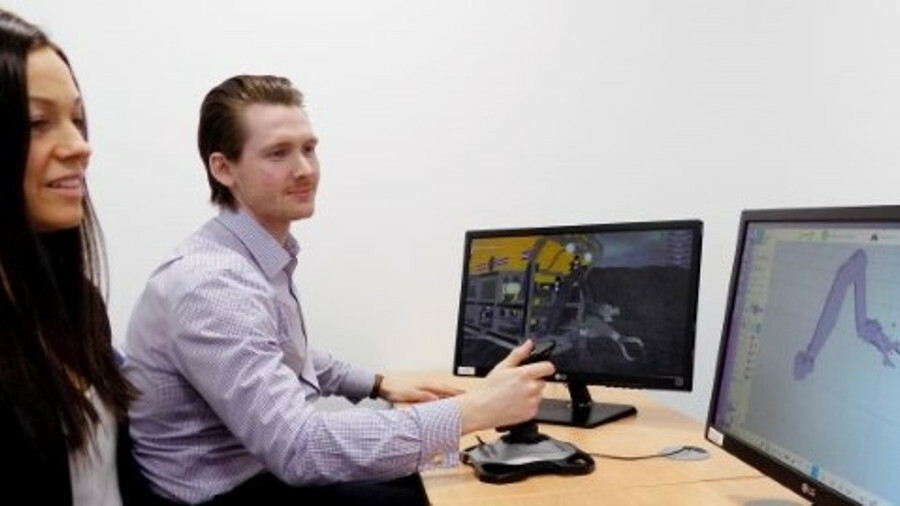
Forum Subsea Technologies and BluHaptics are to collaborate to provide training solutions for remotely operated vehicle (ROV) and subsea engineering applications.
The collaboration brings together Forum’s VMAX software, a 3D ROV simulation product, with BluHaptics’ Dex-OS manipulator control system.
VMAX is used to train and evaluate ROV pilots as well as by subsea engineering teams for modelling and verification of procedures involving intervention tasks related to installing and maintaining subsea equipment.
It can provide a range of ROV training scenarios designed to test pilots’ skills in realistic operational scenarios, many of which require the use of a seven-function manipulator. The user interface for manipulator control is key to providing a realistic user experience.
BluHaptics’ Dex-OS manipulator control system provides an intuitive user interface with the ability to introduce variable levels of automation to make execution of subsea intervention tasks more safe and efficient.
The company describes it as a cost-effective alternative for control of seven-function manipulators within VMAX simulated operations. The company also anticipates that it will provide variable levels of automation to offer inspiration for engineering teams seeking to improve operations involving increasingly complex intervention scenarios.
For ROV operators who are interested in implementing BluHaptics Dex-OS technology into their ROV fleet, VMAX and BluHaptics can now offer a simulated environment as a platform for demonstration and transition training to ROV pilots without tying up expensive ROV assets. Both systems operate on laptops, which offers mobility, convenience and flexibility.
VMAX product director Andy McAra said “We have seen an increase in the use of 3D simulation products by engineers for evaluating subsea systems and the way in which underwater vehicles interact with them.
“For engineers who are a not accustomed to piloting an ROV, let alone controlling a seven-function manipulator, we can now offer a very cost-effective and intuitive alternative to the legacy controller.”
BluHaptics VP business development Luke Wissmann explained that Forum’s portable VMAX simulator had made it possible to demonstrate its Dex-OS system in conference rooms around the world. He said this has enabled the company to demonstrate how the system functions in real-world scenarios. “So demonstrations become very credible, and the value proposition of Dex-OS becomes even more apparent,” he said.
Simulation as a service
Kongsberg Digital has signed the British Columbia Institute of Technology (BCIT) as a pilot-customer for the cloud-based application of its K-Sim simulation technology.
BCIT will be among the first to offer simulation as a service by integrating K-Sim with the new Kognifai digital platform, to enable its students to train anytime and anywhere.
Initially, Kongsberg Digital will focus on enabling students at BCIT’s School of Energy to use the K-Sim Engine thermal power plant (TPP) simulator for engineers by giving them access to the simulator on their own devices. However, the ‘train anytime and anywhere’ strategy is set to improve and extend the use of simulation in other industries too.
In addition to the K-Sim Engine TPP, the first maritime engine room simulators will soon be running in the Kognifai cloud environment, extending the K-Sim product offering from traditional classroom and full-mission simulators to include self-study training where students can use their own computers to access high-quality, simulation-based courses.
With cloud-based training, instructors can assign exercises to students who can complete them anytime and anywhere. The training provider can complement traditional simulator training in the centre with training beyond physical confines and opening hours.
The benefits of cloud-based training using high-quality simulators that are easily accessed and managed by instructors and students through a web portal are numerous.
Through integration of the K-Sim platform with Kognifai, Kongsberg Digital focuses on convenience and ease of use for all users to ensure that students have a more complete and flexible platform to reach their training objectives. Additionally, as the solution is provided as a service, the cost is directly related to the usage, and providers only pay for licences that are used. The cloud-based software licences can for example be integrated within course fees, making the cost-management risk to the training provider virtually zero.


Related to this Story

Events

© 2026 Riviera Maritime Media Ltd.


