


Business Sectors
Business Sectors
Events
Contents
Register to read more articles.
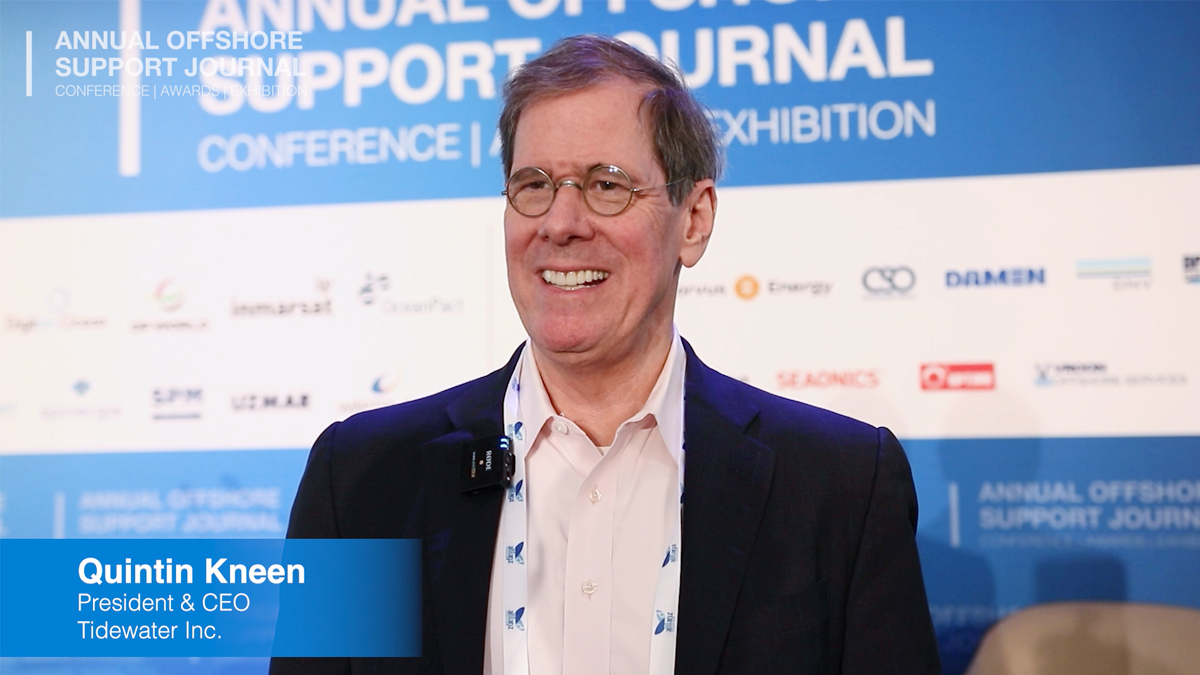
Tidewater chief on the benefits partnerships bring for OSV owners
Tidewater is seeking more opportunities for mergers and acquisitions after purchasing Wilson Sons’ Ultratug to build its fleet in Brazil


Owners have previously built too many vessels during a market upturn, which stresses the system and brings financial distress – Tidewater president and chief executive Quintin Kneen wishes to prevent this.
In a video interview on the sidelines of Riviera’s Annual Offshore Support Journal Conference, in London, UK, on 4 February 2026, he urged owners not to over-order newbuilds and to seek partnerships instead.
“There is a tendency in any shipping industry, but particularly in the offshore industry, for companies to find themselves in financial distress,” said Mr Kneen. “It happens in several different ways, but most of the time it happens from building too many vessels. When we build too many vessels, we stress the system.”
When newbuilds enter owners’ fleets, they often do not have enough seafarers to run them or the money to keep them well-maintained.
“We stress the maintenance supplies, we stress the supplier network, and as a result, things get more expensive and usually more expensive than we were anticipating when we ordered the vessels initially,” said Mr Kneen. “As a result, we do not have enough day rate income to justify spending money on people, safety, training and also on maintenance.”
He said this can lead to vessels becoming unreliable. “They become less safe, and they are not as enjoyable to work on. “So for me, to make this industry better, we have to control the supply.”
Tidewater operates 209 vessels worldwide, mainly in West Africa, the Middle East, the North Sea, South America and southeast Asia.
Mr Kneen said mergers enable owners to overcome some of the financial and commercial challenges, such as rising operational expenses from hiring highly trained crew, purchasing spares and vessel maintenance.
For competent people, training, safety and well-maintained vessels are vital for operating a standardised fleet in global markets.
“At the end of the day, I believe it comes down to having the best people on our ships that makes them the most effective, the most efficient, the most reliable and the safest.”
Mr Kneen said charter day rates are not high enough to attract fleet investment and to maintain vessels and owner profitability.
He is advising OSV owners to consolidate more to have larger fleets operating in key regional markets where they would have greater power over charter rates.
"These companies could then set the standard for safety, training and personnel satisfaction, and make this industry a lot better than it is today," he said. “There is a lot of fragmented ownership in our industry today. Owners would benefit from becoming part of one organisation, not just Tidewater, but also other organisations.
“If there were five or six, perhaps 10 large OSV companies around the world, those companies could set the standard for training, safety and personnel satisfaction. And I think that would make this industry a lot better than it is today.
It would prevent the industry from going into financial distress as easily because operational cost inflation could be shared across larger fleets and owners to build a buffer for when any market downturn occurs.
After the video interview, Tidewater announced its plans to acquire Wilson Sons Ultratug in a US$500M transaction to build its fleet in Brazil.
Wilson Sons Ultratug, a joint venture between Brazil’s Wilson Sons and Chile-headquartered Ultratug, owns 22 platform supply vessels supporting Brazil’s booming offshore oil and gas industry.
Riviera’s Offshore Support Journal Conference, Brazil, will be held in Rio de Janeiro on 13-14 October 2026. Use this link for more information and to register for the event.
Events
© 2026 Riviera Maritime Media Ltd.


