


Business Sectors
Events
Contents
Register to read more articles.
Can gas transform Africa’s energy future?
New discoveries in Namibia and investments in floating LNG have put the spotlight on Africa’s vast natural gas resources


Offshore oil and gas E&P opportunities in Africa are luring investment from international and domestic energy companies, highlighted this past year by major new discoveries in Namibia, first oil from a newly installed FPSO in Angola, and large LNG projects in Senegal and Mauritania. These investments, aimed at monetising the continent’s hydrocarbon resources, are strengthening its regional energy security.
Natural gas, and by extension, liquefied natural gas (LNG), are playing central roles in Africa’s future energy mix. In October, Shell Nigeria Exploration and Production and Sunlink Energies and Resources took a positive FID on a new offshore project in the Gulf of Guinea that will supply feed gas to a seventh liquefaction train at the Nigeria LNG (NLNG), one of the world’s largest LNG export facilities.
Olu Arowolo Verheijen, special adviser on energy to Nigerian president Tinubu, provided some perspective on the importance of Shell’s US$2Bn investment in the HI gas field and that of TotalEnergies in the Ubeta gas field to meet the country’s energy export objectives and raise its standard of living.
“With the Ubeta FID and now the HI FID, we have secured the gas supply needed to make NLNG Train 7 not just possible, but transformative,” said Ms Verheijen. “These projects will significantly strengthen the reliability of Nigeria’s LNG exports to global markets, while expanding LPG supply for domestic use, reducing imports, boosting foreign exchange earnings, and advancing clean cooking access for millions of Nigerian households,” she added.
For the project, Shell will develop the HI gas field, located in 100 m of water and about 50 km from shore, initially installing a wellhead platform with capacity to drill four wells over the field and a multiphase pipeline to deliver gas and associated liquids to a processing plant at Bonny Island.
"While Mozambique has some of Africa’s largest gas resources, only 48% of its own citizens have access to electricity"
Condensates will be separated and exported through the nearby tanker loading terminal and gas will be liquefied in train 7 of the NLNG plant.
According to Shell, there are around 285M barrels of oil equivalent (boe) of recoverable resources in HI and peak production will hit about 9.9M m3 (around 60,000 boe) of gas per day.
Investment in the HI gas field is indicative of Shell’s strategy of developing known hydrocarbon resources in nations where it has significant long-term interest, like Nigeria, to extend and expand production from existing infrastructure.

Bonga North FID
This risk aversion is evident in Shell’s positive FID in December 2024 on the Bonga North project. This involves a subsea tieback to the Shell-operated Bonga FPSO, which has been producing for 20 years. Bonga North Project will require the drilling, completing and starting up of 16 wells (eight production and eight water injection wells), modifications to the existing Bonga FPSO and the installation of new subsea hardware tied back to the vessel. Shell now holds a 67.5% interest in the OML 118 production sharing contract, which includes the Bonga field, after its US$510M deal to acquire TotalEnergies’ minor stake was approved by the Nigerian Government.
“These projects strengthen the reliability of Nigeria’s LNG exports”
Shell president for upstream, Peter Costello, said the positive FIDs in Bonga North and HI demonstrate the oil major’s “continued commitment to Nigeria’s energy sector, with a focus on deepwater and integrated gas.” Mr Costello added: “This upstream project will help Shell grow our leading integrated gas portfolio, while supporting Nigeria’s plans to become a more significant player in the global LNG market.”
The NLNG plant at Bonny Island has six liquefaction trains, with a total processing capacity of 22M tonnes per annum (mta) of LNG and up to 5M tonnes of natural gas liquids (LPG and condensate).
African FLNG
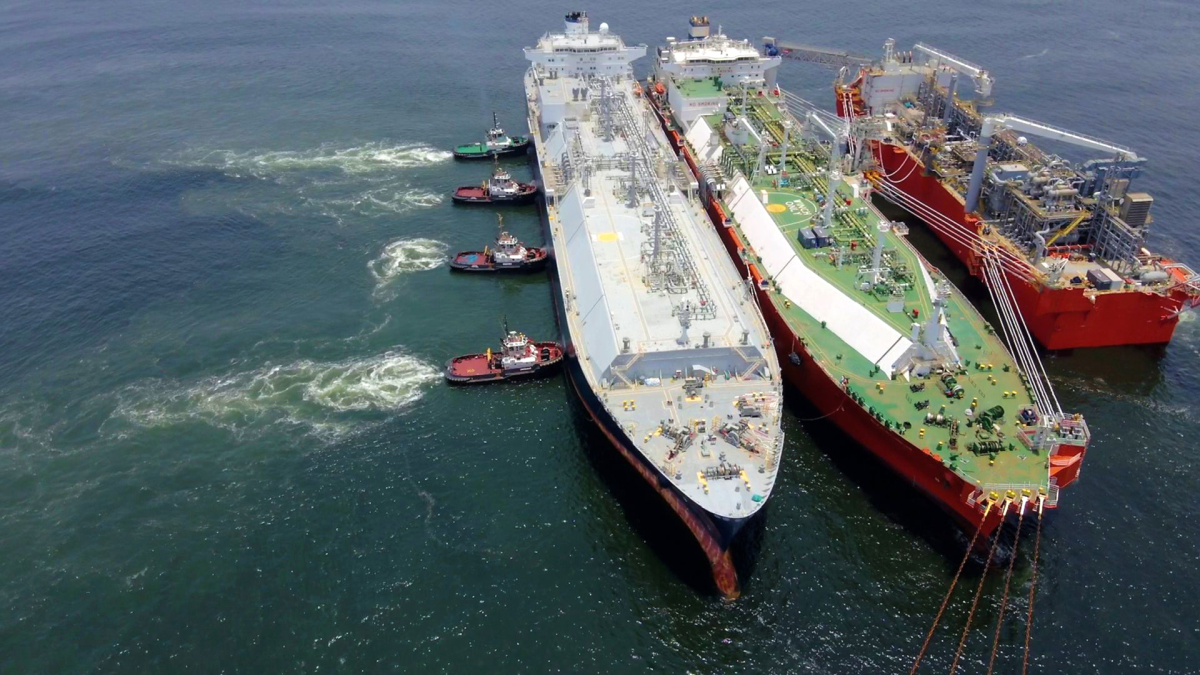
Playing no small part in Africa’s ambitions to grow its energy security are several existing and new floating LNG (FLNG) projects; these are either operational or under development on its shelf on the west coast and in ultra-deep waters in the northwest offshore Mauritania and Senegal and southeast offshore Mozambique.
Among those operating is Eni’s Congo LNG project, which began exporting gas in February 2024 with the Tango FLNG facility. A second and larger vessel, Nguya FLNG, arrived in September, which, once commissioned, will boost the total project capacity to 3 mta.
The Greater Tortue Ahmeyim (GTA) project, led by BP, started production in mid-2025, while Eni’s Coral Sul FLNG project has been operational since 2022. Africa’s first FLNG, Hilli Episeyo, in Cameroon, has been in service since 2018.
Under development are Perenco’s Cap Lopez FLNG in Gabon, the UTM Offshore FLNG project in Nigeria, and Eni’s Coral North FLNG project in Mozambique. Eni and its partners CNPC, ENH, Kogas, and XRG reached FID in October to develop the Coral North FLNG project.
If delivered on schedule, Coral North FLNG will begin production in 2028. With a production liquefaction capacity of 3.6 mta, the newly built Coral North FLNG, coupled with its predecessor Coral South, will bring Mozambique’s overall LNG production to more than 7 mta, making the country the third-largest LNG producer in Africa.
As the International Energy Agency (IEA) said in its Energy Policy Review of the country, the development activities of the Mozambique LNG project were suspended by TotalEnergies in 2021, due to the increase in insurgent violence in the Cabo Delgado province, but is now expected to resume by the end of 2025.
And while Mozambique has some of Africa’s largest gas resources, only 48% of its own citizens have access to electricity and nearly 95% of the population rely on traditional fuels, ie wood and charcoal, for cooking, according to the IEA.
Namibia’s Orange Basin
One of West Africa’s newest natural gas discoveries was reported by Rhino Resources in October. The discovery of rich-gas condensate bearing reserves occurred in Block 2914A in deepwater offshore Orange Basin, Namibia.
Petroleum Exploration License 85 (PEL85), where the well was drilled, is operated by Rhino in a joint venture partnership with Azule Energy (42.5%), NAMCOR (10%) and Korres Investments (5%). Rhino holds the remaining 42.5% stake.
The Volans-1X exploration well, spudded at the end of July using Northern Ocean’s semi-submersible drilling rig Deepsea Mira, reached a total depth of 4,497.5 m. The semi-submersible was contracted in July for a campaign covering one firm well for Rhino, one firm well for another operator and three optional wells, with an estimated firm duration of 112 days and a projected value of some US$40M.
The rig demobilised on 14 September to begin drilling in another location, while Volans-1X laboratory testing activities will remain ongoing.
Deepsea Mira is one of two harsh environment semis owned by the Oslo-listed drilling contractor. The other is Deepsea Bollsta, which is on long-term contract to Norwegian oil major Equinor. Both semis are managed by Odfjell Drilling.
It has been a banner year for Rhino Resources in Namibia. The energy company’s chief executive, Travis Smith, said this was Rhino’s third consecutive hydrocarbon discovery on the block, following those made at Sagittarius-1X and Capricornus-1X.
Rhino’s Angola-based partner, Azule Energy, is a 50-50 JV between BP and Eni. The Volans-1X well marks the third significant hydrocarbon discovery in 2025 for Azule Energy partners, following the Capricornus-1X light oil find in Namibia and the Gajajeira-01 gas discovery in Angola.
New integrated hub
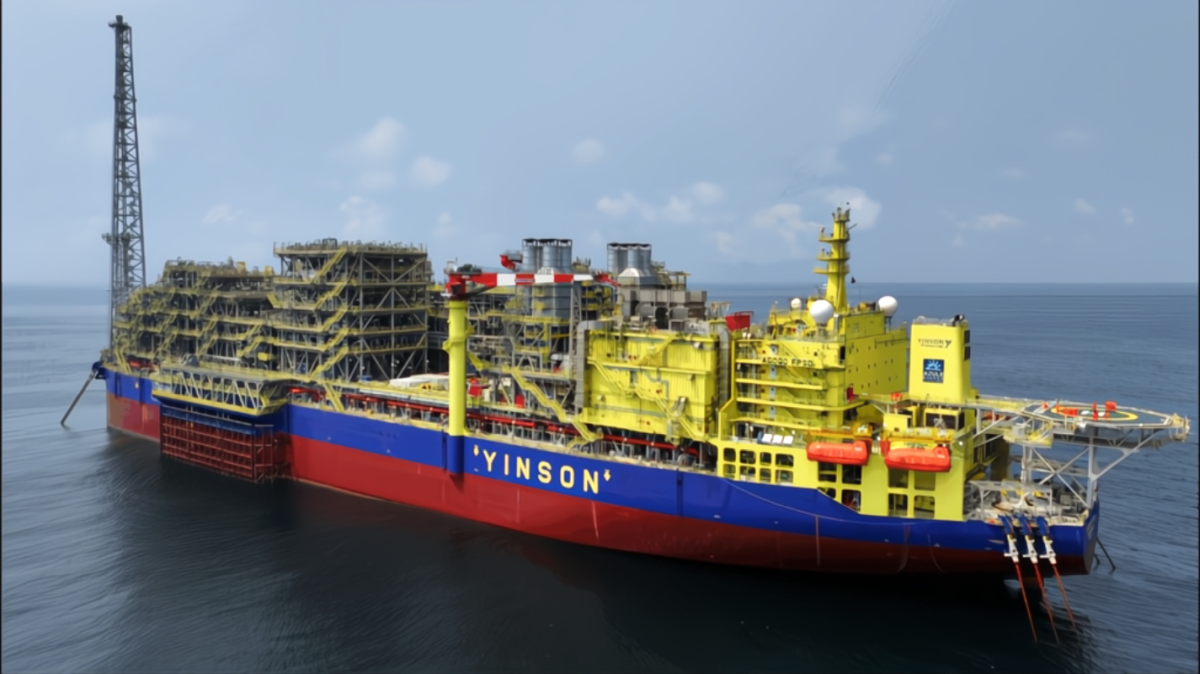
In July, Azule Energy announced the successful startup and first oil production from the Agogo FPSO offshore Angola. The FPSO is the centrepiece of the Agogo Integrated West Hub (Agogo IWH) project, which involves the development of two fields, Agogo and Ndungu, in the West Hub of Block 15/06. As operator of the Agogo IWH project, Azule Energy has a 36.84% stake, with the remaining interests held by Sonangol E&P (36.84%) and Sinopec International (26.32%). Estimates put the combined reserves of the Agogo and Ndungu fields at about 450M barrels, with projected peak production of 175,000 barrels of oil per day (bopd), produced by two FPSOs, Agogo and Ngoma.
Sanctioned in February 2023, the Agogo IWH project began production in just 29 months, setting new benchmarks for the industry.
“The startup of the Agogo IWH project, sanctioned just months after Azule Energy’s formation, represents a defining moment for our company,” said Azule Energy chief executive, Adriano Mongini.
Azule Energy has inked a 15-year contract to the lease for the Agogo FPSO from Yinson Production and holds optional annual extensions of up to five years. The total contract value is more than US$5Bn.
An FPSO with carbon capture
Agogo FPSO represents a step change in floating production vessel design; it has an array of advanced technology designed to minimise its operational environmental impact, while maximising operational efficiency. All topside and marine systems have been designed to be fully electric and it has emissions-reducing technologies, including a closed flare system, hydrocarbon blanketing, combined cycle power generation technology, automated process controls and all-electric drives. Additionally, it is the world’s first operating FPSO with a pilot post-combustion carbon capture and storage system onboard.
Related to this Story

Events

Maritime Regulations Webinar Week
 16 Dec 2025
 GMT - ONLINE
Floating energy: successfully unlocking stranded gas using FLNGs and FSRUs
24 Feb 2026GMT - ONLINE
© 2024 Riviera Maritime Media Ltd.


