


Business Sectors
Business Sectors
Events
Contents
Mooring lines never sleep – the dangers of tension fatigue
As MEG4 points out, “mooring is one of the most complex and dangerous operations for ship and terminal crew. If something goes wrong, the consequences can be severe.”


The mooring of a big ship has always been one of the most important functions of all-round seamanship. And it is becoming even more so because of mounting pressure to make the process safer, faster and – critically – more reliable following too many incidents of vessels breaking free.
When the fourth edition of the Mooring Equipment Guidelines, known as MEG4, was released in 2018 by the Oil Companies International Marine Forum, it set new and higher safety standards. The OCIMF recognised that lines had to rise to the challenge of faster port turnarounds, ever-larger vessels and widely varying conditions including the effect of extreme heat and cold on lines.
As MEG4 points out, “mooring is one of the most complex and dangerous operations for ship and terminal crew. If something goes wrong, the consequences can be severe.”
Avient which was closely involved in the development of the guidelines, welcomes these higher standards. Their Dyneema® SK78 fiber is purpose built to meet head-on the challenges of this new era in mooring.
MEG4 requires a much broader approach to the design of mooring rope than previously. As well as breaking load, rope diameter and other characteristics obvious at purchase, the guidelines encompassed a whole new range of parameters such as angled endurance, material breaking force at high temperatures and axial compression resistance.
In short, lifetime performance.
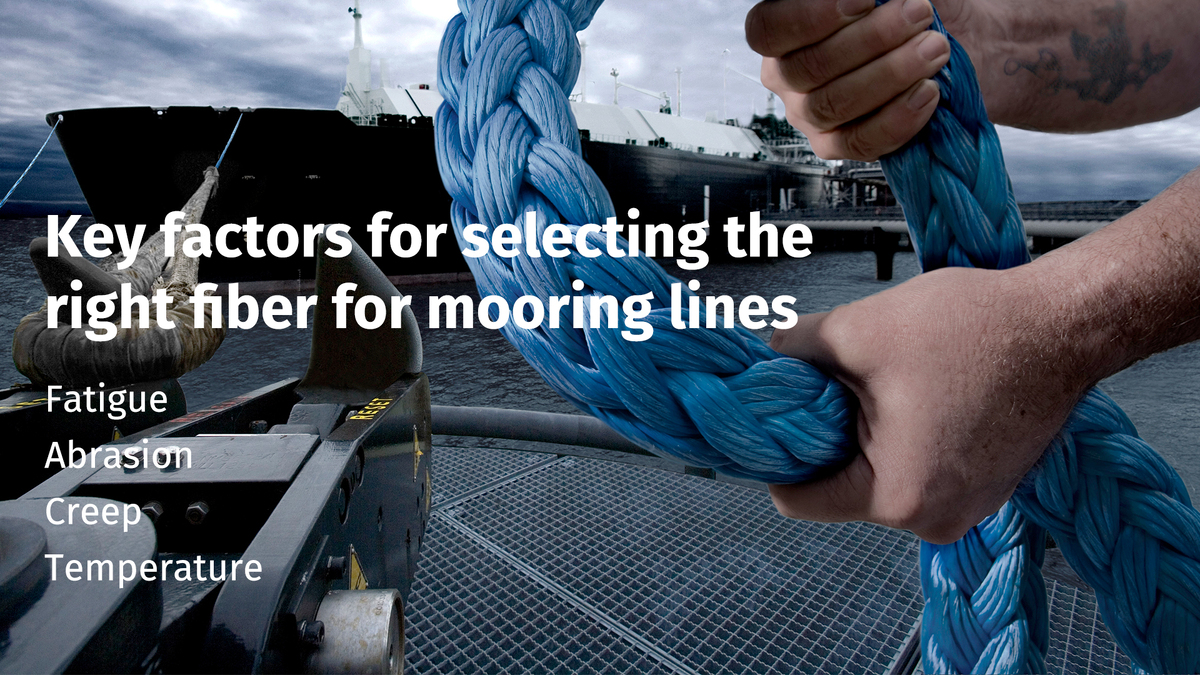
Mooring ropes should be made to last and provide comfort to ship operators, not least the crew. The challenge is, of course, that no ship, port, or crew is the same. So, in partnership with manufacturers of premium mooring ropes, Avient has long been working towards use-specific lines. That’s why mooring ropes made with Dyneema® SK78 are designed to handle the endless stresses and strains imposed during mooring operations that result in fatigue, abrasion, creep, and temperature. Any one of these “FACTs” can lead to failures.
Let’s first consider the importance of fatigue resistance.
Even in port, vessels never stop moving. They are constantly buffeted by wind, tide, current and passing ships. And mooring lines must take the strain, alternately tightening and slackening against huge tonnages. Simultaneously, yarns and strands rub against each other as they are subject to bending angles through, for example, fairleads. Inevitably, this contributes to material fatigue.
The mooring experts at Dyneema® have put together a video series about the FACTs to consider when selecting mooring lines. Their Tension Fatigue video explains how and why they have engineered Dyneema® SK78 so that it offers at least three times the fatigue life compared to generic alternatives
Want more information? Connect with one of Dyneema’s experts by clicking this link.

Related to this Story

Events

© 2026 Riviera Maritime Media Ltd.


