


Business Sectors
Business Sectors
Events
Contents
Register to read more articles.

Commercial structure, not technology, holds back CO2 shipping
CO2 Shipping & Terminals conference speakers stress that commercial models, not engineering gaps, are the real barrier


Although the engineering solutions for transporting liquefied CO2 are proven and available, commercial misalignment, uncertain volumes, and undeveloped financial structures continue to delay project delivery.
The disconnection between emitters, transport developers, and storage providers is leaving shipping companies without the contractual clarity required to proceed.
Navigator Gas business development manager Nina Lynn observed while interest in liquefied CO2 transport is growing, most initiatives remain nascent and dispersed. “These projects are at different stages of maturity and quite dispersed. There is no central backbone yet,” she said.
Ms Lynn underlined the necessity of collection hubs to consolidate volume and provide confidence for investment in tonnage. “We need hubs or collection points,” she said.
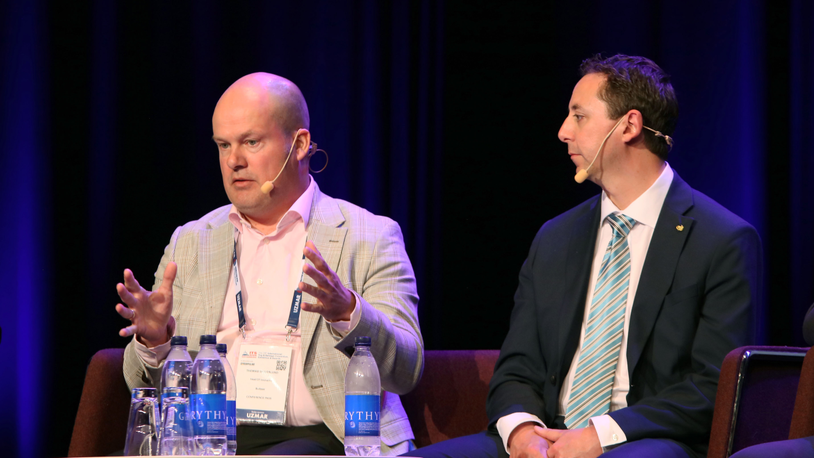
This assessment was echoed during a panel discussion in London, where panellists addressed the structural constraints facing carbon shipping. The conversation formed part of Session 4 of the CO2 Shipping & Terminals Conference, held at the Hilton Waldorf Hotel on 17 June 2025.
Veri Energy head of stores development Chris Armes emphasised the systemic complexity holding back progress. “Carbon shipping is currently not financeable,” he said. “There is congestion and complexity across the value chain. You cannot do this with a spreadsheet and a Zoom call.”
Mr Armes described the current project environment as disjointed, with emitters, capture developers and storage operators misaligned. “We need emitters that want to move carbon and people that can take it and store it – without that connection, we are stuck.”
Mitsui OSK Lines director and head of strategy and decarbonisation Bruce Moore said the company had moved upstream in project lifecycles to exert earlier influence. “We realised we need to go into these projects earlier, to help structure them,” he said. “If you are waiting for an RFP, you are already behind.”
From the technology supplier perspective, TGE Marine Gas Engineering sales director Jakob Nielsen said containment and handling systems are ready. “We have done the engineering. This is not where the challenge lies,” he said. He instead highlighted the need for system-level standardisation and replicable structures. “There is no need to reinvent every time.”
On the legal side, Norton Rose Fulbright partner Alistair Black cautioned fragmented regulatory regimes create uncertainty over custody and liability. “Liability frameworks remain patchy. There is still uncertainty over what happens across borders or during an off-spec event,” he said. Mr Black advised early-stage contract harmonisation across emitters, carriers and storage developers to minimise future disputes.
Societe Generale head of advisory – EMEA and Americas, Chris Wright, explained finance will not be forthcoming without firm commitments. “We are ready, but we cannot lend against uncertain volume and no anchor contract,” he said. Societe Generale project finance executive Justine Bouyssou added financial readiness must be embedded from the outset. “You need to be bankable from day one. That is the starting point.”
Both speakers agreed structured finance could support CO2 transport projects, but only where counterparties are identified, and cash flow certainty is evident. As Mr Moore observed, “The technology is ready. The challenge is the commercial model.”
The CO2 Shipping & Terminals Conference was made possible through the generous support of its sponsors. Gold sponsors included ABS, DNV, Bureau Veritas, Lloyd’s Register, Mitsui OSK Lines, OCEOS, Societe Generale, and TGE Marine. Capital Clean Energy Carriers was the silver sponsor, with the Carbon Capture & Storage Association the supporting organisation.
Riviera’s CO2 Shipping, Terminals & CCS Conference, Europe will be held in Milan on 8 September 2025. Use this link to register your interest and attend the event.
Related to this Story
Events

Maritime Regulations Webinar Week
 16 Dec 2025
 GMT - ONLINE
Floating energy: successfully unlocking stranded gas using FLNGs and FSRUs
24 Feb 2026GMT - ONLINE
© 2026 Riviera Maritime Media Ltd.


