


Business Sectors
Events
Contents
Register to read more articles.
Ever Forward refloated, Maryland asks Evergreen for US$100M to cover costs
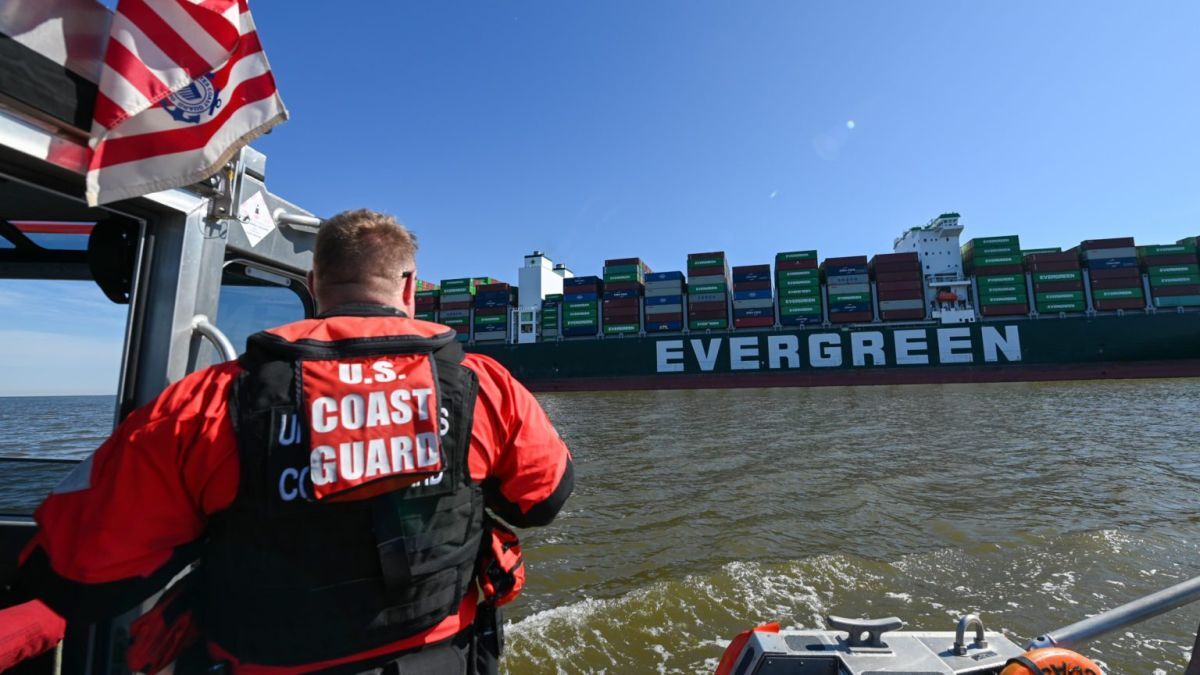
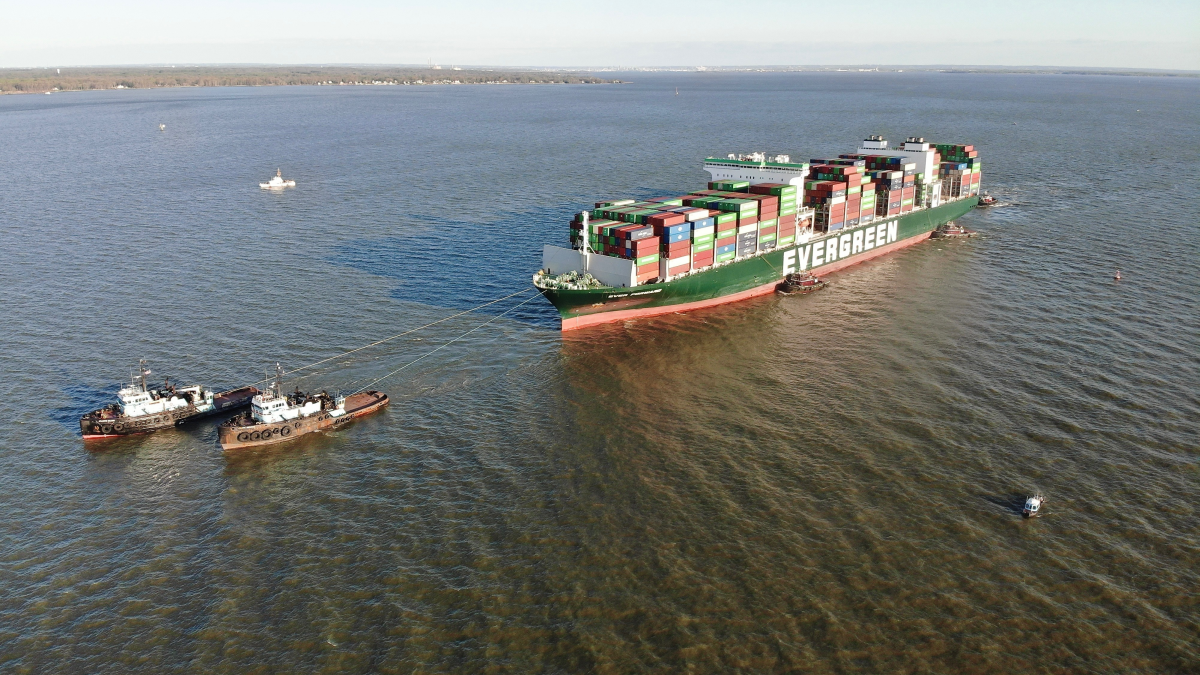
Ever Forward grounded near Baltimore, Maryland, on the US east coast in early March 2022 and lodged in several feet of mud, requiring extensive dredging to free the vessel, nearly a year after sister ship Ever Given disrupted global trade by grounding in and blocking traffic through the Suez Canal


Update:
21 April
After inspection, Ever Forward has reportedly been found to be free of damage and is to return to Baltimore to recover the containers removed in salvage operations before continuing its scheduled route.
"Throughout the refloating efforts, Ever Forward had been regularly found to be free of damage from the incident and there is no indication of fuel leakage or pollution," a statement from Evergreen Line said.
19 April
After 35 days, salvors have freed grounded box ship Ever Forward.
The salvage efforts involved multiple local, state and federal US agencies and teams of private experts to manage the extensive salvage, dredging and offloading operations that comprised the vessel’s rescue.
According to the vessel’s operators, Evergreen Line, the ship will undergo an inspection before returning to the port of Baltimore to reload some of the more than 500 containers that had been removed from the vessel to lighten it enough to overcome the ground force keeping Ever Forward lodged in a muddy shoal of the Chesapeake Bay.
"After the containers were removed, two pulling barges, two tugs from Donjon-SMIT, two tugs from Moran, and two tugs from McAllister freed Ever Forward at approximately 7am [on 18 April]," a US Coast Guard (USCG) statement on the incident said.
Operations to remove the 500 containers with crane barges ran from 9 to 16 April and dredging removed 157,700 m3 of material to a depth of 13 m the USCG said. The dredged material will be used to offset erosion at the Paul S Sarbanes Ecosystem Restoration project.
A letter from Maryland comptroller Peter Franchot called for Evergreen Line to establish an initial US$100M ’responsibility fund’ to compensate and reimburse those involved or whose livelihoods will be impacted by the incident.
Addressing Evergreen Shipping Agency (America) Corp president Benjamin Tsai, the letter said, "This incident has caused, and potentially could cause more environmental damage to the Chesapeake Bay".
"Among its potential consequences include damage to oyster beds and disruptions to the spawning season for several species that our seafood industry – already struggling economically due to labour shortages – will harvest in the coming months," Mr Franchot said in his letter.
Evergreen Line thanked the salvors in a statement, saying, "Evergreen Line is deeply appreciative of the efforts put forth by Donjon-Smit, the salvor, the US Coast Guard, competent authorities of the State of Maryland, and the service providers that were engaged, all of whom worked hard to bring this event to a successful conclusion."
7 April
Days after prior refloat attempts failed, with Ever Forward still hard aground, salvors have determined a lightering operation, in which cargo is transferred from one vessel to another, may reduce weight on board and make the vessel buoyant enough to move.
Dredging operations will continue, according to the US Coast Guard’s fifth division, which is overseeing operational safety.
The salvage team from Donjon Smit determined they would not be able to overcome the ground force Ever Forward is producing, wedged into a muddy, shallow shoal in the Chesapeake Bay.
"The new strategy offers the best chance of successfully refloating Ever Forward," the US Coast Guard said. "The previously announced dredging will continue to a depth of 13 m and shipping containers will now be removed as soon as... two crane barges, with suitable lift heights to remove containers, are installed."
The coast guard said containers will be removed in daylight hours from both the port and starboard sides and placed on receiving barges. The barges will then shuttle the containers back to the Seagrit Marine Terminal in Baltimore, where they will be offloaded.
"Once the containers are removed, tugs and pull barges will attempt another refloat. The shipping channel will remain open to one-way traffic during these operations, any changes will be announced via normal maritime means. All aspects of the operation should take approximately two weeks, however that timeline may change based on weather conditions and other variables," the coast guard said.
The coast guard will maintain the 457-m safety zone around the ship in the Chesapeake Bay for the duration of the operation, with the adjacent shipping channel unaffected.
31 March
Evergreen Line has announced it has declared General Average (GA) on the cargo aboard Ever Forward as refloating attempts drag on.
"Evergreen Line has been making every effort to refloat the stranded ship on behalf of the common interests of cargo owners and the safety of all involved. In light of the increasing costs arising from the continued attempts to refloat the vessel, Evergreen declared General Average today," the company said in a press statement.
After the incident happened, Evergreen appointed the salvor Donjon Smit to conduct underwater inspections and design a refloating plan.
"The program included dredging around the stranded vessel to increase buoyancy and deploying tugboats for the rescue operation. With the approval by the competent authorities, the dredging operation began 20 March. Subsequent to the completion of the initial dredging phase, the rescue team made two attempts to refloat Ever Forward on 29 and 30 March. Unfortunately, both attempts proved to be unsuccessful," Evergreen Line said.
"Considering that the complexity of further rescue operations will require more manpower, equipment and costs to refloat the stranded vessel as soon as possible, Evergreen has for cautionary purposes declared General Average," the company said. "Evergreen Line urges all cargo interests involved, and joint venture slot users to provide security bonds and necessary documents according to the adjusting rules that govern GA in order to take delivery of cargo after the vessel is freed and arrives at its future ports of discharge."
30 March
Ever Forward remains grounded near Baltimore on the US east coast more than two weeks after the vessel sailed outside of the designated navigational channel into shallow water and lodged in several feet of mud.
Local reports said a refloating attempt on 29 March was unsuccessful after extended dredging operations sought to free the vessel’s hull.
With five tugs pulling, the vessel reportedly had not moved after six hours, and salvage teams called a halt to operations.
A Baltimore news station reported that another attempt will be made on 30 March, when a higher tide is expected. Weather conditions, with high winds in the area, held water levels at bay from their expected high tide peak on 29 March.
The US Coast Guard (USCG) cited weather conditions for delays and set a back up date if Wednesday’s refloating efforts are unsuccessful.
"If required, additional dredging operations will commence and a second attempt to refloat the Ever Forward would then be expected to occur on or about 3 April," the USCG said.
21 March
Salvors have drawn up plans to refloat Evergreen Line box ship Ever Forward that are reminiscent of the extended efforts required to refloat the Ever Given box ship in the Suez Canal in March 2021.
Donjon Smit salvage operators have determined dredgers will be required to free Ever Forward from its grounding point in the US’ Chesapeake Bay following multiple underwater inspections of the vessel.
Dredgers will be used to excavate around the stranded vessel to remove part of the mud surrounding the 12,000-TEU vessel, increase the buoyancy of the hull, and increase the clearance between the propeller, rudder and the seabed, according to Evergreen Line.
"The rescue team is mobilising all available local tugboats to join in the refloating operation. After sufficient mud is excavated, the amount of ballast water on Ever Forward will be adjusted to reduce the ship’s weight and the refloating operation will begin using both the tugboats and the power of its main engine. The rescue team will carry out the plan utilising the most beneficial high tide period in the port area," the company said.
Maritime claims consultancy WK Webster said salvage operations could be "protracted and difficult" and require the removal of containers from the vessel to lighten it. The company reported Ever Forward was running with a 13-m draft when it hit bottom in waters just 7.5-m deep.
"It is reported that shipowners and salvors have submitted a plan to refloat the vessel to the authorities, which involves releasing ballast to lighten the vessel and dredging the sea bottom around the vessel before attempting to refloat the vessel at high tide using the vessel’s main engine and tug assistance. The agreement of the authorities to the salvage plan is, however, required before the operation can be commenced," WK Webster said.
"Other reports indicate that two dredgers are currently in the vicinity of the vessel. It appears that the dredging operation may therefore commence soon, although it is suggested that dredging may take up to a week to complete before attempts may be taken to safely refloat the vessel. The apparent complexity, time and expense of the salvage operation now makes the possibility of shipowners declaring General Average more likely," WK Webster said.
17 March
Evergreen Line has said there is no damage to the vessel, following its grounding in Chesapeake Bay in the US, and named the salvor it has appointed to refloat the vessel.
"After Evergreen’s 12,000-teu container ship Ever Forward ran aground in Baltimore, the company immediately activated its emergency response plan and arranged for divers to conduct underwater inspections. We can confirm that the accident did not cause damage to the vessel’s hull and there is no leakage of fuel. The propeller and rudder of the ship are fully functional," the company said.
Evergreen said it has has also appointed salvor Donjon Smit to join the rescue operation.
"A team of experts are at the scene to assess the vessel’s grounding condition, the weight of the cargo on board and the tidal range at the location in Chesapeake Bay. This information will be used to design an effective plan to refloat Ever Forward. As soon as the plan is approved by the competent authority, we will immediately put it into effect," Evergreen Line said.
Evergreen’s 12,000-TEU container ship Ever Forward became stuck on the soft estuary ground of the Chesapeake Bay on 13 March.
15 March
Ever Forward remains grounded near the Craigshill Channel in Chesapeake Bay. The 334-m (1,095-foot long), Hong Kong-flagged ship is not obstructing the navigational channel. However, authorities have implemented a one-way traffic system and vessels operating in the vicinity are required to transit at a reduced speed.
The US Coast Guard (USCG) is on site, off the coast of Maryland, along with a salvage company assigned by the shipowners. The Maryland Department of the Environment and USCG are co-ordinating the initial refloating attempts for the 2020-built container ship. And Maritime claims consultancy WK Webster said a team of salvage experts including naval architects and divers have boarded the vessel to determine the best course of action to refloat the vessel.
Given the location of its grounding, WK Webster said "significant efforts may be required to refloat the vessel and it is possible that recovery issues may arise in respect of any time and/or temperature sensitive cargo in the event of any prolonged delay in the vessel’s schedule".
The USCG said there were no injuries or pollution linked to the grounding or damage to the vessel, in initial reports.
14 March
Evergreen Line ultra-large container vessel Ever Forward has grounded off the US east coast, near the port of Baltimore, Maryland, in the Chesapeake Bay.
US Coast Guard units are on site with the vessel.
"Coast Guard responders are working closely with personnel from the Maryland Department of the Environment to monitor the container ship, investigate how the ship grounded, and develop a plan to safely refloat the ship," the USCG said.
"A Captain of the Port Order has been issued by the Coast Guard requiring the vessel’s crew to conduct soundings of all tanks, bilges, and voids every four hours to monitor potential pollution and report any noticeable change in stability, draft readings, vessel position, or signs of an oil discharge. Additionally, the Coast Guard is enforcing a 500-yard safety zone around the Ever Forward to ensure the safety of those on and around the vessel as well as the safety of the marine environment during ongoing salvage operations."
A statement from ship operator Evergreen Line said the cause of the incident is under investigation.
"At 20:40 on March 13, EDT, Ever Forward, a 12,000 TEU container ship deployed on Evergreen Line’s Asia-US East Coast (AUE) service ran aground when departing the Port of Baltimore. The incident has not caused a fuel leakage. Evergreen is arranging for divers to conduct underwater inspections to confirm any damage to the vessel and is coordinating with all the concerned parties to refloat the ship as soon as possible. The incident did not block the navigation channel or disrupt traffic entering or leaving the port. The cause of the incident is under investigation by the competent authority."
Elsewhere, European waters have seen collisions involving container ships stemming from ship handling and navigational errors, causing damage, cargo loss and environmental threats.
Container ship Laust Maersk collided with Balearic ferry Napoles on 12 March in the Mediterranean Sea. The 2001-built container ship was sailing from Algeciras, Spain to Italy when it struck the ropax ferry, which was en route from Malaga, Spain to Melilla in north Africa. There were no reported injuries, but at least one container was lost and the fore section portside above the waterline of Napoles was damaged.
In Poland, two container ships collided during berthing operations in the Port of Gdansk. According to Fleetmon, container ship Escape struck the stern of berthed container ship Hanni at the DCT Container Terminal on 14 March. Escape was undocking at the time to sail to its next Baltic destination. Both ships sustained minor damage.
In Dominican Republic, cruise ship Norwegian Escape had to be refloated after it grounded with passengers on board on 14 March, while leaving Puerto Plata. This ship was taken back to port for assessments, but there were no reports of injuries or serious damage.
Meanwhile, in eastern Canada, a fleet of tugs was mobilised to assist a drifting Capesize bulk carrier to prevent its grounding. At least four tugs were sent to bring bulk carrier Comanche to safety after its master reported engine failure on 11 March, while transiting Placentia Bay off Newfoundland. It was sailing from Pointe Noire Canada to Suez when there was a mechanical breakdown. The tugs have connected to the maritime casualty and are moving north under the supervision of the Canadian Coast Guard.
Sign up now for the Container Ship Tech & Ops Webinar Week, 11 April 2022
Related to this Story
Events

Maritime Regulations Webinar Week
 16 Dec 2025
 GMT - ONLINE
Floating energy: successfully unlocking stranded gas using FLNGs and FSRUs
24 Feb 2026GMT - ONLINE
© 2024 Riviera Maritime Media Ltd.


