


Business Sectors
Business Sectors
Events
Contents
Register to read more articles.

Decoding the salvage paradox in Liverpool
The British Tugowners Association’s Annual Conference in Liverpool offered a rare window into how salvage works in practice. What emerged was of direct relevance to anyone with a vessel, cargo or insurance exposure at risk


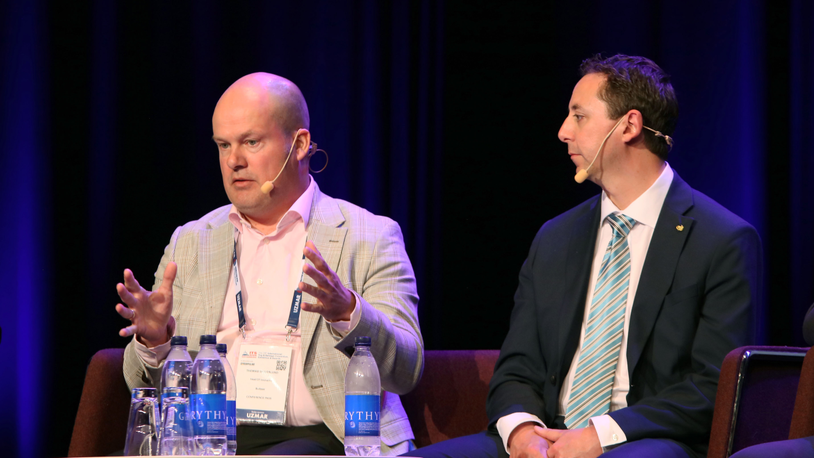
Salvage law is simple in principle but difficult in application. As Michael Howard KC of Quadrant Chambers told delegates at the recent British Tugowners Association’s Annual Conference in Liverpool: “It’s a maze, not a motorway. But you try to end up in the same place (as any other arbitrator) whatever route you take."
At the heart of the framework is Article 13 of the 1989 Salvage Convention, the mechanism by which salvage reward is assessed when there is no time or opportunity to agree a contract. This is not a fee arrangement. It is a structured valuation process, conducted across a set of unweighted factors and ultimately resolved by negotiation or by an arbitrator exercising experience and judgment. For complex casualties, where conditions are dangerous and decisions must be made quickly, it is precisely this flexibility that makes the Convention fit for purpose.
Those factors include the value of the salved property (the only fixed number) alongside danger, skill and promptness, environmental risk and operational professionalism. From these factors, a single figure must be produced.
In practice, three considerations tend to dominate. The salved value sets the ceiling. The degree of danger sets the tone. And the nature and duration of the services, in other words what was done, by whom and under what conditions, fill the space between.

A mock arbitration illustrated how this works. Emerald City, a 59,938 dwt container vessel, grounded on a coral reef in the South China Sea after a failed avoidance manoeuvre. With flooding, a port list, and Indonesian authorities requiring bunker removal before work could begin, salvors patched, lightened, refloated and delivered the vessel to Singapore within 20 days. The salved fund was approximately US$80.8M; expenses were US$3.3M, including US$1.5M for bunker removal on terms later described by Mr Howard as extortionate.
James Severn of Penningtons Manches Cooper, arguing for the salvors, emphasised severe peril, skilful execution in a difficult jurisdiction, and the Convention’s encouragement principle. This is the long-established notion that arbitrators should set awards at a level sufficient to sustain and incentivise the salvage industry as a whole. Joseph Riley, also of Penningtons Manches Cooper, representing the property interests, countered that conditions were relatively benign, risks overstated, some work unnecessary, and the bunker removal costs unrecoverable since the fuel was retained by the contractor. Mr Howard awarded US$12M.
Delegates were invited to estimate the outcome after hearing submissions but in advance of the arbitrator’s award. The spread of guesses was wide (in some cases very wide) which illustrated how opaque the process can appear to people unfamiliar with salvage operations, though the award itself fell within a range that experienced practitioners would recognise as defensible.
For the towage sector, the implications are direct. The industry is moving into more complex casualties, including floating offshore wind and alternative-fuel vessels, under a legal framework that has remained largely unchanged since 1989. The assets are evolving; the principles are not.
That continuity is a feature, not a flaw concluded Mr Severn. Lloyd’s Open Form and the Salvage Convention offer a well-established, commercially viable framework for handling precisely the kind of complex, time-critical situations the sector increasingly faces, he added. "The perception that LOF is too expensive or too unwieldy does not survive scrutiny: the arbitration process provides checks, balances and the opportunity to test every element of a claim before experienced decision-makers."
The room was left in no doubt: when tested, awards will still hinge on those Article 13 principles.
Related to this Story

Events

Maritime Regulations Webinar Week
 16 Dec 2025
 GMT - ONLINE
Floating energy: successfully unlocking stranded gas using FLNGs and FSRUs
24 Feb 2026GMT - ONLINE
© 2026 Riviera Maritime Media Ltd.


