


Business Sectors
Business Sectors
Events
Contents
Register to read more articles.
Five lessons about VLEC design
Experience classing a new generation of very large ethane carriers provides lessons on containment systems, cargo handling and fuel choices, among others, says ABS senior principal engineer, Greece Stavros Niotis


Emerging from the US shale gas boom, the growing trade in ethane — an important feedstock for the petrochemical industry — has given birth to a new generation of very large ethane carriers (VLECs). These ships demonstrate technical innovation on a number of levels, providing lessons that may have broader applications outside of the gas carrier sector.
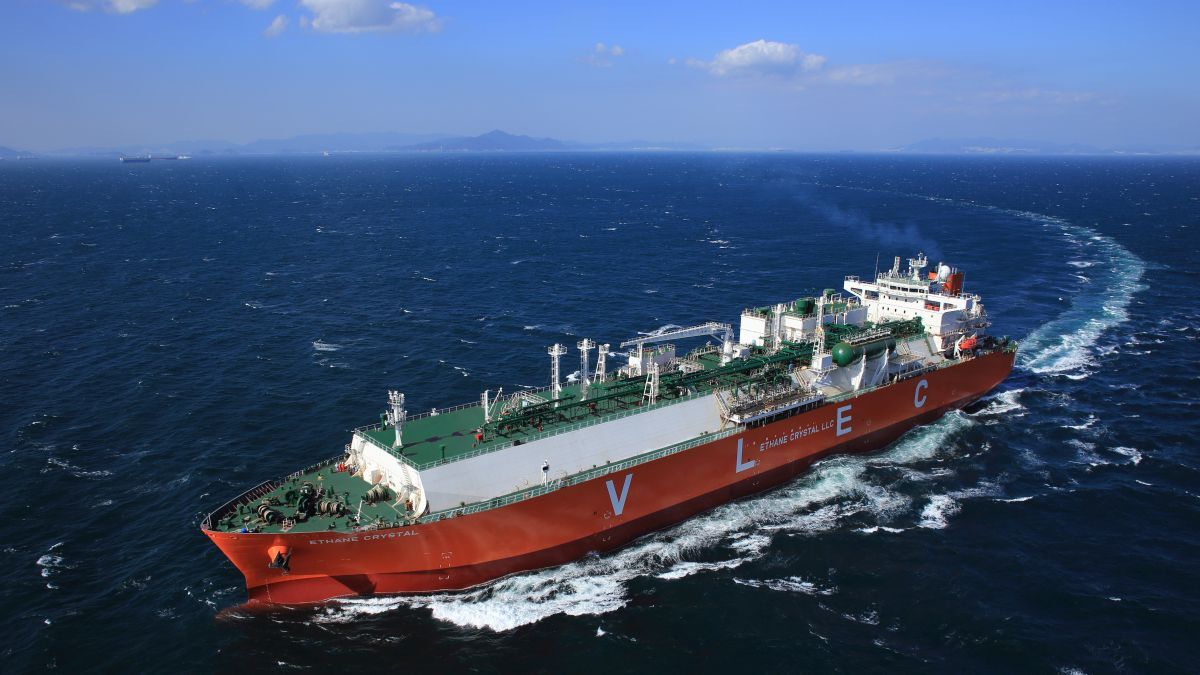
The very first of these new-generation VLECs were a series of 87,000 m3 ships built in South Korea for the Reliance project in India and were delivered between 2016 and 2017. The first of these ships was Ethane Crystal. These vessels featured the GTT Mark III membrane system, but used conventional fuel. A further six 98,000 m3 ships were next built in South Korea for the Satellite project in China, but with engines capable of burning the ethane cargo as fuel.
The same project has been extended to another six 98,000 m3 ships under construction in South Korea with the same GTT Mark III tanks, again with engines capable of burning the ethane as fuel. Another two ships of the same capacity, but with Type B tanks, are under construction for Satellite in China. ABS is classing a further two under construction in China with Type B tanks and the same ethane capacity.
Overall, ABS has provided class services for 12 VLECs in service, all fitted with GTT Mark III containment systems. Half of these ships have ethane-burning engines and the other half, conventional fuel engines. Another 10 ships are under construction, six in South Korea with GTT Mark III and ethane as fuel, and four in China with Type B cargo-containment tanks and ethane as fuel.
ABS has drawn five key lessons from its involvement in these projects.
Containment
In the early days of ethane transportation, cargo was transported in small ethylene/ethane carriers equipped with semi-refrigerated Type C tanks, designed and built in accordance with pressure vessel codes and standards that limited their capacity.
The need to transport larger quantities of ethane created demand for other, more volume-efficient, tank types. The boiling temperature of pure ethane is -88.6oC, but the boiling point of the actual cargo may vary depending on the composition and the presence of methane. Typical commercial ethane includes up to 0.8 mol% methane with a boiling point of -92oC.
According to the IGC Code and based on ethane’s boiling point, special material alloys must be used both on the primary and the secondary barrier of the cargo-containment system (CCS), where the minimum allowed temperature for 3.5% nickel steel is -90oC and for 5% nickel steel is -105oC.
“Fuel flexibility may be a key issue for the next generation of cargo ships”
The main CCS considered for VLECs are membrane-type tanks and the independent Type B tanks, which traditionally were developed and used for the large LNG carriers. There have only been a couple of projects built with independent Type C tanks (using bilobe or star-trilobe designs to increase the volume efficiency), but with limited capacities (not higher than 37,000 to 38,000 m3 ships with bilobe Type C tanks and 85k for ships with star trilobe Type C).
Utilising a CCS previously developed for LNG cargoes for ethane transportation has brought some challenges due to the increased density of the cargo and the higher expected static and dynamic loads and especially sloshing loads, where the strength of a material increases as the temperature decreases. The higher temperature of ethane results in reduced strength of the materials used in the CCS compared to conventional LNG carriers.

The bigger challenge was for the membrane-type tanks, where new materials had to be introduced, such as high-density foam and aluminium wedges for reinforcing the primary membrane against sloshing loads. The impact of these new materials in the system design and principles had to be assessed in detail.
The membrane-type VLEC carriers feature the first application of membrane-type containment tanks for cargo other than methane, a design developed by GTT, known as Mark III Flex HD Foam. This provides the ships with the capability to load ethane and other LPG cargoes.
Cargo handling
Some of the membrane-type ships included the first application of deep-well cargo pumps used in conjunction with membrane-type tanks. This required the design of the pump tower to be specially assessed for the differences between standard submerged pumps and the deep-well pumps, in particular vibration and sloshing loads impact.
Specific challenges had to be addressed and resolved between the yard, class and shipowner. Special consideration needed to be given to the tank ‘cooling-down’ rate as limitations may occur, in order to minimise the differential temperature between the intermediate pipe and the shaft of the deep-well pump. Additionally, the pumps may also be affected by the differential temperature between tank top and bottom during discharging operations.
Since the molecular mass of ethane (30 g/mol) is heavier than air (28.96 g/mol) or nitrogen (28 g/mol), the sampling points of the gas detection system had to be placed at the bottom of each cargo space, unlike gas detection points on an LNG carrier (methane has a molecular mass of 16 g/mol) which are at the top of each cargo space.
Another critical aspect for storage of liquefied gas cargo is the reliquefaction system used to maintain the boil-off gas (BOG) pressure in the cargo tanks. The proportion of methane in the ethane impacts the boiling point. Higher methane content lowers the boil temperature of the ethane cargo and this impacts the design of the reliquefaction plant.
Early-generation VLEC designs, including the six Reliance VLECs currently in service, are designed to carry a maximum of 0.8% mol (the SI base unit) of methane in the ethane cargo. Some new ethane export projects are considering designing the export facility to provide ethane cargoes with a higher methane content of up to 2.0% mol. However, it is important to evaluate the cost savings on the export facility against the cost impact on shipping and the receiving facility.
Ethane as fuel
ABS had already amassed experience with ethane as fuel from the ships classed for Navigator Gas and the conversion from LNG to ethane as fuel of the main engine. The large VLECs drew on this work and, in particular, the approval process needed for burning alternative (non-toxic) cargoes as fuel, as permitted under the 2016 IGC Code 16.9 section and demonstrating that equivalency to the satisfaction of the flag administration.
The use of ethane as fuel is permitted under section 16.9 of the IGC Code and the same approval approach is also applied for burning LPG on an LPG carrier. The industry trend for new construction LPG carriers and some existing ship conversions to use their LPG cargoes as fuel is another example of an increased number of IGC ships looking to burn their cargoes as fuel.
The latest VLEC newbuilds saw the first application to ABS class of the MAN ES Pump Vaporiser Unit (PVU) system designed for the higher (380 bar) supply pressures required for the main engine ethane fuel gas supply system (FGSS).
Incorporating redundant high-pressure cryogenic pumps and vaporisers necessary to supply the higher fuel supply pressures required by the MAN ES ME-GIE engines, this FGSS skid unit was assembled and FAT tested at MAN Cryo in Sweden. Further testing was carried out in South Korea on a testbed supplying ethane to the engine for class approval and NOx testing purposes. Final testing was done onboard after first loading of the first ethane cargo.
“ABS has provided class services for 12 VLECs, all fitted with GTT Mark III containment systems”
ABS also provided approval of the MAN ES main engine safety concept and the relevant documents to the flag authority to demonstrate equivalency with the IGC Code gas detection requirements and with the option to install additional gas detectors where this was considered necessary.
While essentially similar to methane as fuel applications, the engine and FGSS systems for ethane do bring some additional technical and approval challenges, and therefore early engagement with class and flag is crucial to successful project execution.
Fuel flexibility
The application of alternative fuels such as ethane and LPG, while driven out of the gas carrier sector, also demonstrates potential application to other sectors and indicates that fuel flexibility may be a key issue for the next generation of cargo ships. Shipping must comply with increasingly tight environmental regulations, while continuing to present an economically attractive option to owners and charterers.
The shipping industry is also currently researching the use of ammonia as fuel for the potential or near zero, carbon emissions it promises when measured on a tank-to-wake basis.
The ability for gas carriers to use ammonia cargo as fuel (in the same way as ethane and methane) is currently explicitly excluded under the IGC Code on the basis of toxicity. However, the interest in ammonia as a fuel means future work to consider amending the IGC Code to allow burning of ammonia has already been agreed at IMO within a wider review of the IGC Code.
Other efforts on fuel flexibility fall under the IGF Code and where an increasing number of methanol carriers have been burning methanol cargo as fuel since around 2015/2016. Proof of concept on a mainstream ropax ferry, the Stena Germanica has also demonstrated the potential to other sectors. With the adoption by IMO of the MSC.1/Circ.1621 Interim Guidelines for methyl/ethyl alcohol fuels, the regulatory requirements for methanol or ethanol as fuel are now in place.
EEDI/EEXI Requirements
Another area of interest in using ethane as fuel surrounds the challenge of making Energy Efficiency Design Index (EEDI) calculations for ships that use cargo as fuel and specifically how this applies to ethane.
Under IMO regulations, all newly constructed ships require the attained EEDI to be determined and to meet the applicable IMO EEDI reference line as a measure of their energy efficiency. Existing vessels must also have an Energy Efficiency Existing Ship (EEXI) value, which reflects the vessel’s actual efficiency level in operation.
The current IMO calculation guidelines for EEDI do not list ethane fuel properties and its associated carbon (CF) fuel factor. Therefore, it is only possible to determine the EEDI when burning ethane as fuel based on agreed factors.
To facilitate the long-term general application of ethane and EEDI determination, ABS drafted paper MEPC 76/6/9, which was submitted by IACS to the IMO Marine Environmental Protection Committee. This paper proposes the additional fuel parameters and CF to enable calculation of the attained EEDI when burning ethane. This work is due to be considered at the next MEPC meeting in November 2021.



Related to this Story

Events

Maritime Regulations Webinar Week
 16 Dec 2025
 GMT - ONLINE
Floating energy: successfully unlocking stranded gas using FLNGs and FSRUs
24 Feb 2026GMT - ONLINE
© 2026 Riviera Maritime Media Ltd.


