


Business Sectors
Business Sectors
Events
Contents

Register to read more articles.

French-made cruise ship revives golden-age glamour with a technological twist
The world’s largest sailing yacht, Orient Express Corinthian has unique SolidSail technology and LNG-powered electrically driven propellers, combining ultra-luxury with sustainability


More than a century ago, The Orient Express redefined luxury rail travel, offering elegant dining, unparalleled pampering, and intriguing adventure in impeccably outfitted train cars.
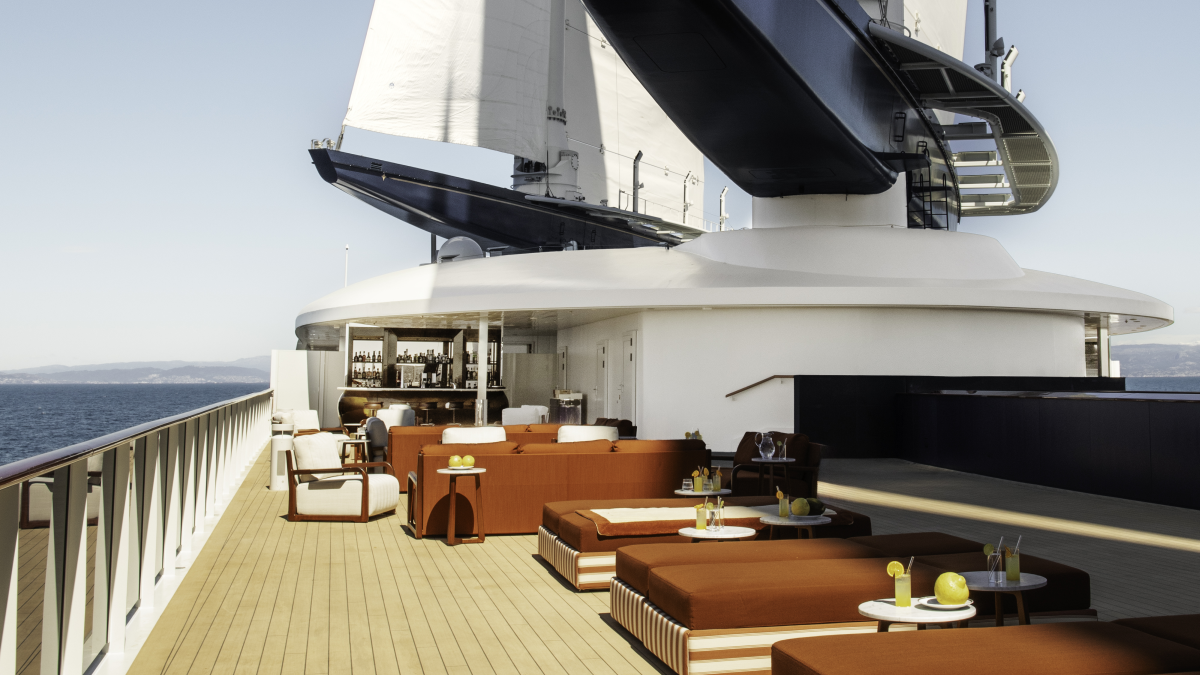
Designed in the same Art Deco style as the legendary trains, Orient Express Corinthian is bringing the romance of the Golden Age of Travel to the sea.
Designed by architect Maxime d’Angeac, the ship draws inspiration from the golden age of travel and France’s maritime heritage, referencing historic liners such as Normandie.
The first of two ultra-luxury cruise vessels for Orient Express Sailing Yachts from Accor, the ship accommodates 110 guests across 54 spacious suites, which range from 45 to 230 m² and have 3.6-m panoramic windows and dedicated butler service, and a crew of 170.
Five restaurants and private dining rooms are placed under the culinary direction of multi-Michelin-starred chef Yannick Alléno. The vessel features eight bars, an Art Deco-style speakeasy, a 115-seat cabaret, a recording studio, and the first Guerlain wellness spa at sea.
While health spas are an expected amenity onboard a luxury cruise ship, the onboard Guerlain facility takes wellness to another level. The spa is 500 square metres, with four treatment suites (including one VIP double suite), a classic and infrared sauna, a relaxation lounge, a barber, a beauty salon, a fitness space, and a 16.5-m lap lane with open-sky views.
Wind power and more
But make no mistake, this 220-metre-long vessel is not just a pretty face; it has state-of-the-art sustainable technology above and below deck. Billed as the “world’s largest sailing yacht,” the French-designed and built vessel is resplendent with advanced engineering. It starts with the vessel’s sails, explained an Orient Express Yachts spokesperson. “Orient Express Corinthian is the first cruise ship equipped with the SolidSail wind propulsion system, developed by Chantiers de l’Atlantique. Her three rigs, each spanning 1,500 m² and rising to over 320 feet (almost 98 m), are fully automated and capable of delivering 100% wind-powered propulsion in favourable conditions.
“This sailing vessel proudly showcases French expertise and craftsmanship”
“The SolidSails rotate through 360 degrees, maintaining optimal trim on any point of sail, whatever the wind direction. With carbon masts that can tilt to 70 degrees – designed, developed, and built in the Bretagne and Pays de la Loire regions – the ship clears the world’s great bridges without difficulty.”
Chantiers de l’Atlantique chief executive, Laurent Castaing, hailed the vessel as a “concrete, technical response to decarbonisation challenges,” noting that the project represents the culmination of a decade of R&D. Sea trials in February 2026 confirmed the design’s viability, with the ship achieving 12 knots under sail alone in 20 knots of wind.
“This is a first for a ship of this size,” observed an Orient Express Yachts spokesperson. And when it comes to CO2 emissions, they said the vessel is the “least-emitting ship in her class over long distances, powered by wind and liquefied natural gas. Maximised wind use, minimal carbon – largest vessel to move solely by wind.”
But when the wind is not enough, the ship can use LNG dual-fuel gensets to power its electrically driven propulsion.
“This revolutionary system is complemented by hybrid liquefied natural gas (LNG) propulsion and numerous energy efficiency features, earning her the best EEDI (Energy Efficiency Design Index) rating in her class, far ahead of any other vessel of comparable size,” added the ultra-luxury cruise company. The owner estimates that the ship’s hybrid propulsion system will help it avoid emitting 9,000 tonnes of CO2 emissions annually.
Five motors and five converters from Ingeteam Power Technology were supplied for ship propulsion systems. Two of the electric motors are used to directly drive the main propulsion. The twin Brunvoll controllable-pitch propellers are designed to be fully feathering to limit drag while sailing. Additionally, Brunvoll supplied its Thrust-OD Box, which works as a thrust bearing with a hydraulic system for the CP propellers.
Three of the Ingeteam motors and three frequency converters are used for the ship’s three transverse thrusters. The electric drive’s low vibration and noise levels maximise onboard comfort for passengers and crew.
“A unique experience designed for an international clientele”
Several Bureau Veritas notations demonstrate the vessel’s engineering, outfitting and attention to crew and passenger comfort. It carries BV’s COMF-NOISE-Pax 1, signifying the highest standard of onboard acoustic comfort for passengers. This indicates that passenger spaces are engineered and verified during sea trials to have exceptionally low noise levels, guaranteeing a top-tier, quiet, and relaxing environment. Its COMF-VIB-Pax 1PK notation signifies a premium, high-level passenger comfort certification for vibration onboard a cruise ship or passenger vessel.
When the ship docks, it can shut down its auxiliary engines and use the Ingeteam frequency converters to connect to the shore-power grid. This reduces CO2 and greenhouse gas (GHG) emissions while the vessel is in port.
Hybrid LNG power
Hybrid LNG propulsion power is supplied by four Wärtsilä 25DF engines, each developing 2,070 kW at 1,000 rpm. Wärtsilä 25DF engines have a two-stage turbocharging system, common-rail fuel injection, and cylinder-combustion control. This enables high power density and efficiency across the full operating range, delivering low fuel consumption and reduced emissions. The Finnish marine technology company also supplied four gas valve units and four Wärtsilä NOx reducers. These advanced emissions after-treatment systems use selective catalytic reduction (SCR) technology to convert harmful nitrogen oxides (NOx) into harmless nitrogen and water vapour. It cuts NOx emissions by up to 90%, ensuring medium-speed marine engines comply with IMO Tier III and EPA Tier III standards. The ambition is to use hydrogen propulsion in the future.
“The world’s largest sailing yacht”
Chantiers de l’Atlantique project manager, Yann Penduff, described the vessel and its sister ship as “very special cruise vessels [that] have been designed to operate with a high level of environmental sustainability. For this reason, the Wärtsilä 25DF engine was selected. It is silent, compact in size yet powerful in performance, so it was the perfect choice for these ships.”
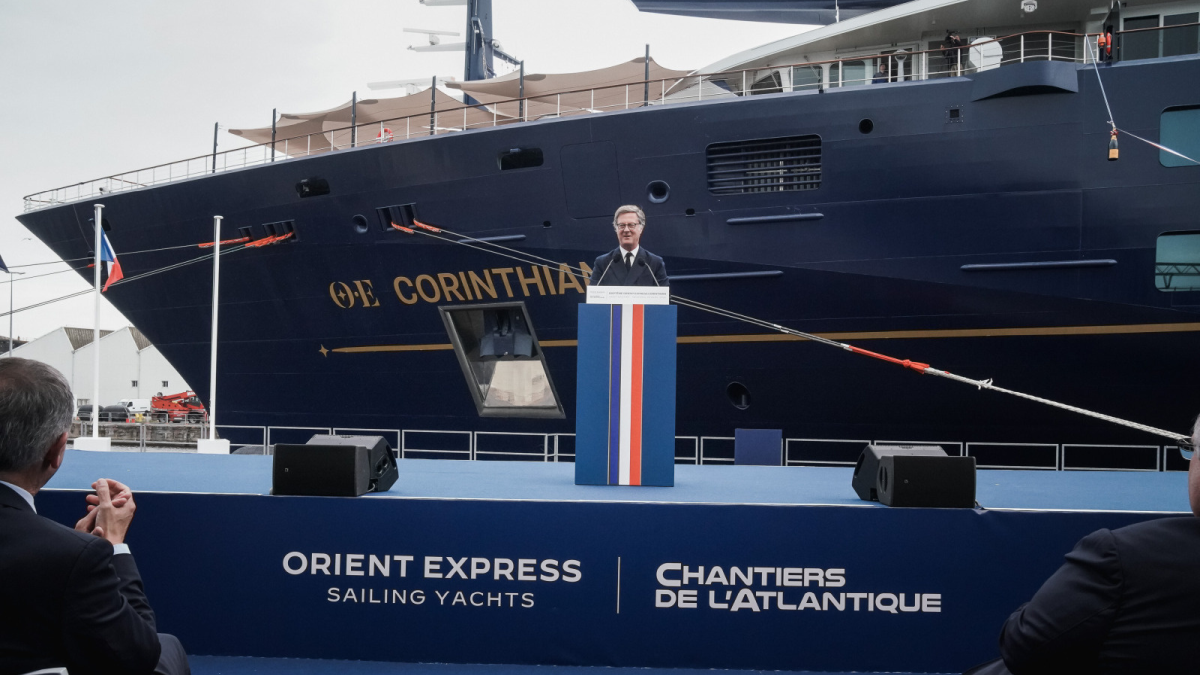
Named in ceremonies at Chantiers de l’Atlantique’s Joubert graving dock in Saint-Nazaire, France on 29 April, Orient Express Corinthian departed the shipyard on 2 May for its inaugural Mediterranean season. From May to October 2026, it will operate in the Mediterranean and Adriatic before crossing the Atlantic for the winter season in the Caribbean, with expansion into Northern Europe scheduled for 2027.
“Bringing Orient Express to the sea fits naturally within the imagination of this legendary brand: a journey rooted in discovery, unhurried time, excellence, and elegance. Orient Express Corinthian embodies this vision with majesty and boldness,” said Accor chairman and CEO, Sébastien Bazin, during the naming ceremonies.
It was fitting that the vessel’s naming ceremony was held at Joubert graving dock because of its place in French shipbuilding. Built during the interwar period to address the infrastructure constraints encountered during the fitting-out of the French ocean luxury liner Île-de-France, the dock was the birthplace of the legendary Normandie.
The naming ceremony opened with a flyover by four Fouga Magister jets, trailed by the colours of Le Tricolore – the blue, white, and red vertical stripes representing the French flag.
Catherine Chabaud, minister delegate for the Sea and Fisheries, officially presented the French ensign to Mr Castaing, granting the vessel the right to fly the French colours.
“It has state-of-the-art sustainable technology above and below deck”
The centrepiece of the ceremony was the formal transfer of ownership from the shipyard to the owner. Mr Castaing presented the ship to Mr Bazin and the president of Orient Express Sailing Yacht, Philippe Hetland Brault.
Mr Bazin also highlighted the role technology played in the ship’s design. “Thanks to its sail-powered propulsion, its spaces enhanced by rare materials, and by offering a unique experience designed for an international clientele, we have met a threefold challenge: industrial, architectural, and artistic. This sailing vessel, born from the collaboration and trust built over the past two years between Accor and Chantiers de l’Atlantique, now proudly showcases the very best of French expertise and craftsmanship.”
An AI-assisted detection system continuously monitors for marine mammals and objects in the water to reduce the risk of collision. The ship’s dynamic positioning system avoids disturbing the seabed by removing the need to anchor.
In 2022, Paris-based luxury brand holding company LVMH (Möet Hennessey Louis Vuitton) acquired a majority stake from Accor in the Orient Express subsidiary, with the goal of developing luxury trains, hotels, and cruise ships under the brand. That vision has been realised in Orient Express Corinthian, and its sister ship, Orient Express Olympian, which is being outfitted at the Penhoët quay in Saint-Nazaire, following its launch on 17 April 2026. Orient Express Sailing Yachts’ fleet could grow further if the owner exercises options for two more ultra-luxury sailing yachts.
Orient Express Corinthian
At a glance
Owner: Orient Express Sailing Yachts/Accor Group
Builder: Chantiers de l’Atlantique
Class: Bureau Veritas
Flag: France
GT: 26,305 tonnes
DWT: 3,116 tonnes
Overall length: 220.0 m
Beam: 25.2 m
Depth: 32 m
Draught: 5.6 m
Passenger capacity: 110
Suites: 54
Main engines: (4) Wärtsilä 25DF, total of 8,280 kW
Electric motors: Ingeteam
Frequency converters: Ingeteam
Propulsion: Brunvoll CP propellers
Sails: (3) Chantiers d’Atlantique SolidSails




Related to this Story
Events

Maritime Regulations Webinar Week
 16 Dec 2025
 GMT - ONLINE

Floating energy: successfully unlocking stranded gas using FLNGs and FSRUs
24 Feb 2026GMT - ONLINE
© 2026 Riviera Maritime Media Ltd.


