


Business Sectors
Business Sectors
Events
Contents

Register to read more articles.
Houthis cause 18M tonnes of added emissions
The Red Sea crisis has led to a “staggering” increase in container ship CO2 emissions


The latest Sea-Intelligence Sunday Spotlight analyses the “dramatic reversal” in years of progress in reducing the container shipping industry’s carbon footprint.
The ongoing crisis in the Red Sea and the rerouteing of vessels south of Africa, has led to a staggering 45% increase in CO2 emissions from container shipping in the European Union in 2024, according to mandatory EU emissions data under the EU Monitoring, Reporting, and Verification regulations. While the overall shipping sector saw a 10% rise in CO2 emissions, the impact on container shipping has been disproportionately severe.
Sea-Intelligence chief executive Alan Murphy said, “If, purely hypothetically, we assumed there was never a Red Sea crisis and the container lines would again in 2024 have reduced their total emissions by 4%, this would have led to total emissions of 35M tonnes in 2024. Instead, the reported reality was emissions of 53M tonnes. Assuming the primary cause of the emissions increase in 2024 is due to the round-Africa routeing, then the actions of the Houthis have caused an added level of CO2 emissions in 2024 related to container shipping of 18M tonnes. This is essentially the same as the carbon emissions from the country of Cambodia.”
He added the Red Sea crisis has, however, not had a measurable impact on other shipping segments than container shipping, as no major increase is recorded in 2024 for these segments.
Environmental threats from sinking vessels
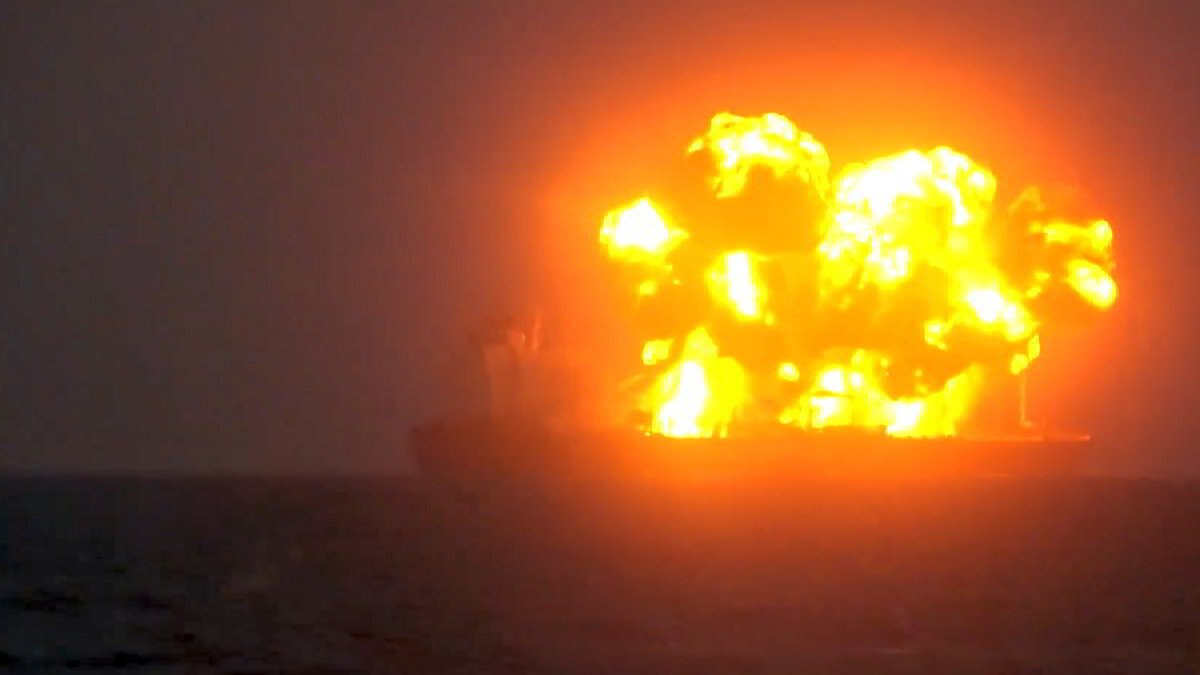
The container shipping sector is neither the only nor the worst-hit sector in terms of damage to Houthi attacks, with recent, deadly attacks focusing on bulk carriers and including bulkers Magic Seas and Eternity-C. And emissions are not the only environmental consequence of Houthi attacks.
According to Yemen’s internationally recognised government Minister of Information, Culture and Tourism Muammar Al-Eryani, Magic Seas was carrying approximately 17,000 tonnes of ammonium nitrate when it was scuttled by Yemen’s rebel Houthi militia, "threatening the marine environment and international shipping lanes". Ammonium nitrate is a chemical compound commonly used in fertiliser production and explosives manufacturing.
The US-based, non-profit Arab Gulf States Institute (AGSI) have labelled Houthis as ’ecocriminals’ based on their tactics of attacking, burning and sinking commercial vessels. In a March 2025 analysis, the AGSI said "The Houthi assaults on shipping traffic are deliberate acts of marine pollution, weaponising oil tankers and bulk carriers to advance their political and military agenda."
The report cited numerous examples of Houthi attacks that continue to endanger what the group described as the fragile but abundant ecosystem of the Red Sea.
"Home to about 1,200 fish species and over 350 types of coral, the region’s coral reefs are one of the world’s richest marine ecosystems and most resilient environments to climate change. Additionally, the Red Sea’s high marine biodiversity generates multimillion-dollar revenue streams for the tourism and fishing industries of littoral countries," the AGSI said.
Among the examples of threats to the region’s rich and varied habitats, the AGSI looked at the Houthi attacks on Greek oil tanker Sounion, which burned for more than four weeks with 150,000 tonnes of crude oil on board before the Houthis allowed EU naval operation Aspides to launch a salvage operation to tow the vessel to safe waters. Had the oil from the vessel spilled, it would have, AGSI said, resulted in the fifth-largest oil spill in history. The report noted the sinking of coal carrying bulk carrier Tutor, as well as an indepth look at the threat from bulk carrier Rubymar, which was sunk by the Houthis in 2024.
On 2 March, Belize-flagged, UK-owned bulk carrier Rubymar sank in the Red Sea after being struck by a Houthi missile two weeks earlier on 18 February. According to the US Navy’s Central Command (Centcom), the vessel had been slowly taking on water and drifting following the attack, which caused a 30-km oil slick to form around the vessel. The ship was carrying about 21,000 tonnes of ammonium phosphate sulphate fertiliser as cargo, Centcom said.
Yemen’s internationally recognised government’s foreign minister Ahmed Awad bin Mubarak said in a post on X (formerly Twitter) at the time, "The sinking of Rubymar is an environmental catastrophe that Yemen and the region have never experienced before."
According to AGSI’s analysis, "Although the cargo holds are still sealed, a massive leak of fertiliser into the Red Sea waters would cause extensive algal blooms with harmful consequences for the entire ecosystem, including large-scale fish die-offs and seawater contamination."
In its assessment in March, during a lull in Houthi attacks on commercial vessels, AGSI said that, although no large-scale ecological catastrophe has occurred yet, "any future Houthi attacks carry the considerable risk of triggering a mass pollution event, which could cause irreversible damage to the Red Sea region".
Sign up for Riviera’s series of technical and operational webinars and conferences:
- Register to attend by visiting our events page.
- Watch recordings from all of our webinars in the webinar library.

Related to this Story
Events
Maritime Regulations Webinar Week
 16 Dec 2025
 GMT - ONLINE
Floating energy: successfully unlocking stranded gas using FLNGs and FSRUs
24 Feb 2026GMT - ONLINE
© 2026 Riviera Maritime Media Ltd.


