


Business Sectors
Business Sectors
Events
Contents

Register to read more articles.
Interconnectors: bridging the gap between ambition and delivery
Electricity interconnectors are increasingly important infrastructure, supporting the energy transition. Enabling electricity to flow between countries, they strengthen security of supply, improve resilience and transmit surplus generation to markets where supply is tighter


The scale of the market is already significant. As Westwood analyst Giulia Cannatelli explains, Westwood data indicates that around 40,000 km of interconnector cable requirements associated with projects are expected to come online between 2025 and 2035, excluding mainland China. At the same time, the market is becoming more ambitious, and projects are growing in scale. However, the rapid expansion of the project pipeline should not be mistaken for guaranteed build-out. Interconnectors are capital-intensive infrastructure projects with long development timelines, and face significant regulatory, financing, commercial and geopolitical risks.
Europe sits at the centre of the current interconnector buildout, supported by a longstanding policy drive towards greater integration of national electricity markets. The EU has set an electricity interconnection target of at least 15% by 2030, a fact reflected in Westwood’s pipeline of projects. Cross-border projects account for 69% of developments yet to reach cable contract award (Westwood considers an interconnector as ‘sanctioned’ only once a cable contract has been awarded).
Although interconnector ambition is becoming increasingly international, the projects that have progressed furthest remain overwhelmingly domestic. Sanctioned activity is heavily concentrated in Western Europe, which accounts for 90% of projects that have reached cable contract award.
Greece is a particularly prominent domestic market, accounting for almost half of sanctioned Western European project involvement, and coordinated investment and access to public funding have helped turn this requirement into contracted projects. Since 2017, IPTO, Greece’s independent power transition system operator has invested €3.1Bn (US$3.54Bn) in electricity infrastructure. Individual developments have also benefited from European financing, such as the €524M (US$587.58M) Western and Southern Cyclades interconnection, for example, which received €157M (US$176,050M) of EIB financing alongside a further €108M (US$121,085M)from the EU Recovery and Resilience Facility. Greece illustrates how a clear grid requirement, TSO-led investment and access to public financing can help projects progress through procurement, despite continued exposure to cost increases and schedule delays, but replicating that progress becomes more complicated when infrastructure crosses national borders and requires multiple regulatory, political and commercial frameworks to be aligned.
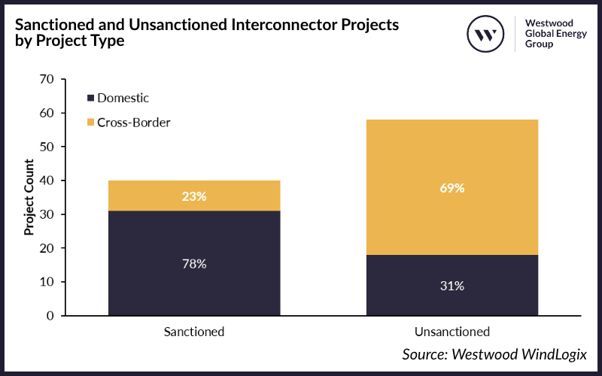
Westwood assessed unsanctioned projects for development maturity, commercial progress, funding and key project risks, assigning each a ‘Probable’ ‘Possible’ or ‘Risked’ rating. The results point to considerable uncertainty. In fact, only 14% of the pipeline is currently rated Probable, while 57% is Possible and 29% is Risked. Risk is particularly concentrated among international developments: 94% of ‘Risked’-rated projects are cross-border. However, cross-border development does not in itself determine project viability, with around 63% of Probable-rated projects also crossing national borders. Instead, the distinction lies in whether strategic support has translated into tangible development progress.
Another factor affecting projects is their physical characteristics and length, and Westwood found that projects with greater cable requirements tend to sit further towards the riskier end of the pipeline, and project complexity could increase further as interconnector models evolve. Hybrid projects, such as LionLink, aim to combine cross-border electricity trading with offshore wind connections, potentially reducing infrastructure requirements and supporting a more integrated North Sea grid. However, regulatory frameworks were largely designed for generation and interconnection separately, creating new questions around how costs and benefits should be shared between countries. The challenge for the cross-border pipeline is therefore not a lack of strategic rationale, but converting that rationale into coordinated regulation, financing and commercial commitments.
Cable demand builds through the 2030s, but timelines remain uncertain. The unsanctioned pipeline points to a significant increase in project delivery through the 2030s. However, the composition of this pipeline also changes over time. Looking at underlying cable requirements, near-term demand is supported by domestic projects, while longer-term demand becomes increasingly dependent on cross-border developments. This shift increases uncertainty around delivery, and even projects with strong institutional and policy support can experience schedule changes.
Westwood’s analysis shows a clear gap between ambition and execution. How much of today’s predominantly cross-border pipeline can transition from ambition to procurement – and how quickly – will ultimately determine the scale and timing of the next wave of interconnector build-out.
Supply chain challenges are growing
Analysis by Aegir Insights suggests that there are currently around 294 interconnector projects worldwide, totalling around 289 GW of capacity and around 70,900 km of offshore cable. Of these:, 110 links are operational, accounting for around 60 GW and approximately 13,400 km of offshore cable already in the water. Aegir Insights says the forward pipeline consists of 171 links, around 214 GW of capacity and 48,100 km of offshore cable.
Like Westwood, Aegir Insights notes that projects at the proposed and planning stages routinely slip, merge or fall away. It says proposed links account for about 73 GW, and notes that 56 links have taken a final investment decision or are under construction. Under-construction projects account for 60 GW.
“Geographically, the North Sea dominates, with 84 links and around 134 GW across all project stages,” said Aegir Insights. “It is also where interconnectors and offshore wind are starting to merge into ‘hybrid’ assets that connect windfarms to more than one country.”
It notes that the pipeline is overwhelmingly high voltage direct current (HVDC) and around 123 of the 171 pipeline links use HVDC voltage-source converter technology, which is now the standard for new subsea HVDC links. They represent around 171 GW and 40,500 km of offshore cable, and are typically the longest, deepest and most technically demanding cable routes to manufacture and install.
As the company also notes, interconnectors compete with offshore wind for the same supply chain, and far-from-shore offshore windfarms increasingly also use HVDC export systems. “Lead times are long and lengthening,” says Aegir Insights. “Our analysis of North Sea HVDC projects found an average delivery lead time of around six years. For German platforms ordered since 2022, award-to-first-power times are now around eight years.
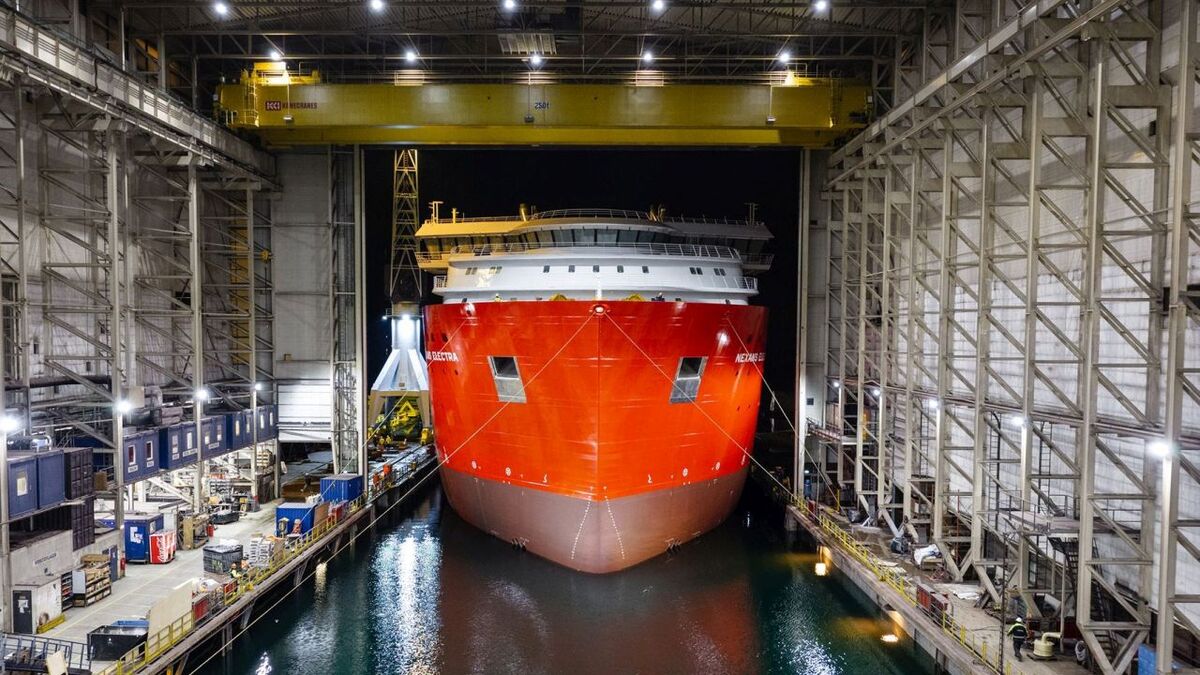
The cable makers are also the installers, and the main subsea cable suppliers operate their own cable-lay fleets. Aegir’s Vessels dataset shows Prysmian with seven operational cable-lay vessels and an eighth due around the turn of 2026/27; Nexans has three operational, and NKT one operational and one on order. “Growth in interconnector demand therefore depends on a supply base that controls both manufacturing and installation capacity,” concluded Aegir.



Related to this Story

Events
Maritime Regulations Webinar Week
 16 Dec 2025
 GMT - ONLINE
Floating energy: successfully unlocking stranded gas using FLNGs and FSRUs
24 Feb 2026GMT - ONLINE
© 2026 Riviera Maritime Media Ltd.


