


Business Sectors
Business Sectors
Events
Contents
Register to read more articles.
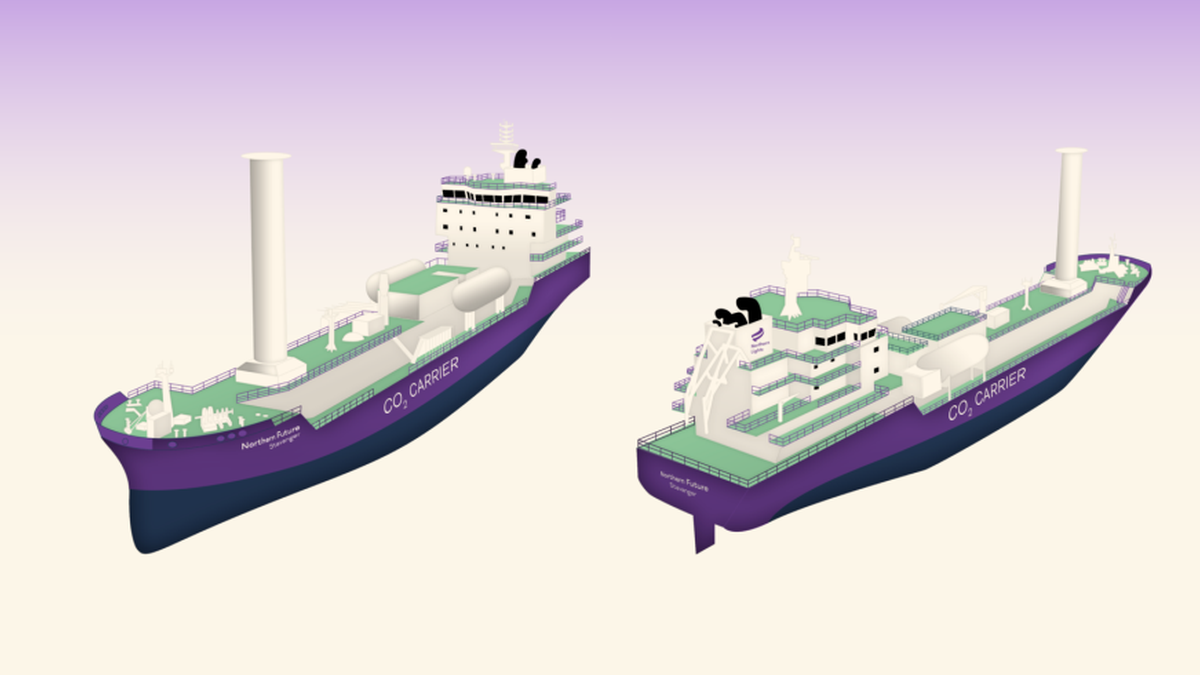
K Line deploys communications on CO2 tankers
Ships built to transport CO2 as part of a pioneering carbon capture and storage project will be equipped with terminals to communicate over two LEO constellations


K Line is equipping its fleet of ships with enhanced connectivity as it prepares to support the Northern Lights carbon capture and storage project in Norway.
The Japanese shipping group will provide CO2 transport to the joint-venture project that will store carbon to mitigate industrial emissions in Europe and in Norway.
On its new ships, K Line Energy Shipping will deploy communications terminals to connect with two low Earth orbit (LEO) constellations of satellites and antennas for 5G cellular communications.
These CO2 gas carriers will use Elon Musk’s SpaceX’s Starlink constellation for high-speed communications when available and Iridium Communications LEO satellites for L-band back-up.
Starlink will be used primarily for crew welfare, operations and business use, with Iridium Certus relied upon during inclement weather, emergency situations or when entering waters where other services may be prohibited.
This combination should ensure operations are consistently sustained, and crew remain connected and safe at sea.
“Northern Lights is the world’s first open-source CO2 transport and storage infrastructure,” said K Line systems and innovation manager, Dmitri Korlukov. “Its mission is to decarbonise industry, strengthen European competitiveness, introduce technological innovation and contribute to reaching climate goals.”
Navarino is providing both Starlink and Iridium Certus for K Line’s ships - installing terminals and providing supporting connectivity and software. Two Starlink terminals and one Iridium Certus will be installed on each vessel, starting with Northern Pioneer and sister ship Northern Pathfinder.
Navarino will also provide its Infinity modules on each ship to manage and control communications across Starlink, Iridium Certus and 5G when available close to coastlines and in ports. Infinity will also manage data consumption by seafarers on the vessels.
“Iridium L-band continues to be a defacto maritime standard for satellite communications, and a logical and dependable companion to Ku and Ka-band systems,” said Iridium vice president and general manager for maritime, Wouter Deknopper.
Ka and Ku-bands of radiocommunications frequencies are used by LEO constellations and for very small aperture terminal (VSAT) connectivity with geostationary orbiting (GEO) satellites.
“Regardless of whether a ship chooses a GEO or LEO broadband provider, Iridium is an ideal companion to support the uninterrupted operations and critical connectivity that a vessel needs,” said Mr Deknopper.
He said Iridium offers weather-resilient L-band connectivity and global coverage that does not encounter permanent line-of-sight blockages faced by GEO systems.
Ships with Iridium Certus on board remain online and connected through small, solid-state terminals that avoid terrestrial interference and noise.
Riviera’s CO2 Shipping & Terminals Conference 2025 will be held in London on 17 June 2025. Use this ling to register your interest and attend the event.
Related to this Story
Events

Maritime Regulations Webinar Week
 16 Dec 2025
 GMT - ONLINE
Floating energy: successfully unlocking stranded gas using FLNGs and FSRUs
24 Feb 2026GMT - ONLINE
© 2026 Riviera Maritime Media Ltd.


