


Business Sectors
Business Sectors
Events
Contents

Register to read more articles.
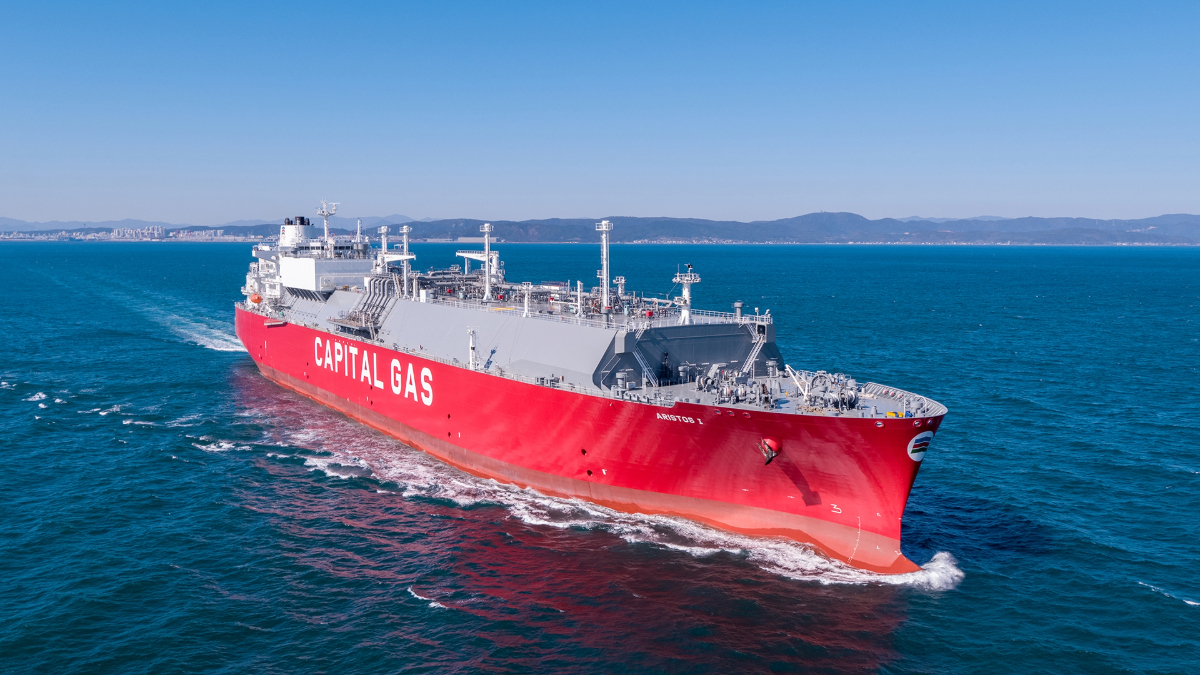
Long-term coverage pays off for Marinakis-led CCEC amid spot market volatility
Evangelos Marinakis-led Capital Clean Energy Carriers (CCEC) remained largely insulated from volatility in the LNG carrier spot market during Q3, thanks to its long-term charter coverage strategy, allowing the company to maintain strong earnings across its fleet


The US-listed shipowner reported average daily time charter equivalent (TCE) rates of US$83,862 for its LNG carrier fleet in Q3 2026, broadly unchanged from US$84,123 a year earlier.
By comparison, Atlantic two-stroke spot rates averaged US$51,039 per day during the quarter, while Pacific rates stood at US$56,157 per day.
“Our strategy of employing latest-generation vessels on long-term charters with high-quality counterparties has insulated CCEC from this short-term volatility,” CCEC chief executive Jerry Kalogiratos said.
The average remaining firm contract duration stands at 6.4 years for CCEC’s LNG carrier fleet and 0.7 years for its LPG and multi-gas fleet.
The company’s contracted revenues amount to approximately US$2.8Bn, rising to around US$4.2Bn if all charter options are exercised.
Commenting on market conditions in Q3, Mr Kalogiratos said the quarter was characterised by continued uncertainty in the Middle East, with LNG transits through the Strait of Hormuz remaining intermittent.
“Although partly cushioned by growing North American liquefaction capacity, the resulting loss of Middle East volumes tightened the Atlantic Basin LNG market, with European storage at multi-year lows ahead of winter and Asian buyers competing for US cargoes,” he explained.
“At the same time, elevated newbuilding deliveries and greater vessel availability led to a softening of the LNG shipping spot market from first-half levels,” he added.
Looking ahead, Mr Kalogiratos expects the LNG shipping market to remain volatile amid geopolitical uncertainty affecting LNG shipping volumes, vessel supply and commodity arbitrage.
Nevertheless, CCEC remains confident in the sector’s long-term fundamentals.
“The wave of new liquefaction capacity coming online through the end of the decade, together with an increased desire for energy security, should underpin demand for LNG. In addition, the need to replace older, less efficient tonnage should drive demand for modern LNG carriers,” Mr Kalogiratos noted.
Financial results climb
CCEC reported net revenue of US$138.1M for Q3 2026, up 44% from US$95.6M in the same period last year. Net income also increased by 52%, reaching US$34.6M compared with US$22.7M a year earlier.
The company attributed the improvement to an increase in the average number of vessels in its fleet following gas carrier deliveries, as well as a rise in available operating days for a pair of LNG carriers that had been undergoing special surveys in Q3 2025.
So far this year, CCEC has taken delivery of eight vessels, with a further eight scheduled for delivery next year.
The company’s in-service fleet comprises 15 LNG carriers, three Handy multi-gas carriers, two medium gas carriers and one container vessel. It also has six LNG carriers, four medium gas carriers, one Handy multi-gas carrier and one LNG bunker vessel under construction, with deliveries scheduled through Q1 2029.





Related to this Story

Events

Maritime Regulations Webinar Week
 16 Dec 2025
 GMT - ONLINE

Floating energy: successfully unlocking stranded gas using FLNGs and FSRUs
24 Feb 2026GMT - ONLINE
© 2026 Riviera Maritime Media Ltd.


