


Business Sectors
Business Sectors
Events
Contents

Register to read more articles.
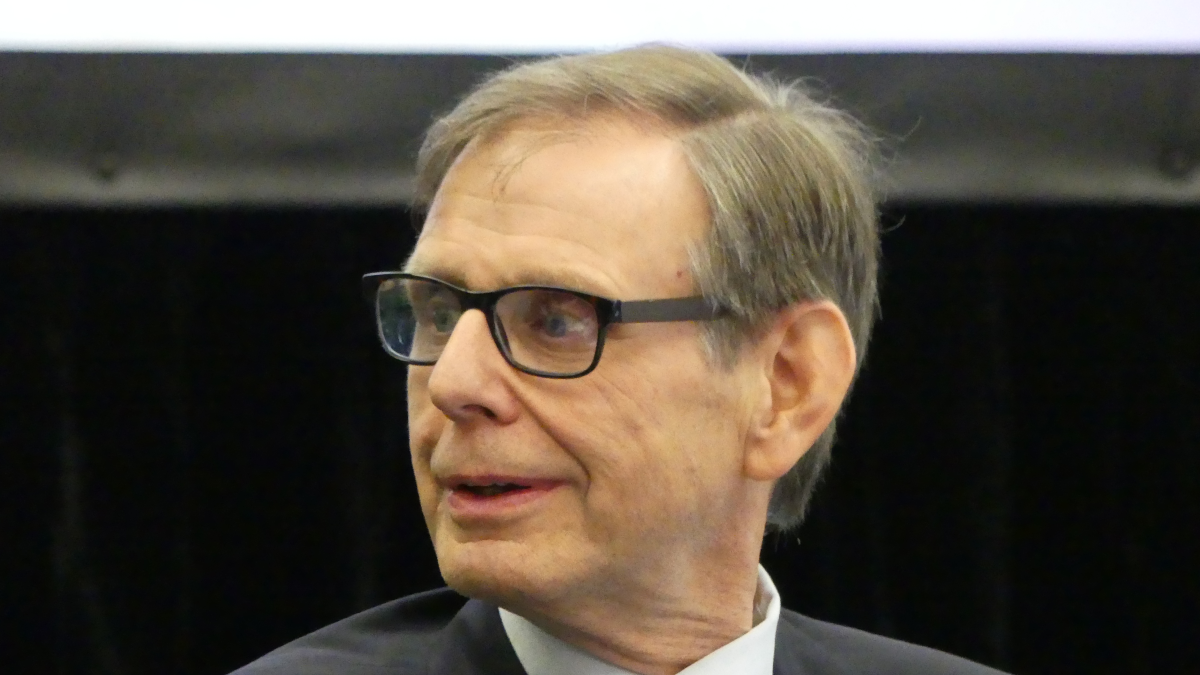
Navigating shipping’s supercycle: Dr Stopford’s insights
Former head of Clarkson Research Services, Dr Martin Stopford, outlines the key phases of the current shipping supercycle and stresses the importance of adaptability in facing technological and market challenges


The shipping industry is no stranger to market cycles, with its inherent volatility shaping the way companies operate and make strategic decisions. However, every few decades, the industry experiences what is known as a ’supercycle’ – a period of prolonged structural change that fundamentally reshapes maritime transport.
Dr Martin Stopford, the retired non-executive president of Clarkson Research Services Ltd, and one of the most respected authorities in maritime economics, recently delved into this topic, offering a comprehensive analysis of where the shipping industry stands in the current supercycle and what lies ahead.
Speaking at the Capital Link Shipping & Marine Services Forum in London on 10 September 2024, Dr Stopford framed his discussion around the cyclical nature of shipping, stressing the importance of understanding the dynamics of supercycles.
"Supercycles are just like big motorcycles – they are a bigger version of the real thing," he said.
He noted that while most industry professionals are familiar with the short shipping cycles that dictate operational decisions – such as where ships trade and how fast they go – supercycles are about much more than short-term adjustments.
They reflect the longer-term evolution of ship technology, market structures, and, crucially, the role of shipping companies themselves.
Supercycles, Dr Stopford argued, are inherently tied to structural change. "If everyone needs structural change, you do not need a supercycle because you just carry on as usual," he said, pointing out the length of a supercycle is not fixed but driven by market forces and technological developments.
Historical data shows that supercycles can last for decades, with the last one spanning 40 years.
The current supercycle, which began in the late 1990s, is in a consolidation phase – characterised by efforts to integrate the technological advancements of the past decades, such as digitalisation and containerisation, into practical business models.
This third supercycle, as Dr Stopford describes it, was propelled by two major shifts: the rise of China as an economic powerhouse and the maturation of the container shipping industry.
The introduction of global container services during the late 20th century revolutionised maritime transport, enabling more efficient and profitable shipping. However, the benefits of containerisation and other technological innovations have yet to be fully realised.
According to Dr Stopford, we are now in a period of “sorting things out,” where companies are integrating these advancements to create a more efficient global shipping system. Looking ahead, Dr Stopford stressed that adaptability is key for companies seeking to navigate the ongoing supercycle.
He noted shipping firms should focus less on trying to predict market trends and more on building resilient, flexible organisations that can quickly respond to change.
“You do not know exactly what is going to happen, but you are going to have to deal with it anyway,” Dr Stopford remarked, underscoring the necessity of agility in an industry where external shocks – whether economic, geopolitical, or technological – are inevitable.
One of the major challenges facing the industry in this current phase is decarbonisation.
Dr Stopford acknowledged the industry’s ongoing struggle to meet regulatory and environmental demands, especially with the uncertainty surrounding the readiness of green fuel technology.
“The big problem here is the timing of technology availability,” he noted, expressing doubts the industry will be fully prepared to meet the 2036 peak of investment that his model forecasts.
Although dual-fuel engines and other technological solutions exist, their effectiveness hinges on the availability of green fuels, which Dr Stopford suspects may not materialise as quickly as the market hopes.
“You can take the horse to the water, but you cannot make it drink,” he said, summarising the industry’s challenge in matching technological potential with practical application.
In this environment of uncertainty, Dr Stopford offered a historical perspective. Drawing from data on previous supercycles, he highlighted the difficulty of making accurate predictions in shipping.
“In 1984, people still thought it would go back up to where it was in the mid-70s, but it did not,” he recalled, pointing to a chart that illustrated how long-term forecasts often fail to anticipate structural market changes.
For Dr Stopford, the lesson is clear: companies that focus on building capacity to adapt, rather than relying on forecasts, are more likely to succeed.
For companies, the challenge is not just to survive this extended period of flux but to thrive by building organisations capable of adapting to whatever the market throws their way.
"Every company needs to work on the organisation to make it capable of dealing with the changes," Dr Stopford noted, adding that it is adaptability, not just innovation, that will separate the winners from the losers in the decades to come.
Find out what is in store for tankers at the Tanker Shipping & Trade Conference, Awards & Exhibition 2024. Register you interest here.




Related to this Story


Events

Maritime Regulations Webinar Week
 16 Dec 2025
 GMT - ONLINE

Floating energy: successfully unlocking stranded gas using FLNGs and FSRUs
24 Feb 2026GMT - ONLINE
© 2026 Riviera Maritime Media Ltd.


