


Business Sectors
Business Sectors
Events
Contents
Register to read more articles.
Chemical tankers face supply pressure in 2026
Chemical tanker fleet expansion and weak scrapping may risk oversupply, warns Harbour senior analyst Francesco Tassello


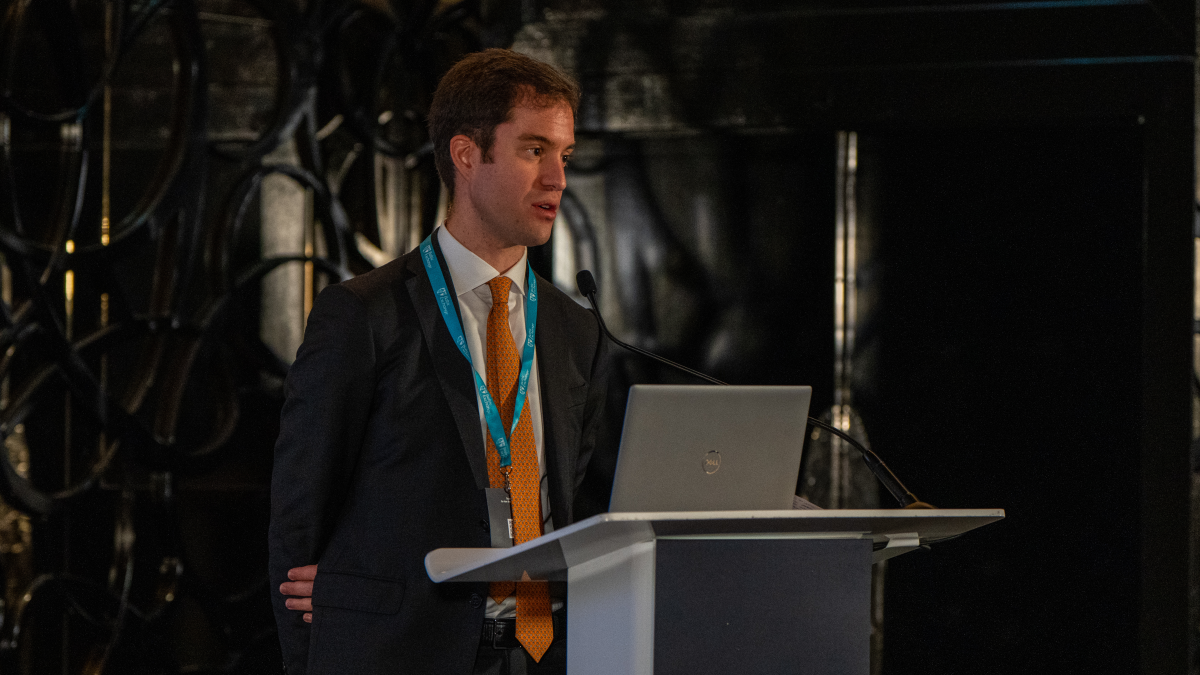
Speaking at the Baltic Exchange Tanker Forum at IE Week in February, Harbour senior analyst Francesco Tassello told the participants that chemical tanker fundamentals in 2026 are being pulled between still-growing seaborne volumes, shifting trade patterns and a fleet delivery pipeline that is starting to look heavy against limited scrapping.
“New Year, but the same uncertainty for chemical tankers this year,” Mr Tassello said, arguing that the market is still expanding but cargo demand is “diverse” and “changing”.
On demand, Mr Tassello said the historic relationship between chemical seaborne volumes and global GDP has “been somewhat strained” by protectionism and geopolitical headwinds, even as he still expects volumes to grow.
“I can still see trade, so actual volumes to keep growing are at about 2% annually this year,” he said, adding that the incremental growth will be “cargo-specific” and increasingly driven by “regional dislocation, feedstock substitution, and regulation”.
He linked changes in tonne-mile demand to both geopolitics and a reworking of where chemicals are produced and consumed.
Mr Tassello said trade dislocation has extended distances as cargoes reroute, describing disruption around key chokepoints since late 2023 and early 2024, and he characterised an “East versus West divide” as a structural feature that supports tonne miles.
“I expect this to be a permanent support factor going forward for miles,” he said.
On supply, Mr Tassello’s baseline expectation was for net fleet growth of about 8% in 2026, with deliveries concentrated in coated MR tankers and stainless steel 25,000-dwt ships, while the overall picture remains sensitive to demolition.
“Everything will hinge on scrapping,” he said, arguing that above-average earnings have had limited demolition in recent years, and this “is raising oversupply risks” into 2026 and 2027.
He also argued that shipyard economics are shaping the orderbook, with smaller chemical tonnage competing for capacity and attention against larger, more lucrative sectors.
“I do not believe we will see contracting strengthen much,” Mr Tassello said, adding that he did not expect contracting to rise above 2025 levels “because of the yard preference for large tankers”.
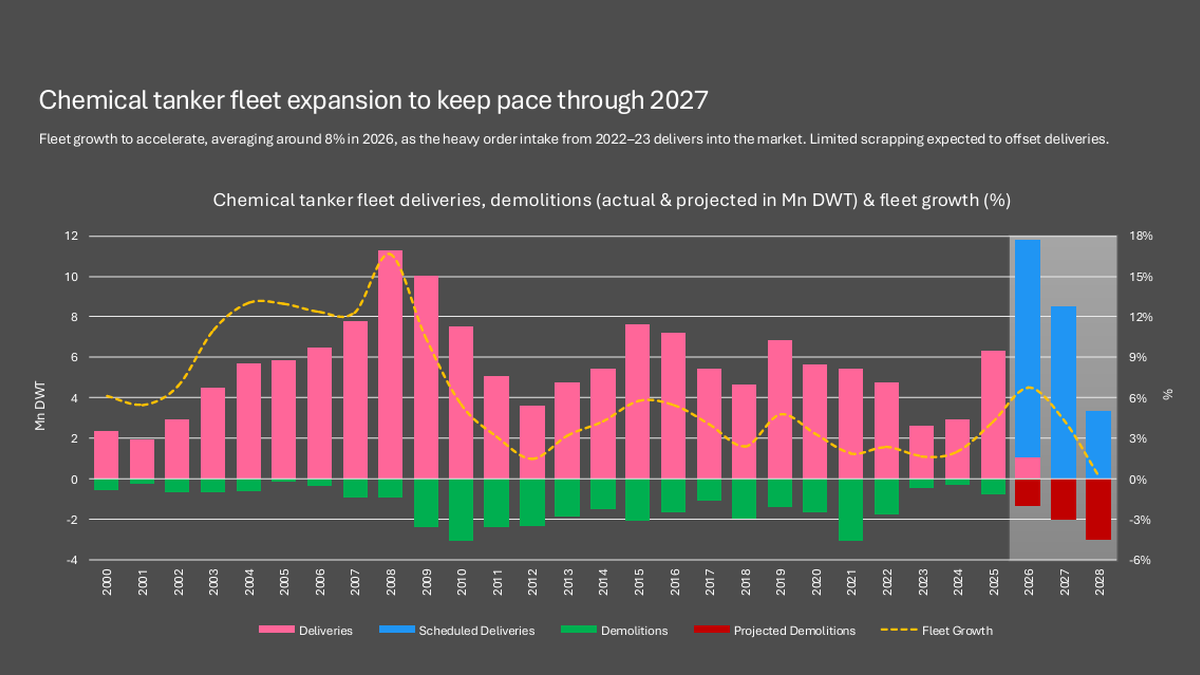
Mr Tassello spent time on the age profile of the fleet and the implications of subdued demolition.
He said the industry has progressively extended trading lives, recalling that a few years ago, ships beyond 15 years old were effectively finished, before requirements shifted toward 20 years, and he suggested the threshold could move again given recent scrapping behaviour.
He said that only the oldest ships are being scrapped in some segments, leaving the active fleet ageing, and he expects that, “by the end of the decade, about 30% of the fleet will be 20 years old or over”.
Scrap prices were one factor in that discussion.
Mr Tassello said scrap prices have been declining since a peak in 2021, and he quantified the change as about US$200 per ldt between November 2021 and current levels.
He also pointed to limited demolition among stainless steel 19,000-dwt ships, saying that just one”19,000-dwt vessel was demolished in 2025, at an average age of 26 years, and that it was the first in that size band demolished since 2022.
On freight, Mr Tassello said chemical tanker rates have eased from peaks in 2023 but remain above historical averages, with volatility shaped less by conventional supply-demand signals and more by geopolitics.
“The traditional demand and the supply drivers have given way to geopolitics in the past couple of years,” he said, adding that any return to prepandemic patterns, if it happens, will be gradual.
He also described a bifurcation between CPP MR earnings and chemical tanker earnings, and argued that stronger CPP markets can limit swing tonnage leakage into chemicals.
Mr Tassello concluded that geopolitics still dominates the outlook, while traditional fundamentals are returning as a constraint through deliveries and scrapping.
Sign up for Riviera’s April 2026 International Chemical and Product Tanker Conference:
- Register to attend here: The International Chemical and Product Tanker Conference 2026, London.
- View the latest issue of Tanker Shipping & Trade here: Tanker Shipping & Trade.



Related to this Story



Events

Maritime Regulations Webinar Week
 16 Dec 2025
 GMT - ONLINE
Floating energy: successfully unlocking stranded gas using FLNGs and FSRUs
24 Feb 2026GMT - ONLINE
© 2026 Riviera Maritime Media Ltd.


