


Business Sectors
Business Sectors
Events
Contents

Register to read more articles.
North Sea spot market tight, but not all ‘plain sailing’ for OSV owners
Average day rates elevated 36% for medium AHTS vessels in April, but other classes are priced below year-ago levels in a roller coaster North Sea spot market


Available tonnage on the North Sea spot remained tight in April, with medium anchor-handling tug supply vessels (AHTSs) in short supply, but average day rates for most vessel classes remained below levels seen a year ago.
Reporting on the market, Seabrokers said: “North Sea charterers were again exposed to periods of severely restricted vessel availability on the spot market during April, particularly so in the Norwegian sector where the market was completely sold out for a short spell.”
Average day rates for an AHTS (>22,000 bhp) were £35,198 in April — a 36% increase over April 2023 when the same vessels were available for £25,898, according to the ship broker.
But as tonnage is drawn out of the sector by more lucrative terms in other markets, tonnage availability dries up.
“Regional spot market supply has dropped to such a level that it only takes a few rig moves to materialise in quick succession for near-term vessel availability to diminish rapidly. That led to peak spot fixture rates in April of £50,000-£77,000 in the UK sector, and NrK550,000-NrK600,000 in Norway,” explained Seabrokers.
It’s been a roller coaster of a year thus far in the North Sea, with average day rates through the roof in January and February for all vessel classes, followed by recessions in March and April.
But as Seabrokers pointed out, it has not been “plain sailing” for OSV owners as utilisation levels are still challenging and monetary weakness in the Norwegian krone makes elevated charter rates less lucrative than they were a year ago.
Utilisation rates for April were 67% for medium platform supply vessels (<900 m2), 73% for large PSVs (>900m2), 63% for medium AHTS (<22,000 bhp) and 58% for large AHTS (>22,000 bhp).
Some charterers have addressed tight availability by exercising long-term options. BP locked down two PSVs; it fixed Vestland Artemis until May 2029 with a five-year extension, and Solvik Supplier with a four-year extension until August 2028.
“Utilisation levels are still challenging”
TAQA Bratani exercised one-year options on three Tidewater platform supply vessels (PSVs) that will keep them on hire until July 2025. Further one-year options could keep them working in the North Sea until 2028.
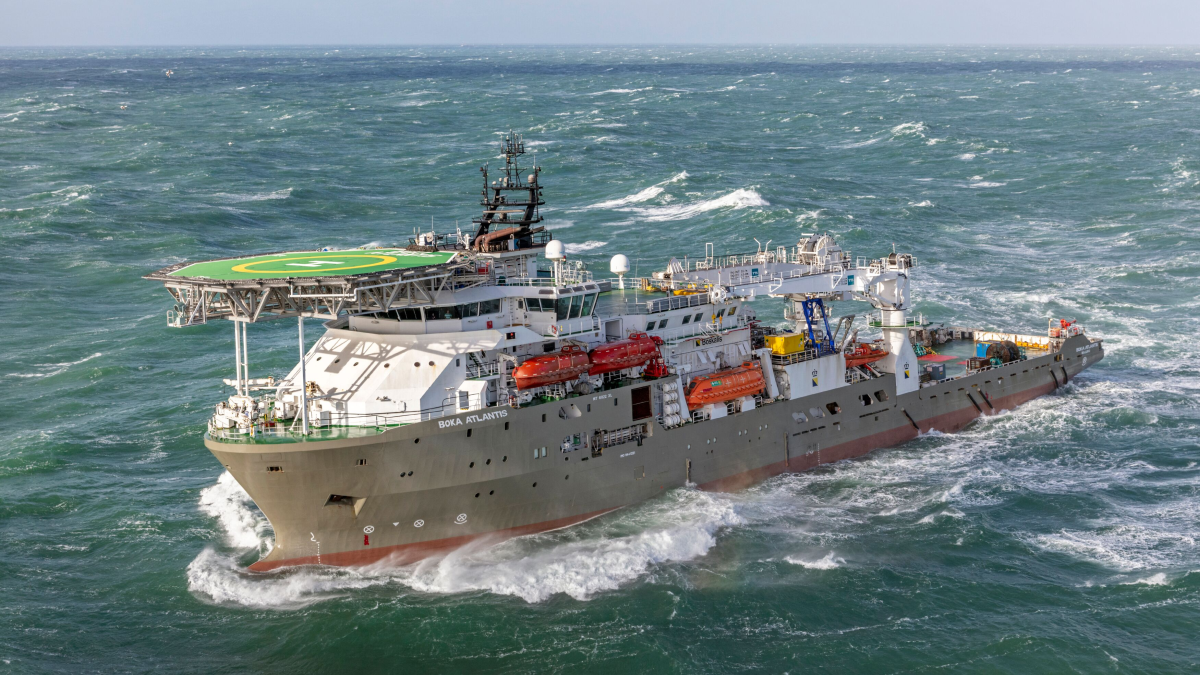
Some OSV owners are investing in technologies to reduce their CO2 and greenhouse gas emissions to support charterers’ ambitions to slash their Scope 3 emissions. In the subsea market, two Boskalis MT6022XL design dive support vessels (DSVs), BOKA Atlantis and BOKA Da Vinci, were converted to diesel-electric battery hybrid propulsion, following their retrofit with energy storage systems (ESSs) at the owner’s service centre quay in Rotterdam. The upgrade was performed by Bakker Sliedrecht.
A key outcome of the upgrade is a reduction in fuel consumption and associated CO2 and NOx emissions of as much as 20%, according to the Dutch systems integrator.
Both sophisticated sister DP-2-class DSVs are operating in the North Sea, based on vessel positioning information. AIS data reported by Vessel Finder showed BOKA Atlantis was en route from Lerwick, UK, to the Tern Field, while BOKA Da Vinci was sailing from Sunderland, UK, to NW Bell, in early May.


Related to this Story



Events

Maritime Regulations Webinar Week
 16 Dec 2025
 GMT - ONLINE
Floating energy: successfully unlocking stranded gas using FLNGs and FSRUs
24 Feb 2026GMT - ONLINE
© 2026 Riviera Maritime Media Ltd.


