


Business Sectors
Business Sectors
Events
Contents
Register to read more articles.
Super-turbines still stretching crane capability
Evolving cranes lift larger loads to greater heights, adapt to market requirements


As wind turbines continue to increase in size, with 20 MW + units on the horizon, so cranes on installation vessels need to cope with heavier loads and lift them to greater heights, but the dynamics of the market are more subtle than that, experts interviewed by OWJ suggest.
Speaking to OWJ in late October, GustoMSC sales director heavy lift Gerben Roks agrees the main trend in the market for cranes for wind turbine installation vessels is still ‘heavier and higher,’ but the most important part of the equation “is how to help our clients get a good return on investment.”
Mr Roks continues, “It’s important for our clients to find the right balance. They need a crane that is fit for purpose, that can handle next-generation turbines, but it is important to bear in mind the lifetime of a vessel, which could be 20-30 years. That means you need to look beyond 20-MW turbines and be prepared for what might come later. We need to be ready to meet demand for even larger turbines and higher lifting heights. Designs capable of a lifting height above deck of 200 m are already on the table, but with larger, heavier loads and larger cranes, the size of a vessel may also need to grow, and that drives up cost.” Economics also play a major role in upgrade projects, he says. “Owners need upgrades for vessels to remain competitive, but there is a limit to what any upgrade can achieve,” he says.
“We can build larger cranes capable of lifting heavier components to greater heights,” says Mr Roks, “but recent developments in the market and the effect of inflation and project cancellations are making owners cautious. There aren’t any technical limits to the further development of cranes but, for the time being at least, there may be some economic challenges. In the medium- to long-term, however, the market remains a very positive one,” he says.
Cranes are also being introduced that have some novel features. GustoMSC recently secured contracts for a new generation of telescopic cranes for wind turbine installation vessels. Mr Roks sees telescopic cranes as having several advantages, not least that as cranes get larger as safe working load and lifting heights grow, being able to retract the boom makes for a more compact vessel when the crane is lowered. “Retracting the boom significantly enhances visibility from the bridge when the vessel is in transit,” Mr Roks explains, “and when the vessel is in port with the crane in the boom rest, much less space is needed at the quay.” Retracting the boom on one of GustoMSC’s telescopic cranes can reduce its length by 40-50 m.
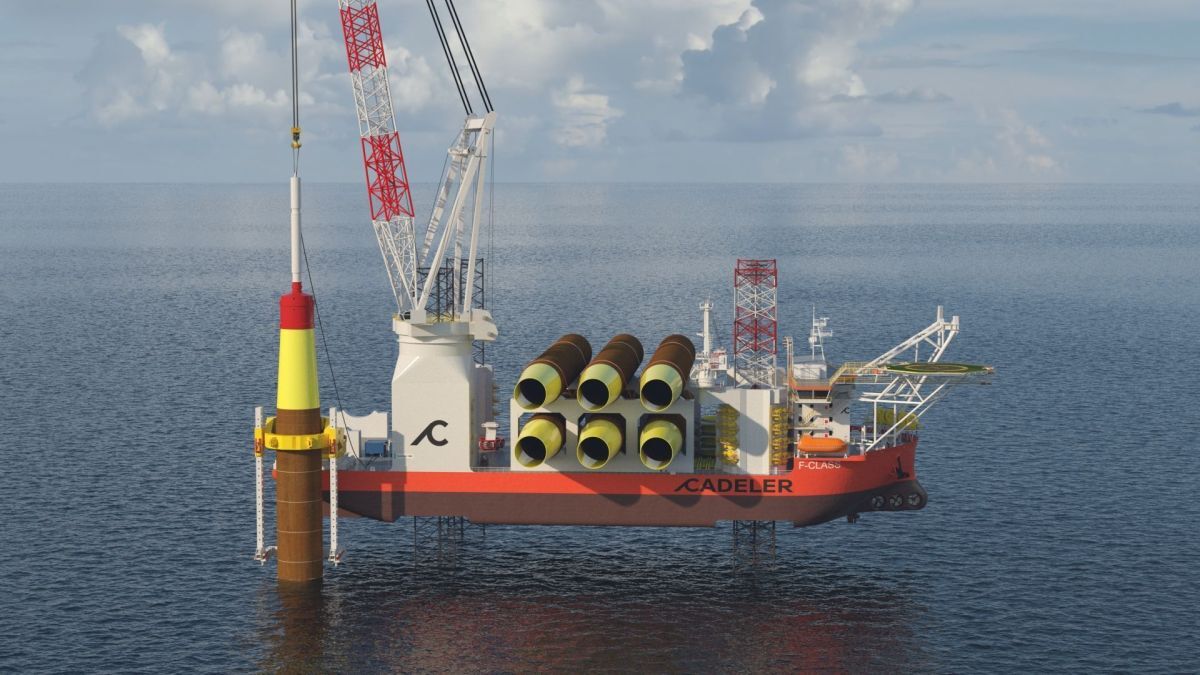
Huisman Equipment product director cranes Cees van Veluw agrees with Mr Roks about the main trends in the market. But he also highlights the growing number of vessels designed to install wind turbines and foundations. Cadeler’s F-class vessels are an example: they are primarily designed for foundation installation projects but will also undertake turbine installation work using the same crane. “When you are lifting and lowering a monopile into the water, wave dynamics mean you also need a gripper to operate with the crane. When you lift components for a turbine, you need a lot of hook height. You don’t need that with a foundation, but the load is heavier. The loads and the way the crane has to handle them are very different. Challenges such as these all need to be considered.”
Mr van Veluw also highlights the need to make lifting safer for personnel, and the growing use of remote control and automation systems. He notes, as turbines grow in size, so blades are getting longer and longer. This is a challenge for contractors as they are required to lift them to ever-greater heights. Responding to this, Huisman and Siemens Gamesa launched a solution designed to stabilise wind turbine components during installation. The concept was developed primarily with blades in mind, but also applies to nacelles and tower segments.
Controlling the movement of relatively light blades when suspended from a crane has proven to be an installation challenge because of the effect of wind load. Huisman’s solution is the Travelling Load Stabilising System. It is based on two pairs of tuggers, working in unison to control the position of the load. One pair is fitted on independent trolleys that can travel along an integrated rail along the crane’s boom. The trolleys automatically follow the main block to maintain an optimal tugger line configuration. The second pair of tugger lines is deployed from the crane tip providing a force perpendicular to the first pair of tuggers. By approaching the load from two different directions, the system provides significantly more control than a conventional single pair of tuggers.
Also new from Huisman is the Wind Gust Buster, which provides crane operators with the ability to anticipate and react to wind speed, gusts and the direction from which the wind is approaching. A LiDAR is used to determine the direction of incoming gusts. Data is processed by the crane’s automation system and displayed to the crane operator and others involved in the process. A typical prediction window is five to eight minutes ahead of an incoming gust, which provides sufficient time to make a ‘go or no-go’ decision when mating a blade to a nacelle.
Mr van Veluw notes that improving a crane operator’s ability to mate the blade with the nacelle in a controlled manner makes the whole operation safer. It can also reduce the likelihood of damage to components such as a blade’s stud bolts. He says developers are familiar with damage to bolts that can arise from unexpected movement of a blade during installation. “Reducing the likelihood of damage with a decision support system can help reduce downtime, speed up installation and reduce costs,” he says. “It also makes life easier and safer for the person guiding the blade into the nacelle.”
A spokesperson for another crane manufacturer, Liebherr, agrees the need to lift heavier loads to greater heights, during installation and during maintenance, are key trends. “Improved efficiency, sustainability and automation pose additional challenges,” says the company, which already has a portfolio of cranes suitable for use in the nascent floating wind market, including its HLC 150000 and the HLC 295000 models.
Liebherr is working on upgrades for its CAL series, which will enable them to handle loads of more than 3,000 tonnes. Like its competitors, the company is developing new drive technologies and predictive maintenance concepts. Anticipating increased demand, it is also reviewing factory workflow and commissioning performance, and is preparing its Rostock facility for what it called “the boom to come.”
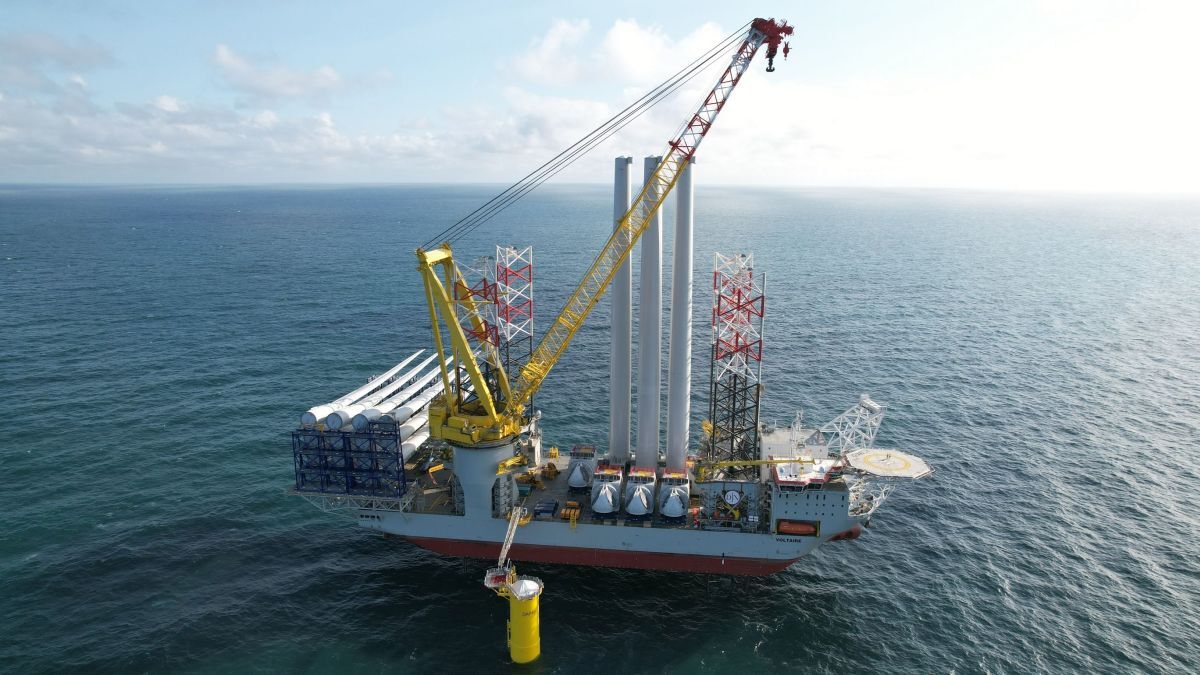
Last but not least, say the crane experts interviewed by OWJ, development of ‘green’ vessels with new forms of power and propulsion such as battery packs are driving the development of cranes with DC, rather than AC drives. Jan De Nul’s new installation vessel Voltaire is the first example of a wind turbine installation unit with a DC-driven crane.
Make your plans now to attend Offshore Wind Journal Conference 2024 in London 6 February 2024
Related to this Story

Events

Maritime Regulations Webinar Week
 16 Dec 2025
 GMT - ONLINE
Floating energy: successfully unlocking stranded gas using FLNGs and FSRUs
24 Feb 2026GMT - ONLINE
© 2026 Riviera Maritime Media Ltd.


