


Business Sectors
Business Sectors
Events
Contents

Register to read more articles.
LNG flows hold through Hormuz, despite threats
Legal, logistical and geopolitical concerns converge as LNG trades continue through a volatile Gulf


The Strait of Hormuz remains the most critical chokepoint for global LNG flows. According to the Institute for Energy Economics and Financial Analysis (IEEFA), approximately 20% of global LNG trade passed through the Strait of Hormuz in 2023, with Europe relying on this route for around 10% of its LNG imports. The route’s strategic weight is now under intense scrutiny amid rising instability in the region, particularly with the escalation of Houthi-led attacks on merchant shipping and renewed sanctions on Iran-linked maritime networks.
While crude and dry bulk vessels have borne the brunt of the violence, LNG carriers have, to date, remained untouched, but the perception of safety is being challenged by the pattern and persistence of recent attacks, including strikes on Greek-owned vessels and the reported deaths of seafarers in the Red Sea. In the first half of 2025, the character of the assaults in the Red Sea evolved from sporadic to methodical and the scale and tactical nature of the Houthi attacks evolved, signalling a shift in operational intent.
This heightened threat environment has already triggered behavioural changes with crude oil and product tankers reported to have performed U-turns away from the Strait of Hormuz. Even where vessels proceed, digital interference adds complexity. The UK Marine Accident Investigation Branch (MAIB) warned that poor watchkeeping practices, in conjunction with electronic navigation overreliance and GPS jamming, are causing collisions and groundings. “We need to radically rethink the role of human watchkeepers in the digital age,” said MAIB chief inspector of marine accidents Andrew Moll.
“The character of the assaults in the Red Sea evolved from sporadic to methodical”
In contrast, LNG flows from Qatar through Hormuz have so far remained stable. IEEFA data show that the volume of LNG passing through the Strait declined only marginally, from 10.4M tonnes per month in early 2022 to 10.2M per month in 2023 and 9.6M tonnes per month for January–May 2025. By comparison, Suez Canal usage for LNG fell from 4.0M tonnes per month in 2023 to just 0.9M per month in the same 2025 period.
The unimpeded passage of Qatari LNG through Hormuz, however, may reflect diplomatic positioning as much as operational considerations. Qatar remains a geopolitical power broker in the Gulf. Yet, a growing share of its exports is carried on third-party-owned and operated vessels. This raises questions about future targeting patterns should malign actors seek to disrupt LNG flows without directly confronting Qatari state assets. Any incident to vessels perceived to be attached to an “enemy” party can become a fair target. The outright targeting of third-party tonnage, such as the Iraqi air force firing an Exocet missile in May 1988 into the 564,736-dwt Ultra-Large Crude Carrier Seawise Giant during the Iran-Iraq war, are replaced with drones, limpet mines and other means, as witnessed by the explosion on the tanker TMS Vilamoura.
Qatar’s role in LNG production is also being shaped by the energy transition. In the past, Middle Eastern producers focused on long-term, destination-fixed LNG contracts, a pattern being replaced by more flexible contracts. According to the IEEFA report, this realignment reflects rising demand for LNG in Asia and Europe, coupled with growing appetite for carbon-neutral cargoes. This trend, however, introduces more exposure to shipping risk, particularly where trading patterns involve transit through Hormuz or the Suez Canal.
“Global LNG trade routes are exposed to intensifying geopolitical risk”
Legal ambiguity further complicates decisions by charterers and shipowners. A briefing by Watson Farley & Williams (WFW) warns that, in the event of a closure of the Strait of Hormuz, it would not necessarily follow that a contract of carriage is discharged by frustration. The firm notes: “The law of frustration is narrow in scope and courts are reluctant to find that a contract has been frustrated.”
Insurance clauses also merit close attention. A second WFW paper outlines that “standard war risk insurance typically excludes losses caused by nuclear, biological or chemical contamination.” Furthermore, “it is often unclear whether war risk policies will respond to acts of state or quasi-state actors.” This becomes especially relevant where the classification of a group such as the Houthis remains contested under international law.
In parallel, shipowners operating through Hormuz must grapple with rights to refuse orders. Under English law, the refusal of a master to transit Hormuz may only be upheld if there is a real and imminent risk. WFW advises: “If a master deviates or refuses an order without sufficient justification, he may place the vessel off-hire and potentially be liable for damages.”
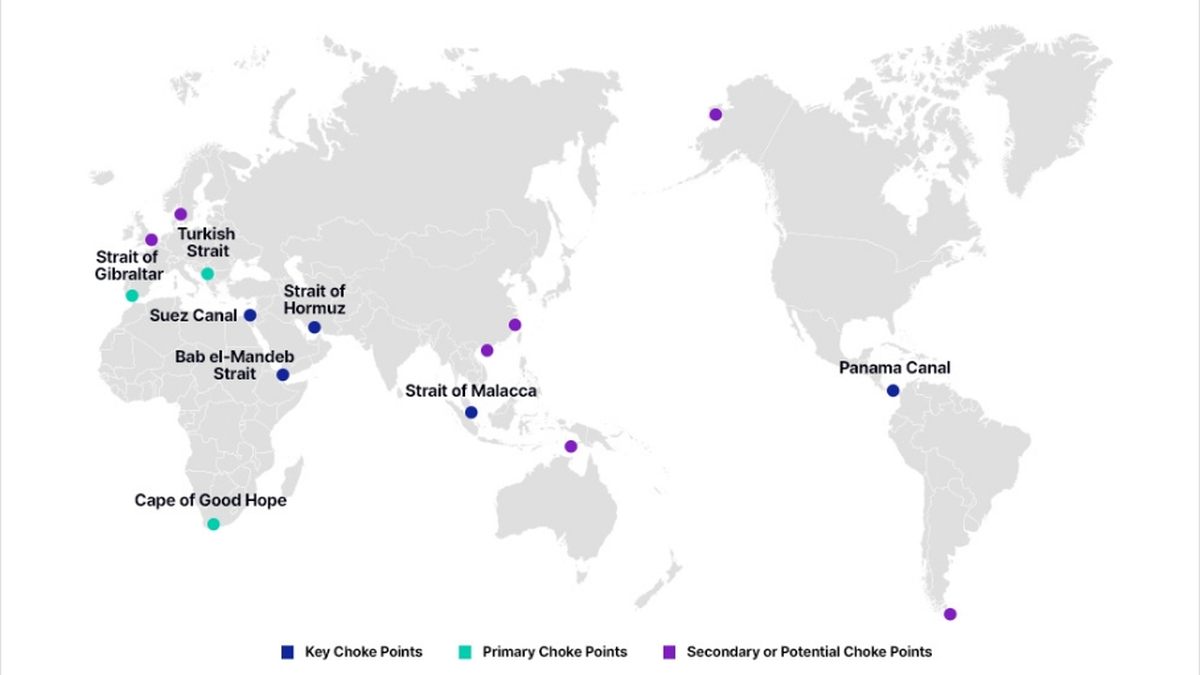
For LNG importers downstream of Hormuz, particularly Kuwait, Jordan and Egypt, the stakes are rising. Kuwait imports most of its LNG via long-term charters from Qatar, while Jordan and Egypt rely heavily on floating storage and regasification units (FSRUs). The IEEFA chart of key chokepoints shows a narrowing corridor of movement into these markets, further exacerbated by reduced transits through the Suez Canal.
Qatar’s export destinations, as mapped by IEEFA, reinforce Europe and Asia as the core end-markets, with Europe accounting for 18% in 2023 and Asia 78%. Europe’s diversification efforts depend on the continuity of these routes. With rising delays in the Bab el-Mandeb Strait the LNG sector could see a fall in reliability metrics and a potential increase in disputes.
In this high-risk environment, the legal position of traders, charterers and operators will depend heavily on the specifics of their contracts and the evolution of events. As WFW advises: “Charterers and owners should proactively review existing contracts, insurance policies and charterparty clauses now to understand where liabilities and exposures may fall.”
The International Gas Union’s World LNG Report 2025 adds weight to this perspective, noting that “global LNG trade routes are exposed to intensifying geopolitical risk,” and observes that “even a temporary disruption in key supply routes could generate disproportionate impacts across the LNG value chain.” The IGU report goes further: “New shipping routes and security investments may be needed to preserve LNG’s competitive and geopolitical utility,” indicating that strategic reassessments are under way.
“Charterers and owners should proactively review existing contracts, insurance policies and charterparty clauses now”
Howe Robinson Partners’ Q1 2025 LNG Market Review notes: “The Red Sea security crisis significantly impacted Suez transits, with many LNG carriers avoiding the route due to heightened risks from geopolitical tensions.” It also states that “the vast majority of inter-basin trades are via the Cape of Good Hope,” reinforcing the scale of rerouting now taking place.
While LNG has thus far been spared, the pattern of escalation across the wider Middle East suggests the margin for error is narrowing. And the Strait of Hormuz remains a high-risk corridor not only for energy security.
If present conditions continue, pressure is likely to mount on Qatari LNG shipping strategies. The use of third-party vessels may offer Qatar commercial flexibility, but it introduces uncertainty in an environment where alignment, perception and intent shape operational risk. For now, LNG flows remain uninterrupted. But as the IEEFA data and actions against shipping in the region demonstrate, the vulnerabilities are neither abstract nor remote.
Related to this Story
Events

Maritime Regulations Webinar Week
 16 Dec 2025
 GMT - ONLINE
Floating energy: successfully unlocking stranded gas using FLNGs and FSRUs
24 Feb 2026GMT - ONLINE
© 2026 Riviera Maritime Media Ltd.


