


Business Sectors
Business Sectors
Events
Contents
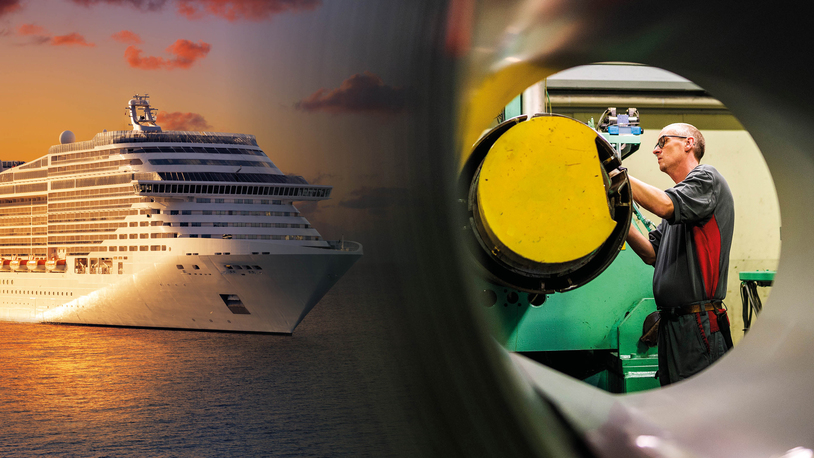
VLCC is the first to have a ballast water treatment plant


Tanker operator, NITC, the world’s fourth largest VLCC owner, has taken delivery of the 317,000 dwt VLCC, Sifa, the first in a series of 22 vessels on order in Korea and China. This tonnage will be absorbed through to 2013, and will take the total oil carrying capacity of the NITC fleet past the 18 million tonnes mark.
Built by South Korea’s Hyundai Heavy Industries (HHI), Sifa is believed to be the first VLCC newbuilding to have been delivered with a ballast water treatment system. Other green features include an innovative Kongsberg ship performance system designed to reduce fuel consumption by up to five per cent. The company has also opted for a fully electronic main engine. Safety and security measures are given high priority and include installation of 16 CCTV cameras to allow better operational control by the crew and enhance security, especially in the event of a pirate attack.
Sifa is 333.14m long, has a moulded breadth of 60m, depth of 30.4m and a design draught of 21m. It has a continuous upper deck (no sunken deck aft) without forecastle, a raked stem with bulbous bow, a transom stern with open water stern frame and a semi-balanced rudder. The ship has been built in accordance with the IACS common structural rules, and the ballast tanks have been coated to comply with IMO’s latest Performance Standard for Protective Coatings.
Generally, Sifa has been built to a standard tanker design and will carry crude oil with a flashpoint up to 60°C worldwide. The material selected for the valves means both standard fuel and condensate can be transported. Since the tanker has been designed to carry crude oil only there is no provision for heating the cargo, only the slop tanks. That said, high specific gravity cargoes can be circulated through the heated slop tanks by way of the tank cleaning pump. The total cargo tank capacity is 351,247m3 and that of the ballast tanks 98,491m3.
On deck, NITC has opted for two electro-hydraulic Rolls-Royce windlasses and eight electro-hydraulic mooring winches from the same supplier. Both the hose handling and provision cranes have been supplied by Oriental Precision Co of Korea. Two totally enclosed lifeboats, each with capacity for 50 people, have been supplied by Hyundai Lifeboats, and Viking has provided five liferafts. Wilhelmsen Ships Equipment (Unitor) is the supplier of the deck foam system.
There are three sets of 5,500m3/h steam turbine driven vertical centrifugal cargo pumps on board manufactured by the Japanese company Shinko. The deciding factor behind selecting these pumps was performance, reliability and the fact that they are standard across the NITC VLCC fleet. A Kashwa flue-type inert gas system and generator has also been fitted.
For tank cleaning, the vessel is equipped with Scanjet washing machines. Scope of supply comprises 42 deck mounted single nozzle units and three submerged twin nozzle types; all operate at 8 bar. The cargo tanks are stripped using a Shinko pump, with cargo eductors are from TankTech. Emerson Saab remote gauges transmit tank levels to the cargo control station. The portable cargo measuring system is from Enraf Tanksystem. Nakakita supplied the cargo valves and the associated remote control system.
A single fixed pitch, four bladed propeller is driven by a Wärtsilä 7RT-flex82T engine, produces a total of 31,640kW (42,989 bhp) at 80 rpm. As a result, Sifa has slightly more power than existing VLCCs in the NITC fleet. The propeller is driven through a conventional shaft, and the stern tube seals are of air seal type and incorporate synthetic rubber sealing rings from Wärtsilä. A seal protector and steel rope guard fitted with a net cutter are also features. Two-ram/four cylinder steering gear of Hatlapa design controls the semi-spade rudder.
Vessel speed at scantling draught on an even keel is 15.55 knots with the engine running at NCR power and 20 per cent sea margin. The Kongsberg performance system has been installed with the aim of helping Sifa reduce fuel consumption by five per cent. It is believed that this is the first reference for the Kongsberg technology on a VLCC. As well as fuel performance, the system is designed to monitor engine efficiency and energy management. It can regulate NOx, SOx and CO2 from the main and auxiliary engine exhaust gas and relay this information to the head office via VSAT communications.
Three gensets, driven by Hyundai’s own HiMSEN engines and each with a capacity of 1,490kW (1,750 kVA electrical output), supply current for the ship’s needs, and the network is backed up by a 375 kVA STX emergency set. The main engine, generators and boiler can operate on residue or distillate fuel and the vessel is equipped to change over to distillate in the event it enters an emission control area (ECA). A Kashiwa high expansion foam and fixed water based local fire-fighting system protects the engineroom, and the deck cargo area is protected by a Unitor foam system.
A Mitsubishi oil fired boiler with a design pressure of 18 bar provides all heating requirements. The hull is protected by an impressed current supplied by KC Ltd. KCC (Korean Chemical Co) supplied hull and ballast tank coatings, as well as coatings for the bottom and upper parts of the cargo tanks.
Other auxiliary machinery includes a Hi Air Korea air conditioning and refrigeration plant, Jonghap waste handling system and Blohm & Voss oily water separator. All the pumps in the engineroom were supplied by Naniwa and the plate type cooler came from Tranter. The two Alfa Laval fresh water generators produce up to 45 tonnes each day. Also on board are: Westfalia purifiers; Sperre air compressors; an Atlas incinerator; Kongsberg engine alarm monitoring system; and Boll & Kirch auto back flushing filters.
To ensure that the tanker is fully compliant with European Union Directive 2005/33/EC, marine gas oil sea water coolers, refrigeration cycle chiller units and MPG service plus storage tanks are installed. This directive requires that ships berthed in EU ports burn only 0.1 per cent sulphur fuel.
Sifa is also believed to be the first VLCC in the world to enter into service with a ballast water treatment system. Two Techcross Electro-Cleen ECS 5,400 X1 systems have been specified. Each has a ballast pump capacity of 4,000m3. The Electro-Cleen system centres on electrolysis and employs no filtration. It differs from standard electro-chlorination systems that inject hypochlorite solution into the ballast line by using titanium electrodes to generate disinfecting particles.
The resulting increase in electric potential provides additional disinfection by damaging the cell membrane of organisms. During sea trials the systems were tested and a risk assessment was carried out by Lloyd’s Register, resulting in the award of the class notation ‘T’.
As well as being persuaded by the technical arguments, NITC says that it opted for TechCross because of its availability (the company had the necessary IMO approvals) at the time of vessel design and construction. Across the entire newbuild programme, NITC has selected Techcross for the first two vessels in the series and OceanSaver plant for the remaining 20.
Crew welfare has been given especially high priority. This vessel is the first to roll off the HHI production line with full MLC 2006 certification. The cabins have been arranged to provide accommodation for 10 trainee cadets and a training officer. There is also a dedicated class room. Leisure rooms where the crew can relax have been provided, and there is even a designated smoking cabin. Sifa will sail with an entirely Iranian complement.
From an operational perspective, NITC has invested heavily in the latest hardware and software. The vessel has global marine VSAT communications from Sea Tel which allows for information generated by the Kongsberg vessel performance system to be relayed to head office, as well as an extensive network of CCTV cameras and real time condition monitoring.
VSAT was preferred, since it was felt that Inmarsat’s FleetBroadband could not compete economically. For example, the company intend to keep the CCTV cameras operating while the vessel transits Somali waters. This alone would cost several thousands of dollars using an Inmarsat FleetBroadband terminal. The latter will therefore be used as a secondary system and backup for the main communication system.
In total there are 16 Hernis CCTV cameras on the tanker: seven on deck; seven in the engineroom; and two in the pumproom. NITC has the capacity to store up to 15 days of continuous footage from each camera. Kongsberg supplied all navigation and radio equipment, the VDR is from Consilium and the loading computer has been supplied by Napa.
Sifa is being operated by NITC under a bareboat charter from Middle East owner, Oman Shipping Co. NITC is a private company and does not feature on any UN, US or EU list of prohibited companies or individuals. Its clients include Shell, Total SA and Saudi Aramco, among others, and its ships carried 104 million tonnes of crude last year, 51 per cent of which went to Europe. To support the environmentally friendly carriage of this product, NITC formed a strategic partnership with Carbon Limits of Oslo, a leading climate change consultancy and developer, which advises the company on green operations. TST


Related to this Story

Events

Maritime Regulations Webinar Week
 16 Dec 2025
 GMT - ONLINE
Floating energy: successfully unlocking stranded gas using FLNGs and FSRUs
24 Feb 2026GMT - ONLINE
© 2026 Riviera Maritime Media Ltd.


