


Business Sectors
Business Sectors
Events
Contents
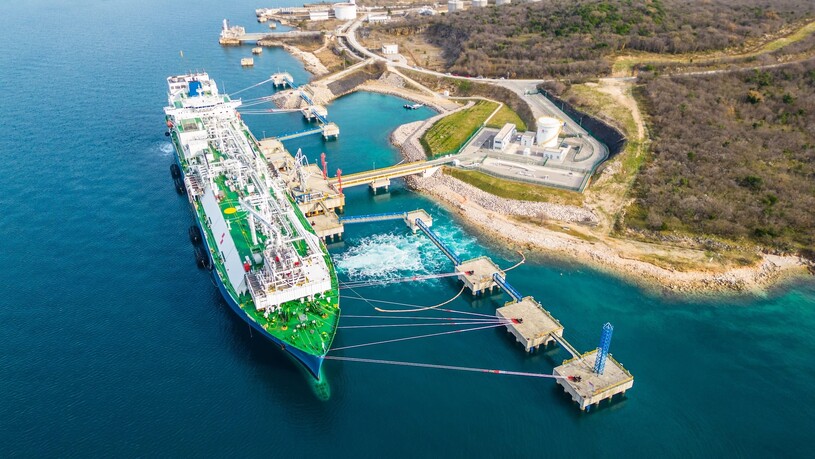
What’s new in small-scale LNG 3
Changing Skangass bunkering regime for Fjord Line ferries in the port of Stavanger


Changing Skangass bunkering regime for Fjord Line ferries in the port of Stavanger
The Norwegian Directorate for Civil Protection (DSB) has approved the road tanker bunkering of Fjord Line ferries at the company’s berth in Stavanger’s Risavika harbour while passengers are onboard the vessels. The road tankers load their consignments for the ships at the neighbouring Skangass LNG terminal in the harbour.
Fjord Lines has recently put the LNG-fuelled roro passenger (ropax) ferries Stavangerfjord and Bergensfjord into service on routes connecting the ports of Stavanger and Kristiansand in Norway with Hirtshals in Denmark.
The road tanker bunkering solution is a temporary one. Skangass is currently constructing a 750m pipeline linking the Skangass LNG terminal with the nearby Fjord Line ferry berth to enable direct LNG bunkering between the shore storage tank with the fuel tanks on the vessels. The line is scheduled for commissioning in summer 2014.
TGE Marine LNG fuel systems in demand
In recent weeks TGE Marine has signed contracts covering the design and supply of LNG fuel gas packages for three vessels, comprising one conversion and two newbuildings.
The scope of the first order, with Rolls-Royce Marine AS for the converted ship, encompasses the engineering and delivery of two vacuum-insulated LNG tanks, each of 150m3 capacity, and the gas processing equipment to send natural gas to the main engine. The package is destined for Bergen Viking, a 4,400 dwt chemical/product tanker that Bergen Tankers AS is having converted in summer 2014 to enable running on LNG. The existing engines on the 2007-built, Statoil-chartered ship are to be replaced by lean burn gas engines from Rolls-Royce.
The other TGE Marine contracts are with MAN Diesel & Turbo and cover the design and supply of high- and low-pressure LNG fuel gas systems for installation on two container/roro (con-ro) vessels ordered by Crowley Maritime at the VT Halter Marine yard in the US. Each vessel will be equipped with three 770m3 vacuum-insulated LNG bunker tanks, high-pressure/low-pressure pumps, boiloff gas compressors, vaporisers, utility and safety systems and a control and alarm board. TGE has subcontracted construction of the bunker tanks for all three vessels to INOXCVA. The 220m-long Crowley ships are scheduled for a 2017 delivery.
Rolls-Royce to power CNOOC tug pair
Chinese state oil company CNOOC has contracted Rolls-Royce to supply propulsion systems for two LNG-powered tugs to be built at Sinopacific’s Zhenjiang shipyard in Jiangsu, China. The deal includes an option for propulsion units for an additional two tugs. Zhenjiang plans to deliver the first tug by the end of 2014. The tugs will be the first built in Asia to run solely on LNG.
For each tug Rolls-Royce will supply a pair of Bergen C26:33L9PG lean-burn, spark-ignition gas engines as well as a pair of Rolls-Royce US 205 CP azimuth thrusters to provide the tugs with rapid manoeuvring and strong bollard pull capabilities. These are key attributes for tugs engaged in the type of escort operations required by LNG carriers in port approaches.
The CNOOC order follows the delivery earlier this year of Borgøy, the world’s first gas-powered tug. Completed by the Sanmar yard in Turkey for Buksér og Berging of Norway, the vessel is also driven by Rolls-Royce Bergen engines. The shipbuilder is also poised to hand over sister vessel Bokn to the same owner.
Support for Evergas bilobe tanks
Technicians from Deutsche Holzevredelung Schmeing (Deho) have completed the installation of dehonit® compressed laminated wood blocks for the three bilobe cargo tanks on Hull No S1019, the third of four 27,500m3 LNG/ethane carriers building for Evergas at the Sinopacific yard in China. The aft two bilobe tanks, with a capacity of 9,686m3 each, are the largest tanks of this type yet built for a gas carrier.
Each tank has one fixed support aft, to secure the tank near the cargo pumps, and one sliding support forward to allow for the expansion and contraction of the tank during loading and discharging. Hull S1019’s forward tank has a tapered bilobe shape and its forward support is positioned at the part spherical forward end.
The arrangement has necessitated a complex shape for the forward sliding support. Deho employed five-axis, computer numerical control (CNC) machining for these dehonit blocks. All the blocks are made from European red beech, a wood which studies have shown has no match when it comes to its support properties.
At virtually the same time as the block installation was being completed in China the lowering of a Sinopacific-built cargo tank was successfully accomplished in Brazil under Deho supervision. Like the four Evergas ships, Hull No EP001, the first 7,000m3 LPG carrier building at the new Vard yard in Rio de Janeiro, has dehonit support blocks.
ABS approval for Elliott Bay LNG barge design
ABS has issued an approval in principle (AIP) to Seattle-based Elliott Bay Design Group for its 2,000m3 combined LNG/marine diesel oil (MDO) bunker barge concept. Termed EB-2000, the design is based on a 78m-long barge with space for 2,000m3 of LNG in Type C pressure vessel tanks and additional tank capacity for MDO.
Elliott Bay says the non-propelled vessel can be built for towing or as part of an articulated tug barge (ATB) combination. It has a trunk level control room, and a stern ballast tank for trim optimisation is available as an optional extra. The EB-2000 LNG vessel is one of several similar barge designs developed by the naval architect firm in response to the growing interest in the use of LNG as marine fuel by US shipowners.
NACKS to build UECC car carrier duo
Oslo-based United European Car Carriers (UECC) has placed an order with Kawasaki Heavy Industries (KHI) for two dual-fuel pure car and truck carriers (PCTCs). The 181m-long ships will be constructed to 1A super Finnish/Swedish ice class for year-round trading in the Baltic Sea. Each PCTC will be able to carry approximately 3,800 standard size cars on its 10 decks. The decks can be adapted for high and heavy vehicles as well as other cargo loaded on trailers. The pair, which are the first LNG-powered car carriers and the first newbuildings for UECC since 2000, are due for delivery in the second half of 2016.
The Lloyd’s Register-class vessels will be built by the Chinese yard of Nantong COSCO KHI Ship Engineering (NACKS), a joint venture between KHI and the China Ocean Shipping Co (COSCO). UECC is also jointly owned, by NYK Line and Wallenius Lines. All the parties, more specifically UECC, Wallenius Marine, NYK Technical Group and KHI, co-operated in the development of the PCTC design.
Each of the new car carriers will be propelled by a single MAN 8S50ME-C8.2-GI gas-injection engine. The propulsion system also features three dual-fuel generator sets and two IMO Type C LNG fuel tanks. The ships will be able to run on LNG, heavy fuel oil and marine gas oil and complete a 14-day roundtrip in the Baltic between bunkering operations using only LNG as fuel. KHI has carried out a four-month verification test programme on the low-speed ME-GI engine and the gas supply system.
UECC plans to base the PCTCs in Zeebrugge, and NYK is reported to be considering the construction of an LNG bunker tanker for use in fuelling the vessels at the Belgian port.
Klaipeda LNG considers FSRU-to-bunker vessel transfers for its new import terminal
Lithuania’s National Commission for Energy Control and Prices (NCECP) has approved the rules for use of the planned Klaipeda LNG terminal. Amongst other things the rules establish the procedure governing the use of the terminal in receiving cargoes, regasifying these cargoes and delivering the resultant gas into the country’s transmission system.
The Klaipeda LNG project is based on the use of a floating storage and regasification unit (FSRU), to be supplied by Höegh LNG, as a receiving facility moored in the port of Klaipeda. The facility is due for commissioning at the end of 2014.
One of the operations covered by the NCECP rules is the ship-to-ship (STS) transfer of LNG from the FSRU to LNG vessels berthed alongside. The provisions have transfers of LNG to coastal distribution tankers and bunker vessels particularly in mind in order to cater for the expected rise in the use of LNG as marine fuel in the Baltic Sea and the spread of a network of small receiving terminals throughout the region. The new terminal has been configured to allow for STS transfers to LNG coastal tankers and bunker vessels of up to 20,000m3 in capacity.
Consilium gas detection for TOTE box ships
Sweden’s Consilium Marine and Safety AB is to supply fire and gas detection systems for each of the two 3,100 TEU, LNG-fuelled container ships that Totem Ocean Trailer Express (TOTE) has ordered at the National Steel and Shipbuilding Co (NASSCO) yard in San Diego, California. The pair are due to enter into service in 2015 and 2016.
Each vessel will be powered by a MAN two-stroke, low-speed, dual-fuel ME-GI engine. As the gas is injected into the engine at high pressure, the fuel system’s gas detection arrangements are a particularly important safety feature.
A total of 52 gas sensors will be installed in tandem with the gas-handling fuel system on each ship. The Consilium sensors will employ a loop-based system with full redundant communication. The key areas where the sensors are to be fitted include the bunker station, the LNG tank space, the fuel gas supply room, the outlets and inlets of double-walled fuel gas piping, the top of the dual-fuel engine, the air conditioning room and the emergency generator room. The automatic gas detection system includes a main readout and alarm unit with repeater panels in the fuel control/gas supply room, the ship’s office and the wheelhouse.
Consilium also supplied a gas detection system for Bit Viking, the product tanker that was converted to LNG running for Tarbit Shipping in 2011. More recently the company’s fire and gas detection systems were chosen for the LNG-powered, dual-fuel Finnish Border Guard offshore patrol vessel Turva building at STX Finland Oy’s Rauma shipyard.
Trelleborg control, mooring equipment caters for small-scale ship/shore interface
Trelleborg Marine Systems has introduced a range of compact quick release hooks (QRHs) for mooring applications involving smaller vessels and terminals. Coastal LNG distribution and LNG bunker vessel handling represent one of the target sectors. Offered as a safer alternative to fixed bollards, the new design is available with single, double, triple or quadruple hooks and in capacities up to 50 tonnes.
Each hook cantilevers from the mounting base, and the design is such that the hook cannot make contact with the deck under any loading configuration. The QRH is designed to be released by hand when a mooring line is attached, even under full load.
Trelleborg has also developed a universal safety link (USL) for small-scale LNG transfer and bunkering operations. Based on SeaTechnikTM fibre optic technology, the USL8810 system allows a single operator to monitor and control both sides of the LNG transfer process. Shutdown can be achieved automatically and safely without risk of damaging surge pressures, and the system can be operated safely and reliably in a gas-hazardous zone. Trelleborg reports that with the USL8810 system, inter-compatibility is assured throughout the LNG small-scale fuelling supply chain.
Connect LNG for small-scale transfers
Connect LNG has completed a successful verification test of its Universal Buoyancy System (UBS), an LNG cargo transfer system for small-scale applications, at the Norwegian Marine Technology Research Institute (Marintek) in Trondheim. In tandem with this development the company has launched the second of three stages in the DNV GL qualification programme for its new technology and initiated a study at Sintef Energy to obtain an expert, third-party verification of its UBS process system.
Connect LNG has developed UBS to provide the industry with a simple means of transferring LNG from coastal tankers to shore tanks. The technology is aimed at facilitating LNG transfers in locations where specialised shoreside infrastructure, including jetties and pipelines, are lacking. Such target sites include stretches of coast with restricted water depths and crowded port zones already filled with busy container terminals and other cargo-handling facilities.
Developers of small-scale LNG facilities face the same types of challenges as those encountered when building a large-scale import terminal, albeit to a reduced degree. These include high investment costs and slow payback on investment; lengthy planning and construction times; the need for thorough seabed and environmental impact analyses; and a stringent permitting process involving many agencies and certification bodies. The Connect LNG solution aims to achieve major reductions in the workloads associated with such tasks.
The UBS technology features a buoy loading system that is used to connect a flexible LNG transfer line from the ship to a pressure vessel storage tank ashore. Connect LNG points out that it is a flexible system that can be moved easily from one location to another. The company’s researchers have carried out a series of model tests over the last few years and are now seeking partners for a pilot project with full-scale testing to begin in early 2015.
RINA to assist Danish shipowners on LNG bunkering plan approvals and surveys
The Danish Maritime Authority (DMA) has authorised Genoa-based class society RINA to act on its behalf in carrying out plan approval and survey work on LNG-fuelled, Danish-flag ships during their construction.
Like a number of leading class societies, RINA has developed its own set of rules and requirements governing the use of LNG or compressed natural gas (CNG) as marine fuel. The rules are designed in such a way that compliance with their provisions ensures the construction or conversion of a vessel which achieves the same levels of safety and reliability in operation as a ship with a conventional liquid fuel propulsion system.
Although drafting work on IMO’s International Code for Ships using Gas or other Low Flash-Point Fuels (IGF Code) is nearing completion, the entry into force of this mandatory set of international regulations is still at least three years away. For owners ordering LNG-propelled vessels over the next few years it will be necessary for them to work to class requirements.
Magnetic bunker mooring from Mampaey
Mampaey Offshore Industries is currently developing a fully automatic magnetic mooring system for bunker vessels. Called DockLock®, the system will feature two pairs of articulated arms mounted on one side of the deck of the bunkering ship. Each arm will have four magnetic pads for attaching to the ship to be fuelled once the two vessels are alongside each other. The magnetic connection is activated once the attachment is made.
The arms and pads are designed to withstand worst-case operating scenarios arising from motions and forces caused by wind, current and passing vessels. The automatic system includes constant monitoring and control, surge protection, a manual override and redundant and failsafe components.
Mampaey, a Dutch family firm, points out that the use of DockLock will result in faster, safer vessel turnarounds with fewer crew and lower costs due to reduced engine use. The company is promoting the new technology with a wide range of applications in mind, including in the nascent LNG bunkering sector.
Mampaey has been involved with LNG operations since 1979, when it supplied berthing equipment for the Montoir-de-Bretagne import terminal in France. Over the past 35 years the engineering firm has supplied mooring and berthing systems for over 50 large-scale LNG terminal and floating storage unit projects worldwide.
The equipment portfolio includes quick release hooks (QRHs) and capstans as well as remote control, mooring load monitoring and berth approach systems. Amongst the recent reference list entries is a 200-tonne QRH for the Shell Prelude floating LNG project.
Shell puts Ontario, Louisiana LNG plants on hold
Shell has temporarily shelved plans to build two small-scale gas liquefaction plants in Ontario and Louisiana that were earmarked to supply LNG as a transport fuel. The energy major had originally proposed constructing the plants, each capable of producing 250,000 tonnes per annum of LNG, at its Corunna refinery near Sarnia, Ontario and its Geismar Chemicals facility in Louisiana.
The Corunna facility was intended to supply LNG fuel along the Great Lakes corridor while the Geismar unit would have made LNG available along the Mississippi River and the US Gulf Coast. While the bulk of the output from both facilities was targeted at the vessel bunkering sector, substantial volumes would have been available for heavy goods vehicles.
Shell has been reassessing its investment portfolio after some recent, less-than-favourable, group financial results. The commercial sense and timing of the plans for the liquefaction plants have been thrown into question by the emergence of new flexible, small-scale LNG production technologies that enable careful matching of customer needs at competitive rates.
GTT plugs LNG barge
ABS has awarded an approval in principle (AIP) for a non-propelled, membrane tank push LNG bunker barge concept developed by GTT North America (GTTNA). The 2,200m3 unmanned barge has been designed for use in both ship-to-ship (STS) transfers of LNG and the transport of LNG in bulk. The intended service arena is US waterways and coastal waters.
The cargo tanks on the 64m-long bunker barge will be of the GTT Mark III Flex type and the vessel is designed to be towed, at speeds of up to eight knots. The flexibility inherent in the design enables the barge to operate as either a mobile refuelling resource or a stationary, moored bunkering station. The latter option still allows movement of the vessel between appointed stations.
N-DSQ to build LNG-fuelled vessels
Nakilat-Damen Shipyards Qatar (N-DSQ) of Ras Laffan has announced its intention to construct LNG-fuelled vessels of various types of up to 170m in length for both local Qatari and overseas clients. The company will use the facilities at the Erhama bin Jaber Al Jalahma Shipyard at the Ras Laffan Industrial City port for this purpose.
Established in 2010, N-DSQ is a joint venture between Qatar Gas Transport Company (Nakilat) and Damen Shipyards of the Netherlands. Nakilat holds a 70 per cent stake in the company and the Damen Group 30 per cent. The yard has delivered over a dozen vessels to date and is currently in the final stages of completing 19 vessels for use in Qatar’s Mesaieed port. Damen has an interest in about 45 shipyards worldwide but N-DSQ is the biggest in terms of the size and height of the building halls.
Kawasaki gas-only main engine for large vessel market gains approval from DNV GL
DNV GL has awarded Kawasaki Heavy Industries (KHI) type approval for its L30KG gas-only main engine. Designed with an output capacity of over 2MW, the marine gas engine is aimed at the large vessel market.
The L30KG technology is based on a gas engine that KHI developed for land-based applications that require electricity to be generated on site rather than taken from the grid. The unit boasts what the manufacturer claims is the world’s highest electrical efficiency, 49.0 per cent, while nitrogen oxide (NOx) emissions are below 200 parts per million (ppm) at 0 per cent O2. The manufacturer states that the unit achieves NOx emissions far below the level set by IMO’s Tier III regulations, which enter into force in 2016, without the need to rely on special equipment such as a selective catalytic reduction (SCR) system.
The L30KG engine is designed to accommodate the load fluctuations inherent in marine applications. It also features technology to support both a mechanical propulsion system, in which the engine is coupled directly with the propeller, and an electrical propulsion system in which the engine generates electricity to drive the propeller indirectly. Kawasaki has conducted land-based tests using a six cylinder, 2.7MW demonstration engine at its Kobe Works. The company has already started marketing the L30KG unit and is also set to complete the process of obtaining type approval for the control system.
Scoping LNG-fuelled Cargill deepsea vessels
Cargill, DNV GL, Shell and Xyntéo have agreed to jointly explore and assess the potential for using LNG to fuel vessels that Cargill operates on deepsea routes. The ships under consideration are bulk carriers and medium range product tankers. Cargill, an agricultural trader, is the world’s largest charterer of bulk carriers, and at any given time there are upwards of 500 vessels at sea engaged in the delivery of the company’s products.
While Cargill is the potential user of the LNG according to the scenarios under investigation, Shell is the supplier. DNV GL is providing input on risk management while Xyntéo, an international advisory firm, is managing the development of the project. As the effort moves forward, the companies will reach out to other players in the industry, including vessel owners and shipyards.
The participants acknowledge that the use of large, LNG-fuelled vessels on deepsea routes poses a number of unique technical, operational and commercial challenges that need to be carefully evaluated. They are looking at investments that would begin in or around 2016.
Cryonorm LNG fuel system for Eiger
Cryonorm has supplied an LNG fuel gas system for Danser Containerline’s push-tow combination vessel Eiger, which is currently being converted to dual-fuel running. The principals point out that the project is the first retrofit of a gas-fuelled propulsion system for an inland waterway container barge in Europe. The work includes the supply and installation of two new Wärtsilä 6L20DF engines, each with a power output of 900kW, by Koedood Dieselservice.
The Cryonorm supply contract, with Koedood, involves the engineering, design and supply of the LNG fuel system onboard. The package consists of LNG bunker stations on the port and starboard sides of the vessel, a 60m3 LNG bunker tank, a control system, a glycol-water system, vaporisers, valves, instruments and gas-processing equipment.
The vacuum-insulated Type C pressure vessel bunker tank was built for Cryonorm by Spain’s Ros Roca Indox Cryo Energy and is mounted underdeck, in an athwartships position, just forward of Eiger’s engineroom. A full tank of LNG will enable the vessel to make a Rotterdam-Basel return journey running on gas.
Rommerts Ship Design of Zwijndrecht in the Netherlands has also participated in the conversion project, providing the necessary naval architect services. Eiger is scheduled to commence dual-fuel running on the River Rhine in June 2014.
Waterfront tankers to run on methanol
The decision by Vancouver-based Waterfront Shipping to opt for MAN B&W ME-LGI main engines to power a new series of 50,000 dwt methanol carriers may not be LNG-related but it provides a further indication of the extent to which shipowners are prepared to go in the drive for clean-burning alternatives to traditional marine fuel oil. The Waterfront ships will run on methanol, one of the fuels covered in the new International Code for Ships using Gas or other Low Flash-Point Fuels (IGF Code), now in its final drafting stages at IMO.
The commitment by the three shipowner participants in Waterfront – Westfal-Larsen, Mitsui OSK Lines (MOL) and Marinvest/Skagerack Invest – to the use of methanol fuel also shows the extent to which MAN Diesel & Turbo is progressing with the development of engines to run on fuels that yield much reduced levels of harmful emissions. The company is designating the methanol-burning, electronic, liquid gas injection (ME-LGI) engine as its ME-B9.3-LGI model.
The three shipowners have placed orders for their new methanol carriers separately. Westfal-Larsen has contracted two option one vessels and specified 6G50ME-LGI engines. MOL has also ordered two option one vessels but specified 7S50ME-B9.3 propulsion units while the Marinvest/Skagerack Invest contract is for one option one option one, with each of these vessels to be provided with 6G50ME-LGI engines.
Hyundai Mipo Dockyard will build the Westfal-Larsen and Marinvest/Skagerack Invest tankers and HHI-EMD, Hyundai Heavy Industries’ engine and machinery division, will make the engines. For the MOL contract Minami Nippon Shipbuilding will construct the newbuildings and Mitsui Engineering & Shipbuilding (MES), a Japanese licensee of MAN, will build the engines.
MAN Diesel & Turbo points out that the ME-LGI dual-fuel engine is designed to handle low-flash-point, low-sulphur fuels like LPG and methanol. The engines on the Waterfront Shipping tankers will run on 95 per cent methanol, ignited by 5 per cent pilot oil. The engine manufacturer is currently working towards a Tier-III-compatible version of the ME-LGI engine.
Caterpillar engines enroute for Hamburg LNG-hybrid barge and cold-ironing duties
Caterpillar Marine has begun shipping the five Cat G3516C marine gas engines selected to power the Becker Marine LNG-hybrid barge that is being constructed for operation in the port of Hamburg in the service of cold-ironing cruise ships. The barge will also back up the local electricity and heat grid when not meeting the hotel power needs of visiting cruise ships.
The engine units are being despatched from Caterpillar’s Lafayette, Indiana manufacturing facility, and their installation in Europe is being supervised by company affiliate Zeppelin Power Systems. The G3516C is a spark-ignited, gas engine specially designed to operate in commercial vessel applications. The gas-fuelled units, which are the first marine-classified LNG engines to be delivered by Caterpillar, will be capable of providing up to 7.75MW of electric power in aggregate. The fuel system for the Cat G3516s is an inlet-fumigated, low-pressure gas arrangement able to run at 100 per cent power with gas qualities down to Methane Number 70.
The Komárno yard in Slovakia is building the 74m-long LNG-hybrid barge for Hybrid Port Energy, a unit of Becker Marine. The stationing of the barge in Hamburg, which is scheduled for summer 2014, will make the German port the first in Europe able to provide cold ironing power to cruise ships. The initial vessels to be serviced are a pair of newbuildings for AIDA Cruises, currently under construction by Mitsubishi Heavy Industries.
Chart Ferox is supplying two 40-foot ISO intermodal LNG containers and a skid-mounted gas processing unit for the barge. The arrangement will enable LNG to be supplied in modular form, with the tank containers swapped on a full-for-empty basis, while the need for a dedicated bunkering station will be eliminated. LNG



Related to this Story
Events

Maritime Regulations Webinar Week
 16 Dec 2025
 GMT - ONLINE
Floating energy: successfully unlocking stranded gas using FLNGs and FSRUs
24 Feb 2026GMT - ONLINE
© 2026 Riviera Maritime Media Ltd.


