


Business Sectors
Business Sectors
Events
Contents

Register to read more articles.
NorthStandard study demonstrates benefits of AI navigation support
Container ship operators reduced close encounters by more than 50% by using artificial intelligence to improve navigational safety


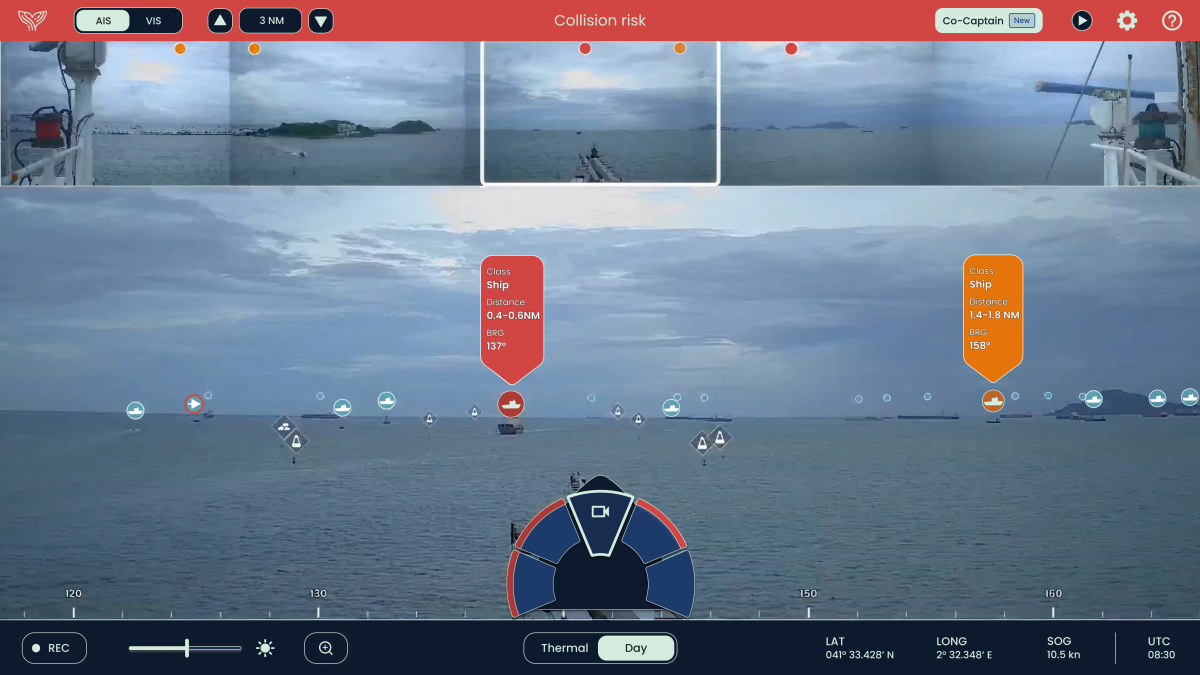
A study led by a protection and indemnity insurance (P&I) provider has found that close encounters involving container ships can be significantly reduced using artificial intelligence (AI) for navigational support.
NorthStandard P&I club undertook a 12-month study with Orca AI, using its AI navigation services for a cohort of 139 container vessels. Applying this technology resulted in a 52% reduction in high-severity close encounters over 12 months, with an initial 22% reduction achieved within the first six months.
This study examined almost 11M nautical miles of voyages of container ships with Orca AI technology installed, measuring the incidence of high-severity close encounters as a primary safety metric. It measured the closest point of approach (CPA), time to CPA, the interaction between ships implementing IMO’s anti-collision regulations and traffic density.
The study compared the initial system adaptation period, during the first three months after installation, with the stabilised usage phase over 10 or 12 months, to identify whether AI-enhanced situational awareness improves navigational safety.
The report found increased adherence to safety management system protocols in open waters, and reduced high-severity close encounters across congested shipping corridors, including 36% decreases in the North and Baltic seas and 18% in seas around China and Japan.
“Fleet growth, crewing shortages, rising asset values, and increasing disruption to navigation systems are compounding navigational risk," said NorthStandard head of loss prevention, Colin Gillespie. “The operating environment today is more complex, less predictable and less forgiving.”
Mr Gillespie referenced increasing reports of interference and spoofing of signals from the Global Navigation Satellite System (GNSS) following geopolitical conflicts, particularly in the Middle East, eastern Mediterranean, Persian Sea and Black Sea.
Orca AI’s digital watchkeeper modules and software provide insights to support bridge teams navigating vessels through congested waters.
The report identified a clear shift toward more proactive crew behaviour, reflected in the higher use of the Orca AI platform in congested waters.
“What we are seeing through our work with Orca AI, and now reinforced by this study, is that improved situational awareness and earlier risk detection can materially reduce close-quarters situations,” said Mr Gillespie.
“For our members, and bridge teams, that translates directly into safer operations, lower exposure to navigational risk, and more consistent decision-making under pressure.”
AI decision support plays an increasingly important role in enabling safe and timely decision-making, said Orca AI chief executive and co-founder Yarden Gross.
“This joint analysis validates at scale that earlier, better-informed decisions on the bridge lead directly to safer voyages,” he said. “By improving detection, prioritisation, and response in real time, crews can manage developing situations before they escalate into high-risk encounters."
Report findings show that crews actively use AI-assisted situational awareness to manage multiple contacts, prioritise risk, and maintain awareness in rapidly developing situations.
“As this shift becomes measurable and consistent across fleets, we can expect it to increasingly be reflected in reduced risk exposure and, over time, how insurers assess that risk.”
Sign up for Riviera’s series of technical and operational webinars and conferences:
- Register to attend by visiting our events page.
- Watch recordings from all of our webinars in the webinar library.
Related to this Story

Events

Maritime Regulations Webinar Week
 16 Dec 2025
 GMT - ONLINE
Floating energy: successfully unlocking stranded gas using FLNGs and FSRUs
24 Feb 2026GMT - ONLINE
© 2026 Riviera Maritime Media Ltd.


