


Business Sectors
Business Sectors
Events
Contents
Register to read more articles.
DFDS and partners launch UK-Netherlands ropax green shipping corridor project
Transforming a DFDS route into a green corridor for methanol-fuelled ferries


The UK’s northeast is playing a major role in a new government-funded initiative designed to advance environmentally friendly travel within Europe.
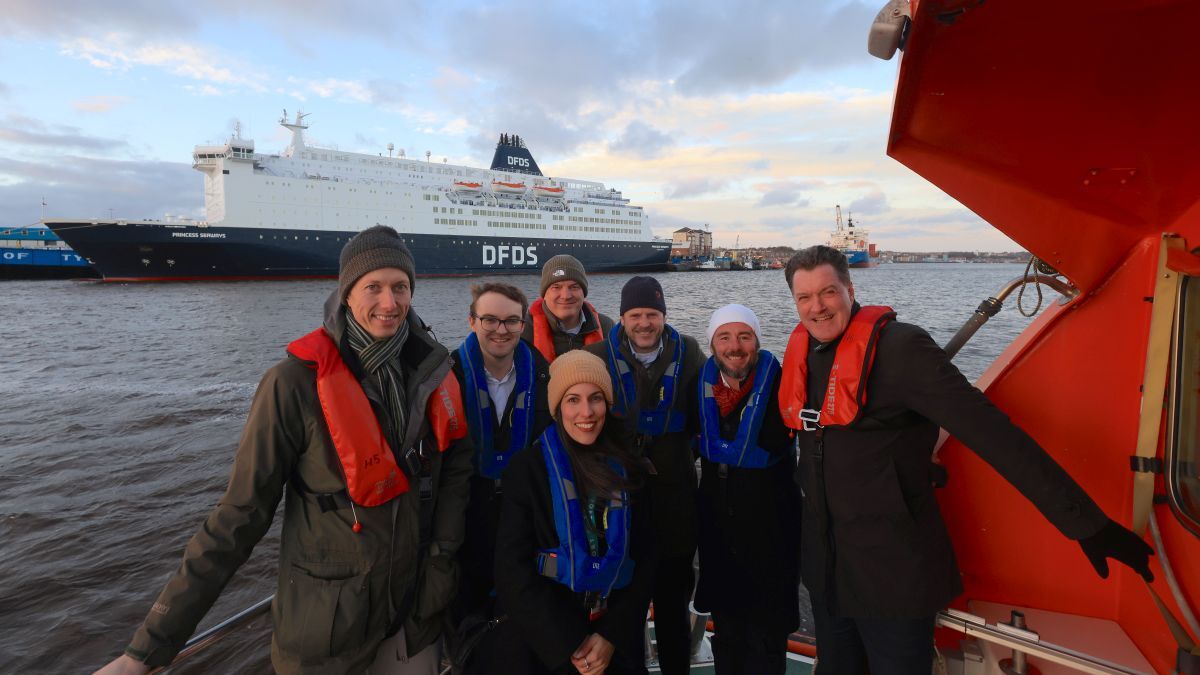
Partners from across the UK and Europe came together at the Port of Tyne recently to officially launch the Green North Sea Shipping Corridor Project, which aims to create one of the world’s first green shipping corridors between the Port of Tyne and the Port of IJmuiden in Amsterdam.
The project is part of a £9.0M (US$11.5M) investment announced by UK Maritime Minister Mike Kane in October while at the Port of Tyne, to decarbonise shipping and turbocharge green jobs, from which the Port of Tyne was successful in winning the International Green Corridors Fund.
During the partners’ visit, representatives from each organisation, which includes the two ports, DFDS, Ricardo and KVSA, officially launched the project, helping to make smarter, cleaner shipping a reality.
This initiative aligns with plans for DFDS to target a significant reduction in CO2 emissions, by transitioning to methanol-fuelled roro and ropax vessels.
The project will focus on decarbonising the route between the Port of Tyne and the Port of IJmuiden, currently served by ageing vessels. It will determine the necessary landside infrastructure at the two ports for fuelling and electrification, analyse the fuel supply chain and evaluate the economic and environmental benefits.
The partners already have a longstanding relationship, having connected the northeast and the Netherlands via a DFDS ferry route for many years, which runs between the Port of Tyne’s International Passenger Terminal and the Port of IJmuiden. The ships currently on the route transport passengers and their vehicles, freight units and HGVs carrying vital goods and finished products to and from the continent.
Port of Tyne chief executive Matt Beeton said, “By establishing this green corridor between the Port of Tyne and the Port of IJmuiden, we aim to significantly reduce carbon emissions between the northeast of England and Europe, with the aim of saving up to 850,000 tonnes of CO2 annually. The success of this project will bring more green jobs to the region and drive the development of port infrastructure for electrification and refuelling state-of-the-art clean-powered vessels.”
DFDS director, business development and strategy, Declan Walsh said, "DFDS is committed to becoming a carbon-neutral transport and logistics company by 2050 and the decarbonisation of our passenger business is a key part of this journey. Transforming our current Amsterdam-Newcastle route to a ropax green corridor is a massive undertaking and we are fortunate to have such great partners to help us make this happen".
Port of Ijmuiden managing director Peter van de Meerakker said, "This project is very important for us, as we need to accelerate the reduction of our shipping emissions. With the zero-emissions new tonnage of DFDS, we are taking an important step forward, since a lot needs still to be done on both sides of the North Sea and this project helps to enormously speed up and achieve our goals."
Sign up for Riviera’s series of technical and operational webinars and conferences:
- Register to attend by visiting our events page.
- Watch recordings from all of our webinars in the webinar library.
Related to this Story
Events

Maritime Regulations Webinar Week
 16 Dec 2025
 GMT - ONLINE
Floating energy: successfully unlocking stranded gas using FLNGs and FSRUs
24 Feb 2026GMT - ONLINE
© 2026 Riviera Maritime Media Ltd.


