


Business Sectors
Events
Offshore Support Journal Conference, Middle East 2025
 09 Dec 2025
 DUBAI
DUBAIContents
Register to read more articles.
Update: oil companies oppose Saipem-Subsea7 merger
A proposed merger between Saipem and Subsea7 has hit headwinds from energy companies that fear the combined company will have a dominant position in the Brazilian market


Oil companies developing deepwater fields in Brazil have opposed a proposed merger between energy contractors Saipem and Subsea7 as they fear the combination would monopolise the subsea installation market.
The merger of two of the world’s largest offshore engineering contractors will create a behemoth, with considerable influence on the global energy contracting market and a sizeable fleet of specialised vessels.
Brazil oil industry group IBP has submitted documents to Brazil’s antitrust agency Cade, which has subsequently asked Saipem and Subsea7 for further information on their considered merger, according to Reuters.
There are concerns the combined group, to be called Saipem7, would dominate the market, increasing prices and costs for installing subsea umbilicals, risers and flowlines (Surf).
If the merger is approved and goes ahead, Saipem7 will operate a fleet of more than 60 construction vessels ready to take on complex offshore energy projects.
But oil companies, including Brazilian state energy group Petrobras and oil majors ExxonMobil and TotalEnergies, fear this fleet would prevent competition in the market.
In Brazil, its only main competitor would be TechnipFMC, which has also raised its concerns with the Brazilian industry group. One oil company not expected to have any objection would be Italy’s Eni, the biggest shareholder in Saipem.
Brazil is the top market for Surf installation to develop the nation’s giant oil and gas fields in ultra-deepwater which rely on subsea networks tied into large moored floating production, storage and offloading facilities.
However, there was good news for the two contractors, as the merger into Saipem7 was approved by UK authorities in November.
9 September
Saipem and Subsea7 announced their merger in July 2025, with expectations that this transaction to form Saipem7 would be officially completed in H2 2026. It will operate a fleet of more than 60 vessels and drilling rigs, have a workforce of over 44,000 professionals and expertise in complex, high-tech offshore energy and infrastructure projects.
Both Milan, Italy-headquartered Saipem and Oslo, Norway-listed Subsea7 anticipate Saipem7 would have revenue of around €21Bn (US$24.7Bn) and earnings before interest and tax of over €2Bn (US$2.3Bn) and a combined backlog of contracts of around €43Bn (US$50.5Bn) depending on the point of transaction completion.
Saipem7 will be incorporated in Italy and headquartered in Milan, and will have its shares listed on both the Milan and Oslo stock exchanges, while Saipem and Subsea7 will have 50% ownership each.
It is highly likely to complete successfully as Siem Industries, a principal shareholder in Subsea7, and Eni and CDP Equity, reference shareholders of Saipem, have all committed to vote in favour of the proposed combination.
As part of this deal, Saipem7’s chief executive will be designated by Eni and CDP Equity and its board chairman by Siem Industries. It is currently envisaged that, upon completion, Kristian Siem will be appointed as chairman of the board of directors of Saipem7 and Alessandro Puliti will be appointed its chief executive.
Saipem7’s offshore engineering and construction business would be named Subsea7, headquartered in London, UK, and led by Mr Puliti as chairman and John Evans as chief executive.
"Saipem7 would have revenue of around €21Bn"
This combined group would provide a full spectrum of offshore and onshore services, from drilling, engineering and construction to life-of-field services and decommissioning in oil, gas, carbon capture and renewable energy.
It will have a diversified fleet of over 60 construction support vessels able to undertake various projects, from shallow water to ultra-deepwater operations, using a portfolio of heavy lift, high-end J-lay, S-lay and reel-lay for installing rigid and flexible pipelines, umbilicals and cables.
After this EU cross-border statutory merger is completed, Siem Industries would own around 11.8% of Saipem7’s share capital, while Eni will own 10.6% and CDP Equity 6.4%. Subsea7 shareholders participating in this proposed combination will receive 6.688 new Saipem shares for each Subsea7 share held.
Q2 2025 operations
At the end of June 2025, Subsea7 had a contract backlog of $11.8Bn, which it said gives investors over 90% visibility on 2025 revenue guidance. At that time and into Q3 2025, its vessels were operating in west Africa, South America, Europe and US Gulf and Australia.
Seven Arctic, Seven Borealis and Seven Pacific were installing flexibles, umbilicals and manifolds at Azule Energy’s Agogo project, while Seven Vega was active on TotalEnergies CLOV development, all in Angola.
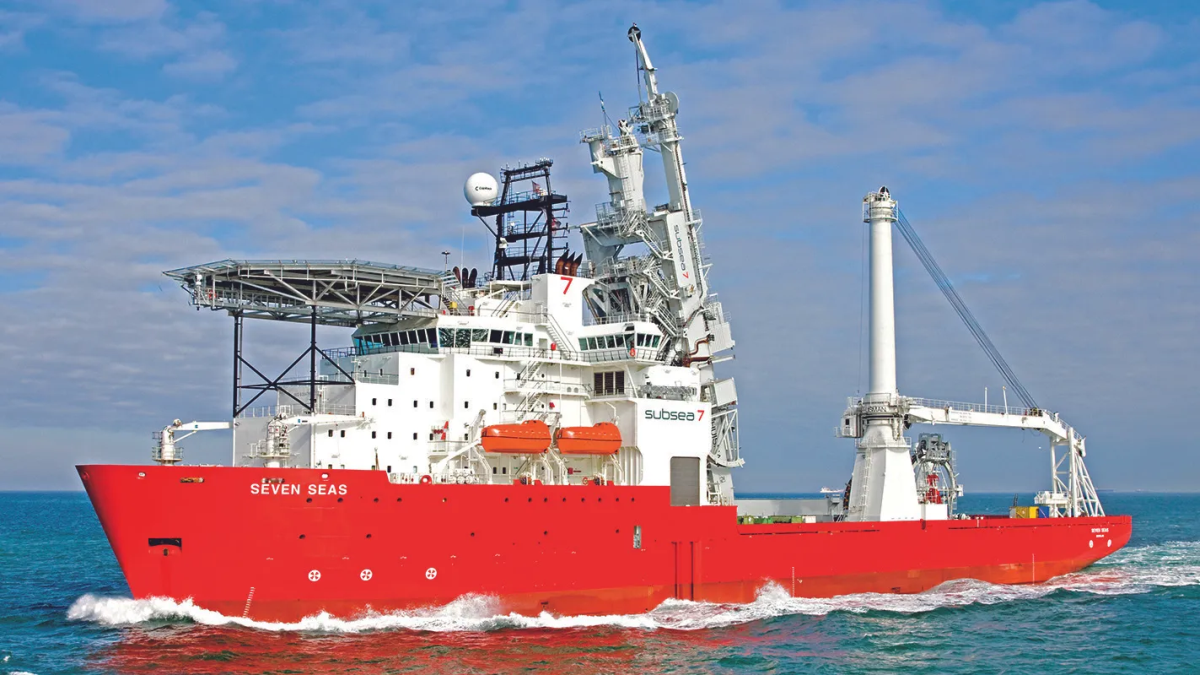
Seven Oceans and Seven Seas were working on a range of US projects including Sunspear, Salamanca and Shenandoah, while in Brazil, Seven Cruzeiro completed its work at Bacalhau and began its new three-year charter for Petrobras.
In Norway, Seven Navica continued reel lay activities for Yggdrasil and Irpa while Seven Oceanic completed a campaign at the Scarborough field in Australia and was heading to the North Sea market, stopping off at Cape Town, South Africa, at the start of September, according to automatic identification system data.
Seaway Strashnov and Seaway Alfa Lift were working on the Dogger Bank C windfarm project in the UK where they will install 87 monopiles; Seaway Ventus was installing 95 monopiles at the East Anglia Three project in the UK. Seaway Aimery and Seaway Moxie were installing cables at He Dreiht in Germany.
Subsea7 chief executive, John Evans, says the company had gained US$2.5Bn in contracts and “delivered strong growth in profitability” in both subsea and renewables. He is positive on the future for the sector going into 2026.
“Tendering activity remains high, with a balance of greenfield and tie-back prospects”
“In subsea, tendering activity remains high, with a balance of greenfield and tie-back prospects for a diverse range of clients and geographies,” says Mr Evans. “In the renewables industry, near-term momentum is dependent on progress of the UK allocation round, but offshore wind remains a long-term structural growth market.”
In Q3 2025, Subsea7 won a major contract (valued between US$750M and US$1.25Bn) from Turkish Petroleum Offshore Technology Center for phase three of the Sakarya field development in the Black Sea. Subsea7’s workscope includes engineering, procurement, construction and installation (EPCI) of the subsea umbilicals, risers and flowlines.
In Taiwan, Subsea7’s subsidiary Seaway7 gained a substantial contract (between US$150M and US$300M) from Synera Renewable Energy (SRE) to transport and install 35 inter-array cables for the Formosa 4 windfarm, 20 km off the coast of Miaoli County, starting in 2028. In addition, Seaway7 was selected as the preferred contractor for installing 57 inter-array cables on SRE’s Formosa 6 project, with contract finalisation expected in 2026.
Saipem activities
In Q3 2025, Saipem completed subsea work, which started in 2024, for ExxonMobil on the Yellowtail project in the prolific Stabroek deepwater block in Guyana, where its flagship vessel FDS2 installed rigid flowlines and steel risers using its J-lay facilities, in water depths of around 1,800 m.
Saipem’s Saipem Constellation installed the flexible risers and umbilicals and connected the pre-laid rigid riser to the floating production storage and offloading (FPSO) vessel, and chartered-in multipurpose support vessel, Normand Samson provided pre-commissioning, surveys, light construction and installed flowline jumpers fabricated at Saipem’s yard in Georgetown.
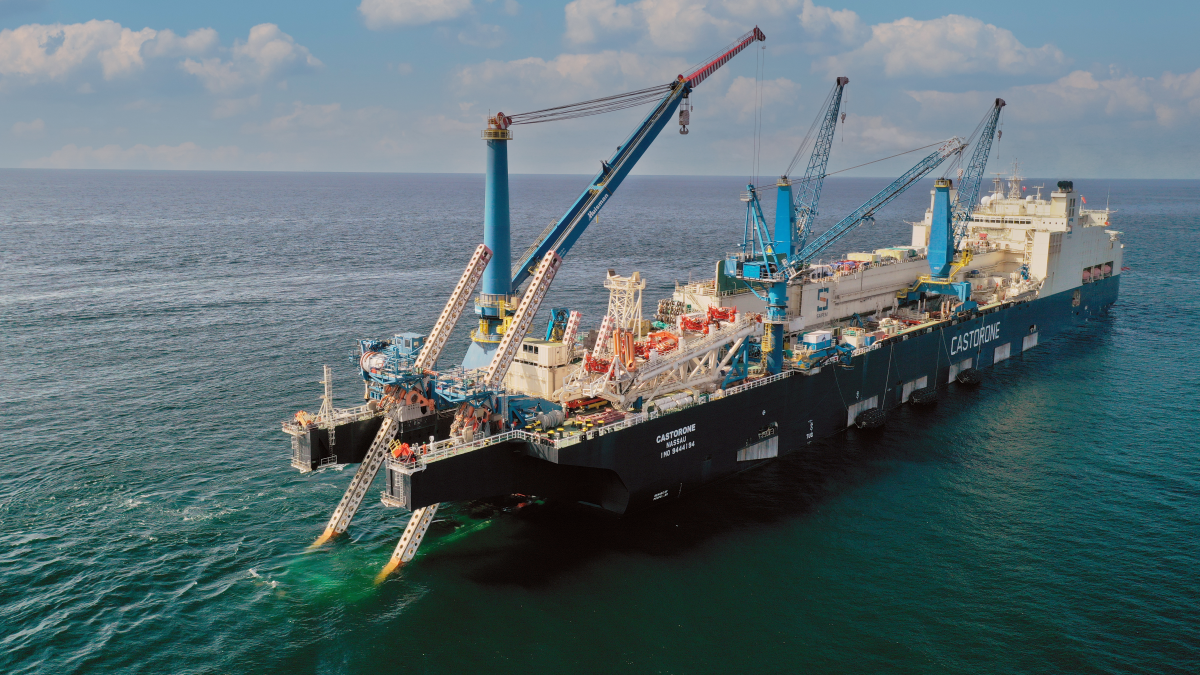
Saipem also installed pipelines for Equinor’s Irpa project in the Norwegian Sea. Its 2012-built, 325-m pipelay vessel Castorone deployed an 80-km pipe-in-pipe from the Irpa field to the floating Aasta Hansteen platform in water depths of around 1,350 m, making Irpa the deepest subsea field development in Norway to date.
In another project, Saipem completed converting its Scarabeo 5 semi-submersible drilling unit into a floating plant for the separation and boosting of hydrocarbons (FPU) for Eni’s Congo LNG project. Saipem’s activities entailed engineering, procurement, construction, transportation and commissioning of this FPU to be installed offshore the coast of the Republic of Congo, northwest of the Djeno terminal, at a depth of around 35 m.
Riviera’s OSJ Subsea Conference will be held in London on 2 February 2026. Use this link for more information and to register for the event.
Related to this Story
Events
Offshore Support Journal Conference, Middle East 2025
09 Dec 2025DUBAI
Maritime Regulations Webinar Week
16 Dec 2025GMT - ONLINE
Maritime Decarbonization Conference, Americas 2026
22 Jan 2026HOUSTON
Offshore Wind Journal Conference 2026
02 Feb 2026London
© 2024 Riviera Maritime Media Ltd.


