


Business Sectors
Business Sectors
Events
Contents

Register to read more articles.
Shallow-water well cap technology unveiled to prevent leaks becoming environmental disasters
Equipment has been developed to enable OSRL to tackle oil spills from hydrocarbon production wells in shallow waters when conventional methods are unavailable or unviable


Oil Spill Response Ltd (OSRL) has developed equipment enabling it to tackle oil leaks from hydrocarbon production wells in shallow waters.
It worked with two other companies to combine existing modules into one system that enables oil-well capping when surface conditions make conventional vertical access unsafe or impracticable.
It integrates OSRL’s split lowering system (SLS) developed with InterMoor, and the new snub-line winch developed by Oceaneering.
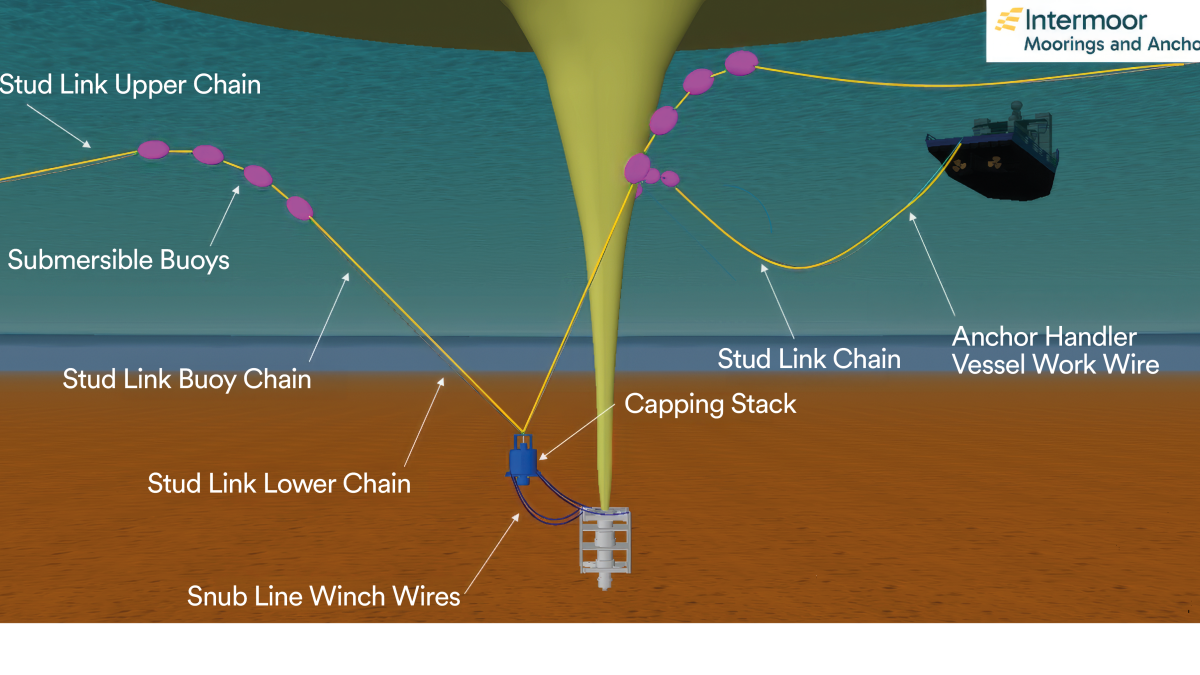
This SLS stack can be deployed, positioned and lowered from an offset location outside the hazardous surface plume, while the winch system is used for controlled final alignment and landing on the blow-out preventer (BOP) or wellhead.
“This shallow‑water deployment capability reflects OSRL’s continued investment in strengthening industry’s readiness for complex subsea incidents,” said OSRL chief executive, Vania de Stefani.
“Bringing together the SLS and snub-line winch helps support safer, controlled capping stack deployment in challenging shallow‑water scenarios and reinforces the value of collaborative preparedness across the industry,” she said.
OSRL said the stack can be deployed in water depths from 75 m to 600 m where surface conditions prevent safe vertical access, without a seabed interface of components, to support complex well‑control scenarios.
This can include if the oil plume is vertical from the uncapped well, resulting in surface boiling of volatile organic compounds and gases with low explosive limits.
This would put a vessel operating above the well in the danger zone, thus preventing safe vertical access to the wellhead and BOP. to cap the uncontrolled well.
In these cases, a fleet of anchor-handlng tugs could be positioned near the well to manoeuvre the capping stack onto the top of the wellhead using the SLS and stud-linked chains assisted by submersible buoys.
In Q3 2026, OSRL relocated one of its key oil-spill response assets in Guyana from a shore base to the new emergency response base in Vreed-en-Hoop, enabling strategic placement of equipment and people to support ExxonMobil’s oil production operations in the nation.
Ms de Stefani said this was one of only 13 capping stacks in the world and one of only two in Latin America.
“Prevention is at the core of everything we do, supported by robust systems, rigorous standards and continuous monitoring, making scenarios requiring this equipment highly unlikely,” she said. “Even so, it is reassuring to know it is already in place, ready if ever required.”





Related to this Story
Events

Maritime Regulations Webinar Week
 16 Dec 2025
 GMT - ONLINE

Floating energy: successfully unlocking stranded gas using FLNGs and FSRUs
24 Feb 2026GMT - ONLINE
© 2026 Riviera Maritime Media Ltd.


