


Business Sectors
Business Sectors
Events
Contents

Register to read more articles.
Shipping enters controlled wartime access regime
In its latest update, maritime intelligence provider Windward notes that Hormuz traffic continues, but under selective access, dark activity and tighter insurance constraints


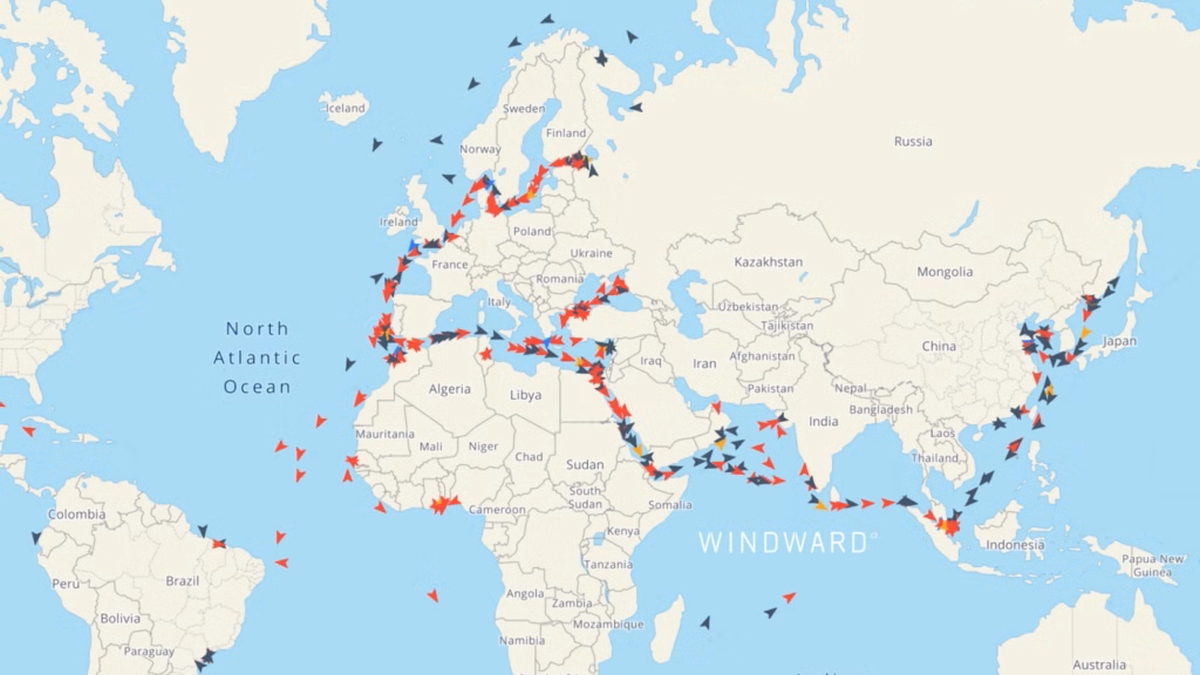
Maritime traffic through the Strait of Hormuz has not stopped, but it is operating under what Maritime intelligence provider Windward described as a constrained and controlled wartime system shaped by selective access, degraded vessel visibility, insurance stress and sanctions-era trading networks.
In its latest updates of 26 March 2026, in the form of an explanatory notice and an accompanying webinar briefing, Windward noted that “maritime traffic through the Strait of Hormuz has not ceased, but it has fundamentally changed” and that “the system has not broken, but has shifted into a constrained and controlled operating environment.”
AIS-visible crossings dropped sharply during the conflict, with only 16 vessels recorded transiting the Strait during the third week.
That description was echoed in Windward’s briefing, where Windward senior maritime intelligence analyst Michelle Wiese Bockmann said the company was seeing an “Iran Revolutionary Guard-controlled corridor in place” and that vessels linked to India, China, Pakistan and Bangladesh, along with ships supplying agricultural cargoes to Iran or moving its energy commodities, were attracting safer passage through Iranian territorial waters.
Ms Wiese Bockmann said transits are down 95% and that much of the remaining movement was dark, and added, “One of the hallmarks of Iranian energy commodities trading is that they have been sailing through ‘dark’. It’s more or less business as usual in terms of shipping, shipments of crude and supplies.”
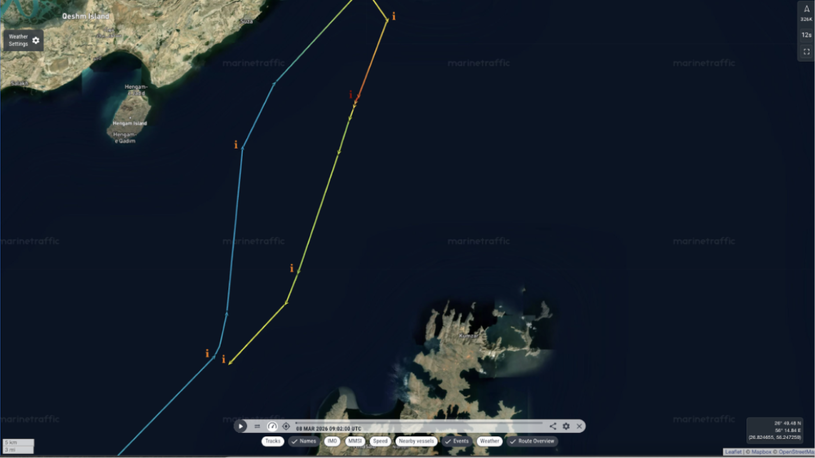
Windward’s explainer noted the Strait remained active, but no longer under open, unrestricted passage, with vessels travelling “increasingly through routes that run along Iranian territorial waters rather than standard international navigation lanes.”
Windward said this reflected “a selective transit model in which access appears contingent on cargo type, destination, and alignment with Iranian interests.”
The briefing also linked this shift to the way vessels are using AIS - 36 vessels were identified broadcasting nationality signals through AIS destination fields, including 23 Chinese-linked ships using messages such as “CHINESE CREW OWNER” and “CHINA OWNER & CREW.”
These broadcasts appeared intended to signal alignment or neutrality, and that access through Hormuz was “increasingly conditional.”
Dark activity across the Gulf reached 427 events on 20 March, and more than 1,100 vessels were affected by GPS and AIS interference within 24 hours of Operation Epic Fury, with more than 30 jamming clusters identified across the region during the second week of the conflict.
That made conventional vessel tracking less reliable as a guide to actual trade flows, and maritime awareness in and around Hormuz could no longer be inferred from AIS alone.
In the Windward webinar briefing, Standard Chartered Bank executive director, high-risk client monitoring, group financial crime compliance, Michael Stock, said any arrangement under which tolls were paid to Iran for safe passage would be unacceptable for a major international bank with a large US presence.
Mr Stock added that Iran’s existing financial architecture and trading mechanisms outside Western sanctions had long been in place, but he added that the 30-day waiver on Russian oil on the water discussed by President Trump was difficult for a large financial institution to use because the sanctions architecture built over years could not be quickly reversed without imposing substantial operational and compliance risk.
That same argument applies to any Trump agreement on the sale of Iranian crude oil, and the ability of a company operating in or adjacent to administrations which had sanctions in place would be restricted to the extent that the cost of compliance could outweigh the gains from the cargo.
RUSI director, Centre for Finance & Security, Tom Keatinge, took a similar line on Iran’s ability to operate outside the Western financial system.
“Iran has a playbook,” he said, arguing that the country had experience in maintaining trade and revenue through established channels.
He said opportunistic buyers would continue to emerge if discounted cargoes remained available, but “they will not be using the Western financial system.”
Mr Keatinge said the shadow fleet is, in effect, one of the clearest beneficiaries of the present conditions. “If you’re running a shadow fleet, then, unfortunately, this is your moment,” he said, adding that those vessels appeared more likely to pass through the Strait untroubled while others remained blocked.
Windward’s update explained this in greater detail, noting examples of vessels actively exploiting the conflict environment through AIS suppression, false flagging, ship-to-ship transfers and what it called zombie vessels.
One case cited involved a 26-year-old LNG carrier whose IMO number corresponded to a vessel listed as broken up in the Equasis database.
Another involved the sanctioned Russian tanker Trust, which Windward said conducted a high-probability semi-dark transfer in Omani waters involving about 325,000 barrels of crude.
The briefing also looked at how supply was being rerouted, noting that Saudi Arabia’s East-West pipeline had become more important by allowing crude to reach Yanbu without transiting Hormuz.
By 22 March, more than 30 tankers were present at Yanbu, while 64 crude tankers were signalling the port as their destination.
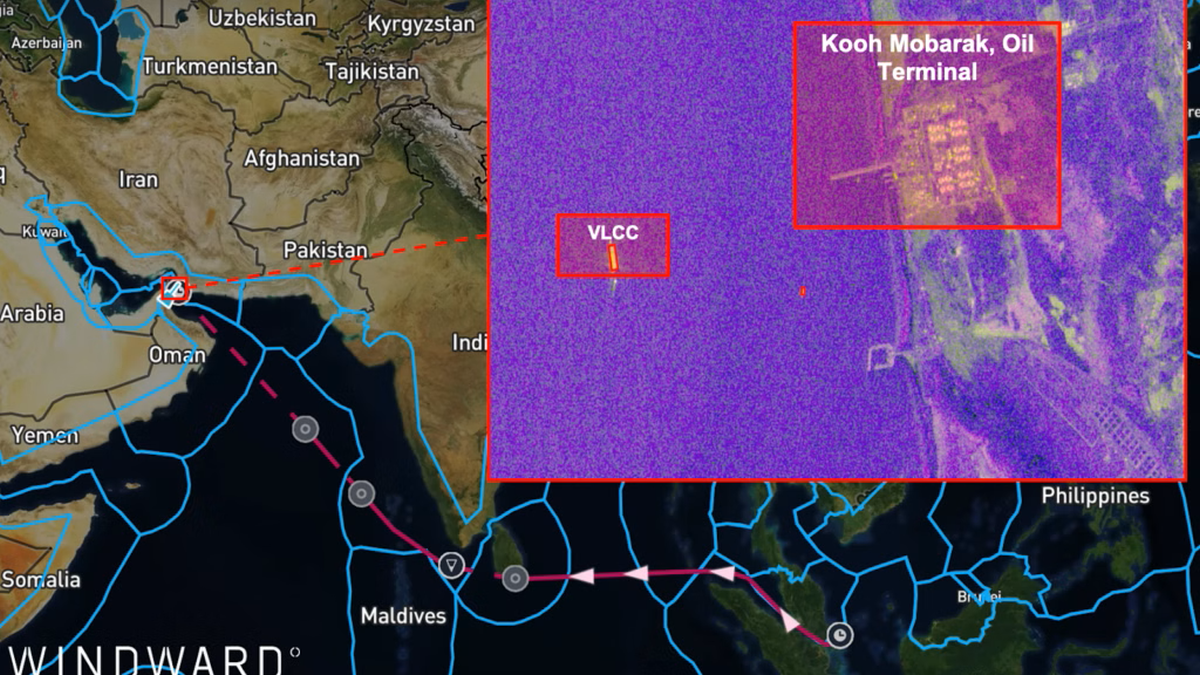
Iran is pursuing its own bypass route through the Kooh Mobarak terminal east of the Strait, supported by the Goreh-Jask pipeline.
Neither Mr Stock nor Mr Keatinge suggested that a simple return to earlier operating conditions should be expected.
Mr Stock said, “Going back to what it was seems unlikely,” because the conflict has injected uncertainty and exposed how much leverage Iran could exert over maritime access.
He said it would take something dramatic to re-establish enough trust for commercial actors to restore anything close to former transit conditions.
Mr Keatinge was less convinced that policymakers would draw lasting lessons from the crisis, warning that states have also been slow to adjust after earlier energy dependence shocks, of which there have been many clear examples in the region.
Taken together, the Windward briefing and explainer presented Hormuz not as a closed waterway in a simple sense, but as a maritime corridor still functioning under a different set of rules – one in which traffic continues, but under selective passage, degraded visibility, tighter insurance conditions and an operating model that gives greater room to sanctions-era networks than to conventional commercial shipping.
Sign up for Riviera’s April 2026 International Chemical and Product Tanker Conference:
- Register to attend here: The International Chemical and Product Tanker Conference 2026, London.
- View the latest issue of Tanker Shipping & Trade here: Tanker Shipping & Trade.

Related to this Story

Events

Maritime Regulations Webinar Week
 16 Dec 2025
 GMT - ONLINE
Floating energy: successfully unlocking stranded gas using FLNGs and FSRUs
24 Feb 2026GMT - ONLINE
© 2026 Riviera Maritime Media Ltd.


