


Business Sectors
Business Sectors
Events
Contents
Register to read more articles.
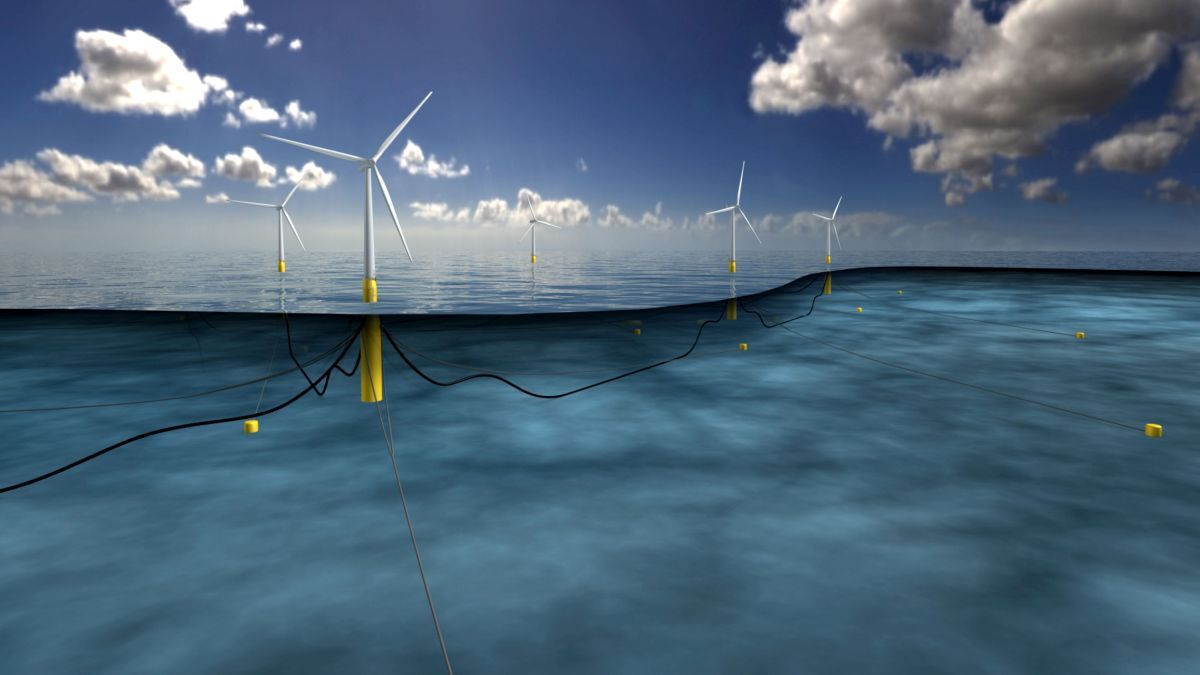
Substation on the seabed could reduce floating wind costs
If further developed, technology pioneered in subsea projects in the offshore oil and gas sector could facilitate the adoption of ‘float out and sink’ subsea substations for offshore wind


A number of solutions for offshore substations have been proposed for the floating wind market, but one that is gaining traction is the use of subsea technology. Installing a substation on the seabed, it is argued – rather than on a floating platform exposed to extreme weather conditions where it would need regular maintenance – could result in significant cost savings.
In recent years, more and more infrastructure in the offshore oil and gas market has been installed on the seabed. Technology used on projects such as the Åsgard field in Norway has proved that power and control systems such as transformers, power cables, terminations and high voltage wet-mate connectors – all of which are essential for offshore wind – can be installed on the seabed and operate reliably in the long-term.
Following a similar approach in the offshore wind industry could have many benefits, SINTEF research scientist Eirill Bachmann Mehammer told a EERA JP Wind seminar in April 2021, and could lead to significant cost reduction.
Ms Mehammer told the seminar that for a far-from-shore floating windfarm, transmission costs could account for half the total cost of a project. That being the case, she said, enhanced components would be needed if the levelised cost of energy (LCOE) from floating wind is to be economically viable.
“Installing elements of the grid connection system on the seabed, applying technology that is already proven in the offshore oil and gas industry, will enable cost-effective and reliable large-scale floating windfarms,” she told the seminar. “In deep water, a conventional substation on a bottom-fixed structure is impractical. The alternative is to have a floating substation, or to utilise subsea technology. By locating the substation on the seabed, costs are reduced and robustness increased compared to floating substations.”
Compared to a floating substation, she explained, a subsea substation would not experience movement due to environmental forces and would operate in close to constant environmental conditions. Moreover, with a subsea substation, there would be no need for a dynamic high-voltage export cable and a static export cable could be used instead.
“Existing subsea technology from the offshore oil and gas sector can be adapted to fit the needs of the floating wind sector, but costs need to be reduced and capability extended,” Ms Mehammer told the seminar.
In her presentation to the seminar, Ms Mehammer looked at the various types of technology that would be required for a subsea substation. These include subsea transformers optimised for deepwater floating wind with the high power rating that would be needed, along with efficient cooling solutions, environmentally friendly insulating fluids, reliable condition-monitoring systems and reliable and environmentally friendly subsea switchgear. Equipment would also need to be developed that could work at higher voltage levels. Packaged together in a subsea substation, they could facilitate the use of a ‘float-out and sink’ platform that would be less expensive to transport and install.
New types of subsea cable systems would also need to be developed, Ms Mehammer told delegates. These include inter-array cables with increased ‘ampacity’ – that is, cables able to transmit a greater maximum current continuously without exceeding temperature ratings – and with greater reliability.
Lead-free design would also make cables more environmentally friendly and significantly lighter, but work would need to be done to reduce the cost of producing, transporting and installing new-generation cables.
“Static high-voltage alternating current export cables that are lead-free would be less expensive to produce, transport and install, but would also need to have higher voltage ratings,” Ms Mehammer said. Compared to a conventional 66-kV transmission system, they would need to operate at 220 kV. This compares to the current standard voltage level for most offshore windfarm inter-array grids of 33 kV.
New types of subsea connectors and penetrators would also be required, Ms Mehammer explained, including wet-mate connectors cable of operating at higher voltage ratings. The cost of these would also need to be reduced. Dry-mate connectors capable of operating at higher voltage ratings would be required: potential avenues for achieving cost reduction in this kind of component include smart material selection, reduced qualification and test regimes compared to oil and gas installations, and interface component design collaboration.
New, more advanced subsea junction boxes would also need to be developed, and costs reduced. This could be facilitated in part by reducing the length of dynamic cables that would be required. If more advanced junction boxes could be developed, this would increase system flexibility and reliability by removing the need for offshore wind turbines to be connected in series.
Looking at the main challenges for subsea substations and associated equipment, Ms Mehammer highlighted harsh ambient conditions in far-from-shore floating windfarms, and that as turbines get larger, equipment capable of operating at higher voltages would be required. Large load variations would place stresses on components; standardisation would be required; and there would be a push towards using more environmentally friendly materials.
If these challenges can be addressed, she suggested, subsea collection systems will be a key part of future hybrid high-voltage DC/HVAC offshore grids.
“More research and innovation is required to bring forward and demonstrate innovative power-upscaling and cost-reducing subsea technology solutions that can connect floating windfarms to the grid,” she concluded, “but environmental benefits would accrue from a reduction in the scale of gas-insulated switchgear and lead-free cables, minimising the environmental footprint of offshore assets.”
Innovation in these areas would also significantly reduce the LCOE of floating wind and provide European manufacturers and developers with new, ‘future-proof’ technological solutions, significantly strengthening their competitive position in the global offshore wind market.
Riviera Maritime Media’s Offshore Energy Webinar Week is being held 14 June 2021 – use this link for more details and to register

Related to this Story

Events

Maritime Regulations Webinar Week
 16 Dec 2025
 GMT - ONLINE
Floating energy: successfully unlocking stranded gas using FLNGs and FSRUs
24 Feb 2026GMT - ONLINE
© 2026 Riviera Maritime Media Ltd.


