


Business Sectors
Business Sectors
Events
Contents
Register to read more articles.
Sustained Iranian oil flows amid Hormuz disruption reflect prepositioned supply since late 2025
Updated data on crude oil reveals that Iranian exports continue to flow globally despite disruptions in the Strait of Hormuz, with Tehran having prepositioned its supply since late 2025


Meanwhile, analysts warn of potential oil supply constraints if tensions persist, as producers may prioritise domestic needs. In such a scenario, availability would be dictated not by price or logistics but by access and policy decisions.
AXSMarine shipping analyst Nikolas Zannikos told Riviera that Iranian crude exports have not collapsed despite disruptions in and around the Strait. “Instead, flows continue through rerouteing and operational adjustments, with increased volatility rather than outright interruption,” he explained.
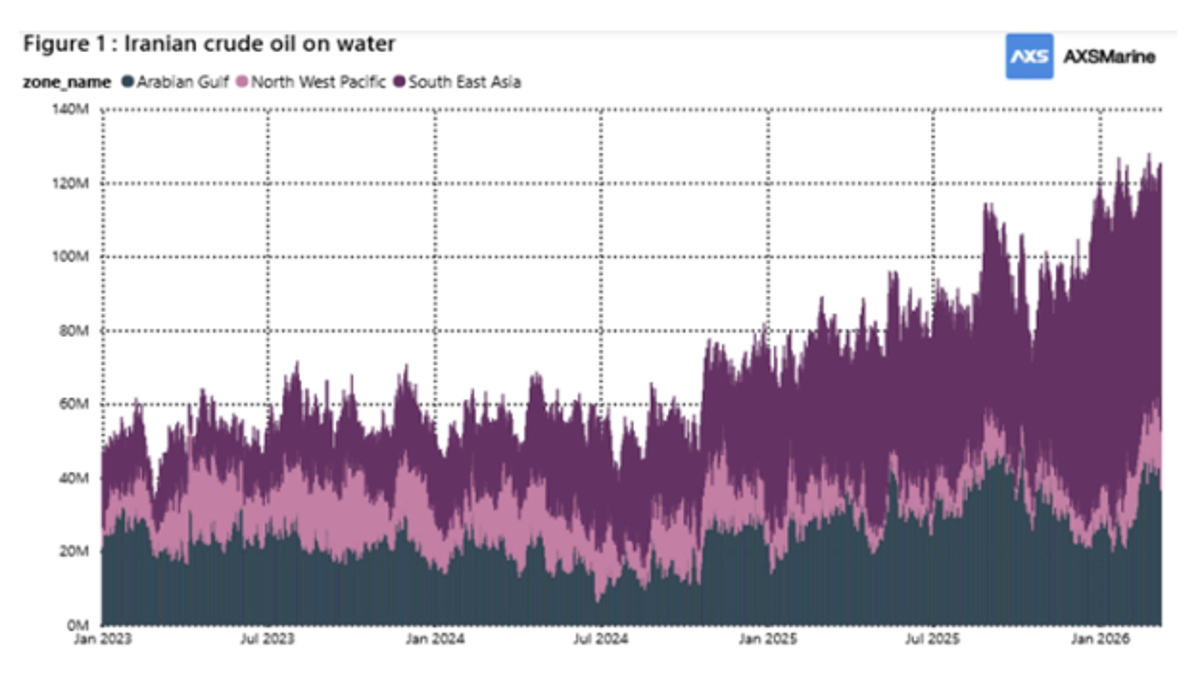
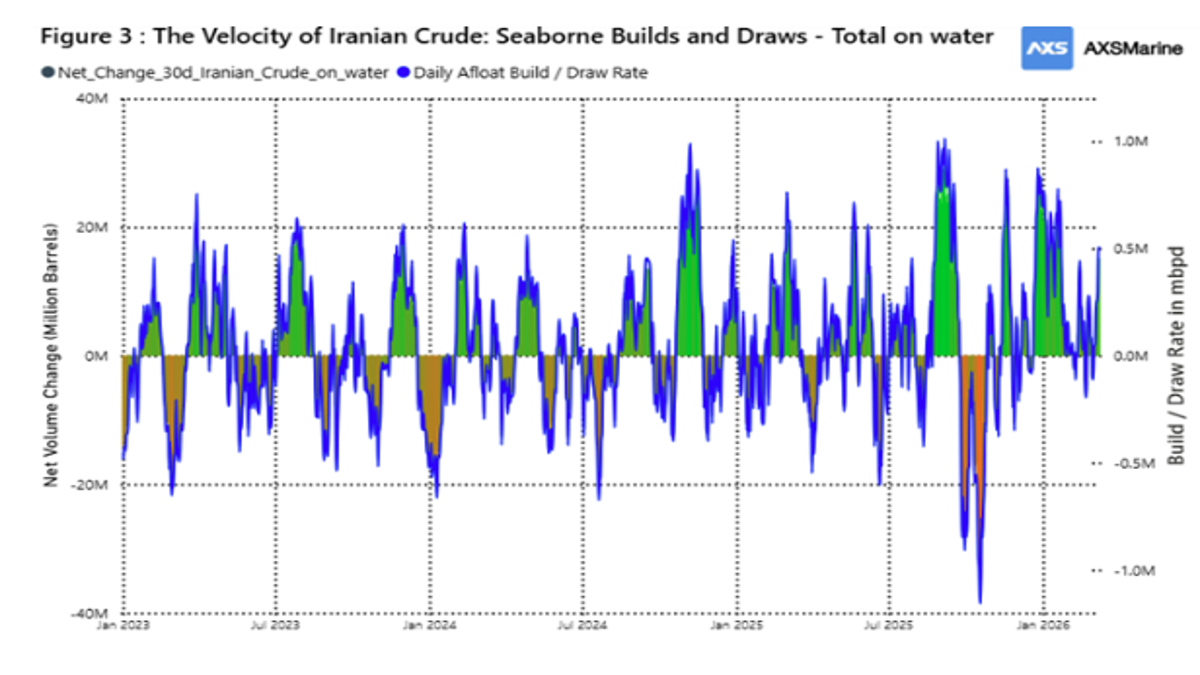
AXSMarine data show that Iranian crude “on water” built significantly through late 2025, particularly across Asian regions. A growing share of Iranian crude was positioned in southeast Asia and the Far East ahead of the drawdown phase, indicating that barrels were already staged close to key demand centres.
“This build-up phase was followed by a sharp drawdown, where the system experienced an extreme negative swing of roughly 30-40M barrels over a short period,” Mr Zannikos said.
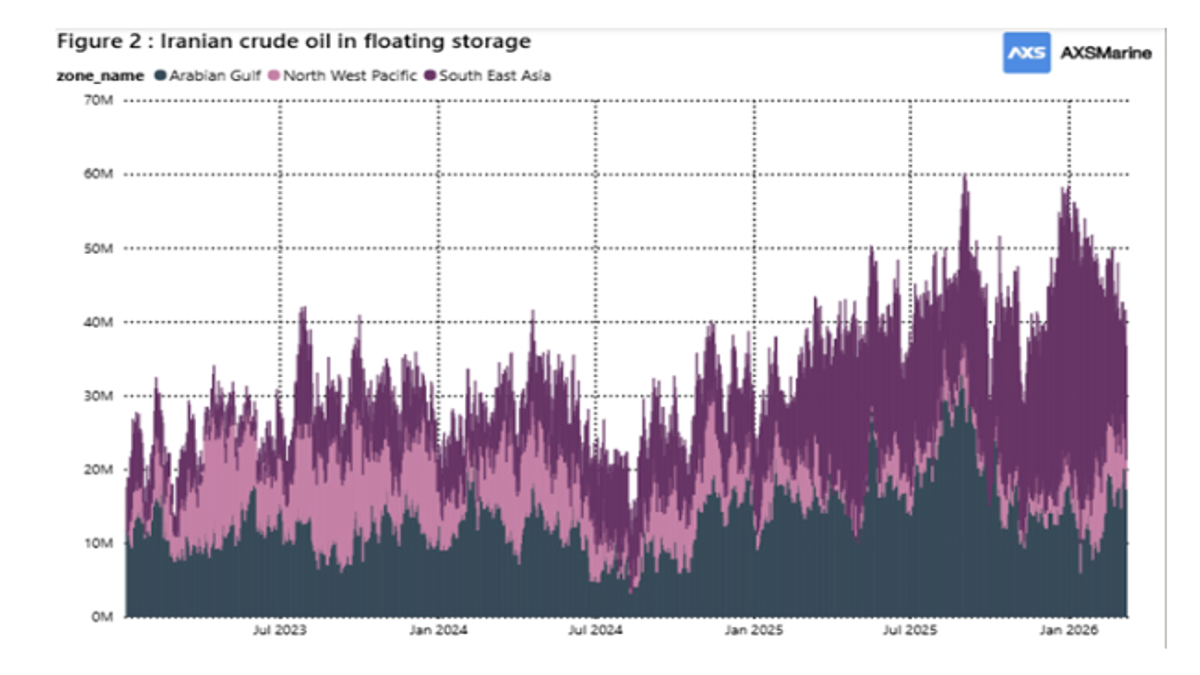
At the same time, floating storage declined sharply, but total crude on water did not drop proportionally. “This divergence indicates that barrels were not removed from the system but converted from idle storage into active transit and discharge,” he added.
“The late-2025 movement is best understood as a conversion of floating storage into active flow,” Mr Zannikos noted. Floating volumes fell sharply while transit volumes rose, suggesting that previously idle barrels were absorbed into the system through discharge and movement toward end markets. This reflects sustained absorption capacity rather than actual supply destruction.
“This is why the Iran story is better described as prepositioned supply than as resilience by accident. The stock build in the earlier phase provided a buffer, while the subsequent velocity-driven drawdown demonstrates how quickly that buffer could be mobilised when demand conditions aligned or geopolitical turmoil increased,” he explained.
Potential supply constraints ahead
The situation has highlighted a market shift, where supply is increasingly prioritised for domestic needs. “Restrictions on refined product exports, such as those recently imposed by China, demonstrate how quickly supply can shift from global circulation to domestic retention,” Mr Zannikos said.
“Even without an outright crude supply loss, such measures tighten global availability by preventing barrels from circulating internationally,” he added.
Under sustained stress, similar behaviour could emerge in crude markets, with producers prioritising domestic needs or restricting exports, effectively reducing the supply available to the global system without any physical loss of production, Mr Zannikos highlighted.
If disruption persists, the next phase may not be further rerouteing, but potential supply destruction or administrative restriction of flows – particularly in systems without buffering capacity or alternative routeing flexibility. “Availability would no longer be determined purely by price or logistics, but by access and policy decisions,” he said.
“Today’s disruption is not just testing whether oil can move, but whether the system that prices, insures, finances, and routes it remains a market at all, or becomes a series of managed corridors shaped by governments rather than traders,” Mr Zannikos added.
For the shipping industry, the current phase has increased tonne-miles as flows are rerouted and inefficiencies build. However, a more constrained scenario could have negative implications. “Where supply is actively withheld or physically disrupted, total volumes may decline even as routeing remains fragmented,” Mr Zannikos said.
“This creates a market where miles remain elevated, but tonnes become uncertain,” he concluded.
Riviera’s Tankers 2030 Conference will be held in Singapore, 19-20 November 2026. Use this link for more information and to register for the event.


Related to this Story

Events

Maritime Regulations Webinar Week
 16 Dec 2025
 GMT - ONLINE
Floating energy: successfully unlocking stranded gas using FLNGs and FSRUs
24 Feb 2026GMT - ONLINE
© 2026 Riviera Maritime Media Ltd.


