


Business Sectors
Business Sectors
Events
Contents

Register to read more articles.
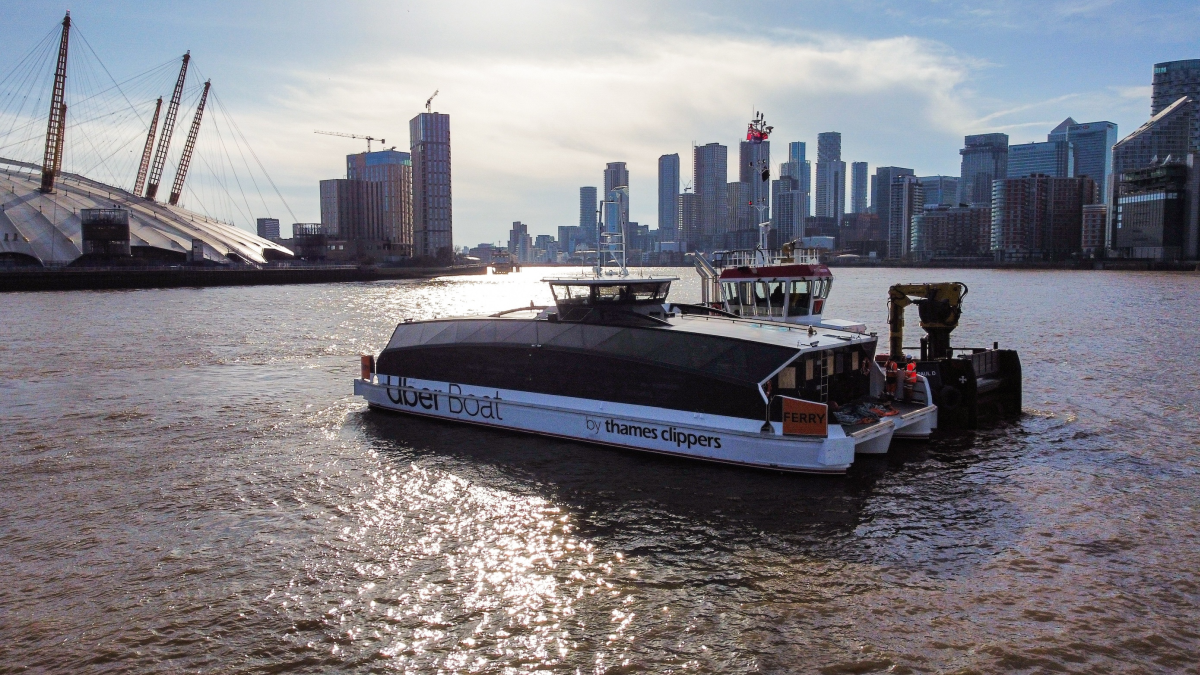
Uber Boat by Thames Clippers: blazing a trail with Orbit Clipper
CEO Sean Collins opens up on what it means to be a trailblazer with the first all-electric cross-river passenger ferry in the UK


The UK’s first fully electric cross-river passenger ferry has been delivered – and owner Uber Boat by Thames Clippers commemorated its first passenger crossing with a ceremony that included the Mayor of London, Sadiq Khan, among attendees.
“The first-time passenger journey went very well,” recalled Uber Boat by Thames Clippers chief executive Sean Collins.
Developed with part funding from the Department for Transport and Innovate UK, the ferry was built in conjunction with project partners including high-speed aluminium ship builder, Wight Shipyard Co, maritime civil engineering consultants, Beckett Rankine, and electric infrastructure specialists, Aqua superPower.
Orbit Clipper will operate between Rotherhithe on the south of the river and Canary Wharf on the northern side with zero tailpipe emissions, providing an accessible, fast and green service for thousands of Londoners and visitors a day.
While Orbit Clipper, being a pioneer in fully electric river crossings, has experienced some challenges, it has overcome them. Mr Collins explained, “There have been delays in the supply chain, so it is not fully operational yet. Because of its concept, it can’t fully function in operation until everything is in place from an infrastructure perspective.”
The main issue is that the automatic docking system has not been completed. Mr Collins said, “We challenged the capability of the docking system. We can get quite significant wave heights due to the tide and wind. The system had to be more capable of facing far greater conditions than what was originally anticipated. The design kept changing. But it is under construction and will be ready in the next three months.”
He said that despite this delay, the vessel can still operate, as the ferry operator has installed a temporary mechanism to lower and raise the boarding ramps. “Crew training was always going to be a three-month lead time to full operation anyway,” Mr Collins pointed out.
The automatic docking system is central to the ferry operation – not just to this project but potentially for other electric ferries, too. Mr Collins explains the background to the system. “A traditional ferry will run onto the quay, or it will moor, but we wanted to do away with the mooring element, and we couldn’t afford to waste battery power for it to run onto the quay. It literally had to be grabbed and locked; that is what it does automatically.”
The system works on hydraulics. “We looked at metallic docking systems, indeed, everything on the market, but we couldn’t find anything to allow the vessel to operate. It is a lot bigger than the existing vessel, but still not big and heavy enough to sit still in the conditions that would allow the majority of off-the-shelf docking systems to work. So, we have had to design something bespoke, but which can be used in similar applications elsewhere. This concept has ticked the box of Innovate UK logic.”
The idea behind the CMDC2 Innovate UK funding project was to create a demonstrator that was groundbreaking and that would deliver a concept that could be replicated and expanded upon.
The automatic docking system has the added benefit of boosting manoeuvring. “Manoeuvring is extremely important, and we had to develop the infrastructure for pilot guides and fender units. The infrastructure minimises the amount of power needed to operate the vessel, and there is less power needed to manoeuvre because of the docking system. Long term, this will reduce our overall operational costs as well,” said Mr Collins.
Important elements in the design and construction are that the ferry had to be built to the required class, but equally, it needed to be as light and efficient as possible to accommodate the battery element over a four-day operation. The hull had to be efficient, and as the ferry operates in very shallow waters at low tide, it had to have a relatively low water draft.
Orbit Clipper will be charged overnight at Canary Wharf. This will enable the ferry to work a full 16-hour day. But, as Mr Collins recalled, this wasn’t without its challenges. “On this occasion, it has been land ownership that has caused the issue [for shore power charging]. We had to go across land, and that has been quite obstructive.” Alongside this, the shore power is quite expensive, more so than fuel. But Uber Boat by Thames Clippers is getting the electricity at a cheaper rate because the ferry is being charged overnight.
The shore power connection is a plug-and-play. While it isn’t automated, because the advanced capability is not there yet, there is the option to upgrade in the future.
EST-Floattech provided the batteries for both Orbit Clipper and Uber Boat by Thames Clippers’ third electric hybrid fast ferry, Mars Clipper. The first two, Earth Clipper and Celestial Clipper, contain batteries from Spears, but that battery provider has removed itself from the market.
Speaking about the decision to choose EST-Floattech, Mr Collins said, “It is a great product, and this is the key for any business – they are good people to deal with.”
He explained that teething issues are to be expected – as first movers, there is constant evolution and “every time you take the next step, you are innovating”.
The battery for Orbit Clipper provides just under 1 MW in power and is placed centrally to satisfy weight distribution.
Mr Collins highlighted the benefits of an electric ferry. While the capex is more than a conventionally fuelled vessel, maintenance costs should be less because it doesn’t have engines, and the battery life is 7-10 years.
A major challenge is training for the new technology, but Uber Boat by Thames Clippers has moved forward with initiatives to plug the gap here.
Mr Collins expanded, “The training is very difficult – there are no courses, no skill development other than learning through manufacturers and the supply chain through commissioning.”
One advantage for the ferry operator is that the crew have been able to learn from the current electric-hybrid high-speed ferries in the fleet, Earth Clipper, Celestial Clipper, and Mars Clipper. Mr Collins continued, “The propulsion system is the same in the cross-river concept, so there is a combined skill set that we have evolved inhouse, but for me, we should be developing proper training courses that allow young people to enter the industry and fully understand the technical developments they will work with.”
Uber Boat by Thames Clippers has developed an electric training system with South East Essex College, and to this end, has given them equipment on which they can teach people. The ferry operator has already taken on four apprentices from the college.
When asked how electric and battery power will be developed in the fleet, Mr Collins said, “Our fleet will be a mixture of hybrid and battery; there is not enough infrastructure and charging capacity throughout the river for full electrification. It is going to take a while for us to get the energy power generators into the substations that feed the network. We need substations strategically located that replicate the demand.”
Mr Collins summed up, “We’ve got to be delivering from a social responsibility perspective – this ferry will last 25 years, and we have to be fit for the future. We had to build a ferry that offered a significant energy reduction to a design that can be future-proofed to be improved.”




Related to this Story


Events

Maritime Regulations Webinar Week
 16 Dec 2025
 GMT - ONLINE

Floating energy: successfully unlocking stranded gas using FLNGs and FSRUs
24 Feb 2026GMT - ONLINE
© 2026 Riviera Maritime Media Ltd.


